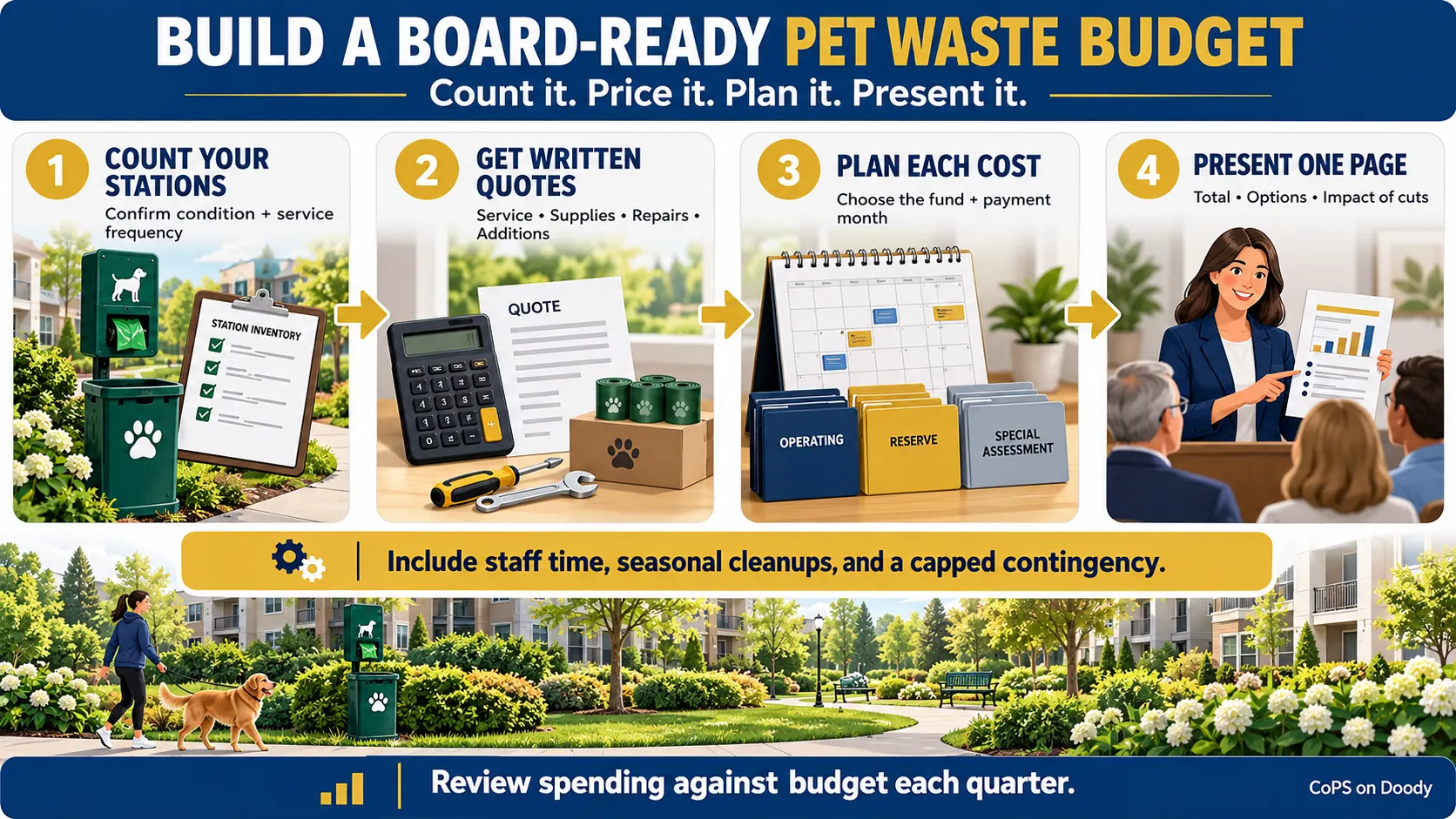
Build a board-ready pet waste budget from written quotes, with each cost assigned to the right fund and month.
June 9, 2026
If you're working out how to create an HOA budget, the pet waste line is one of the easier lines to build, because its price starts with two numbers you can count: how many stations the community has and how often they're serviced. Add bags and liners, repairs and replacements, any new stations, seasonal cleanups, staff time if your own crew does the work, and a contingency. Then put each cost in the right fund and in the month you'll actually pay it.
Let us walk you through that one line, with 2027 cost data, a worksheet you can fill in, and the budget rules that apply in the DC metro and Atlanta.
How do you create an HOA budget, and where does the pet waste line fit?
A community association has two types of budgets, as a 2019 post on CAI's Ungated blog puts it: an operating budget that runs the community through the year, and a reserve budget for future expenses. The same post describes the board's first job as gathering information: a reserve analysis, bids for contracts, projected increases in utility and service costs, and past years' budget trends. Costs the association must pay by law or contract get allocated first.
Here's one way to build any budget line, applied to pet waste.
Step
What it means for the pet waste line
Step 1: Check the rules
Your governing documents and state law set the budget calendar and owner notice. See the state table below.
Step 2: Gather last year's actual costs
Twelve months of pet waste invoices, supply orders, and repair bills, plus staff hours if your crew services stations.
Step 3: Count what you have
Station count, service frequency, and the condition of each station.
Step 4: Price next year
A written proposal or renewal price for service, plus quotes for repairs, new stations, and cleanups.
Step 5: Sort each cost by fund
Operating, reserve, or one-time. The reserve test below decides the hard cases.
Step 6: Place each cost in its month
The CAI Research Foundation's best practices report on financial operations says to assign each item to the month the expense is expected, rather than dividing the year's total by 12.
Step 7: Add a contingency
A capped amount for mid-year changes, kept apart from reserves.
Step 8: Present one page
The total, the options, and what changes if a line is cut.
Seven inputs, though not every one applies every year: station service, bags and liners, repairs and replacements, new stations, seasonal cleanups, in-house staff time, and a contingency.
Station service: count and frequency set the price
Two inputs drive the service price: how many stations you have and how often they're serviced. If two proposals cover the same stations on the same schedule and the prices still differ, ask each provider which assumption explains the gap. Our bid-leveling worksheet shows how to convert proposals to the same unit, including counting visits from the calendar (a weekly schedule is 52 visits in most years and 53 in some).
Don't build this number from how many dogs live in the community or how many homes there are. How many stations a community needs depends on how much common area it has in convenient locations, the routes residents walk, the layout, foot traffic, and how densely the homes are built. Every community is different, which is why we visit every community.
If the board is considering a frequency change, ask your provider for a written proposal showing the new rate before the budget is set, so the line carries the real number. Before adding visits to fix overflowing stations, look at what's in the cans. Residents sometimes put household trash in pet waste stations, and a newsletter reminder may solve that better than an extra visit.
Bags and liners
A managed program typically includes restocking bags and replacing the can liner on every visit. Ask whether the service price includes them or bills them by usage. If they're billed by usage, start from last year's invoices and adjust for any stations you're adding. If your own staff buy supplies, count the bags, the liners, shipping, and the time someone spends ordering and stocking them. Don't look to this line for savings: residents can only use a station when the dispenser is stocked.
Repairs and replacements
Dispensers, lids and hinges, cans, signs, and posts all take weather and daily use, and old stations eventually need replacing. A managed program typically includes inspecting each station during service and telling the community about recommended repairs. Ask your provider for those recommendations and the condition of each station; our guide to pet waste station maintenance covers what to check. Price repairs to stations you're keeping separately from replacement of old stations, and get a written quote for each replacement.
New stations and relocations
Adding a station is a one-time installation cost, and it also raises the service line from the month the station goes in. Locations are agreed upon with the community, and many boards approve a placement map before anything is installed. Put the installation in the month you expect it, and carry the higher service price from then on. When residents ask for a new station, the Community Improvement Priority Matrix helps the board decide whether it belongs in this year's budget or next year's.
Seasonal cleanups
Some common areas need attention outside the stations, such as trails and wooded edges after leaf fall, or lawns after the snow melts. Our guide to improving your program without a bigger budget explains what these cleanups fix. Price each one on its own and put it in its month. NOAA's 1991 to 2020 normals put the median last spring freeze at March 15 in Atlanta, March 24 at Reagan National, and April 15 at Dulles, which helps place a spring cleanup. In the fall, schedule around leaf collection; Montgomery County's 2026 leaf collection begins November 9. Atlanta averages 2.2 inches of snow a year, so a snowmelt cleanup is mostly a DC-metro line.
In-house staff time
If your maintenance staff service the stations, the cost is real even when it doesn't show up as its own line. It's spread across payroll: wages, paid time off, benefits, and payroll taxes. Add the time spent ordering and stocking bags, and the manager's time on complaints and supply orders. In June 2026, benefits made up 23.1% of employer costs per hour worked for private-industry service occupations and 31.4% for installation, maintenance, and repair occupations, according to the Bureau of Labor Statistics. To make the cost visible, multiply the hours your staff spend on stations by their full hourly cost. This mostly comes up in apartment and condominium communities, and in larger associations with their own maintenance staff.
If a landscaper handles the stations inside a larger contract, ask the landscaper to state what portion of the price covers the stations, so the board can see it.
Contingency
A 2019 CAI blog post says associations should set aside contingency funds, separate from the reserve budget, for unanticipated expenses. It gives no percentage, and we found no authoritative source that does. A method works better than a number. The CAI Research Foundation's financial operations report describes a community that caps its contingency line at a limit the board approves, has the board ratify each use, and then moves the cost to the line it belongs on. Virginia's Common Interest Community Board also suggests associations consider an operating reserve for budget overages. For pet waste, the likely uses are a station damaged mid-year, a station residents ask for after the budget is adopted, or a frequency change.
What will costs look like in 2027?
For the service line, don't apply an index. Ask your provider for next year's price in writing. For in-house staff time and supplies you buy yourself, these are the latest public figures.
Input
Latest figure
Use it for
Employment Cost Index, private industry, 12 months to June 2026
Total compensation up 3.3%; wages up 3.1%
In-house staff time
Employment Cost Index, by occupation
Service occupations up 3.4%; installation, maintenance, and repair up 3.6%
In-house staff time
Employment Cost Index, by metro area
Washington-Baltimore up 3.6%; Atlanta up 2.7%
In-house staff time
Consumer Price Index, all items
Up 3.4% nationally and 2.9% in the Atlanta area (12 months to August 2026); up 4.0% in the Washington area (12 months to July 2026)
Supplies you buy yourself
Minimum wage
Virginia $13.75 from January 1, 2027; Maryland $15.00; Montgomery County $18.00 for employers with 51 or more employees and DC $18.40, both since July 1, 2026; Georgia employers covered by federal law pay at least $7.25
Entry-level in-house staff
The pet waste budget worksheet
Fill in one row per input, and leave a row blank if it doesn't apply this year.
Line item
How to calculate it
Your figure
Fund
Month(s)
Station service
(Months at the current price × current monthly price) + (months at the new price × new monthly price from the written proposal), or price per visit × visits per year
Operating
Every month
Bags and liners, if billed separately
Last year's usage × current unit price, adjusted for station changes
Operating
As billed
Repairs
Each recommended repair × its quoted price
Operating
When scheduled
Replacement of old stations
Number of old stations × installed price per station
Operating, or reserve if listed in the reserve study
When scheduled
New stations or relocations
Number of stations × installed price per station
One-time, not from the reserve fund
Installation month
Seasonal cleanups
Number of cleanups × quoted price
Operating
Each cleanup month
In-house staff time
Hours per month × full hourly cost × 12
Operating (payroll)
Every month
Contingency
Capped at the limit the board approves
Operating, kept apart from reserves
Not assigned to a month
Total
Sum of the rows above
Worked example: one community, month by month
Here's the worksheet for a hypothetical community with 12 stations on weekly service and a calendar fiscal year. Two old stations are due for replacement in April, and the board has approved a placement map that adds one station at a trail entrance in late April. The service price includes bags and liners. The letters stand in for your own quotes; they're placeholders, not prices.
Month
What's paid
Line item
January to March
3 × [S12], the monthly price for 12 stations
Station service
March
[C], spring common-area cleanup
Seasonal cleanups
April
[S12], plus 2 × [R] to replace two old stations, plus [N] to install the new station
Service, replacements, new stations
May to December
8 × [S13], the monthly price for 13 stations from the written proposal
The monthly view shows two things a single annual total would hide: April is a heavy month, and the service line steps up once the new station goes in. If your fiscal year starts in another month, shift the rows to match.
Operating or reserve: where does each cost go?
Recurring service, bags and liners, routine repairs, and cleanups belong in the operating budget. Stations go into reserves only if your reserve study lists them as a component.
CAI's current Reserve Study Standards (2023) use a three-part test. The association is obligated to maintain the component, its need and schedule can be reasonably anticipated, and its total cost is material to the association. Stations may meet the first two parts. Materiality depends on the community. Virginia's Common Interest Community Board suggests a threshold such as 1% or more of the total budget, or $500 to $1,000, with related items grouped, and its list of typical components doesn't include stations. Maryland's reserve study statutes exclude "a minor expense that is otherwise addressed by the budget." Replacing one station is usually an operating cost. Replacing many stations on a schedule may be material enough for reserves. That's a call for your reserve specialist.
Two more points from CAI. The CAI Foundation's 2014 reserve study best practices report says an item covered under a maintenance contract isn't a reserve item, so repairs included in a service contract stay in operating. And the 2023 standards say the cost of constructing or installing a new item can't be taken from the reserve fund. Adding stations is a one-time decision the board funds another way, though new stations can then be added to the reserve study for future replacement.
Cost
Where it usually goes
When it might go elsewhere
Service visits, bags and liners, repairs
Operating
Not reserves
Replacing one or two old stations
Operating
Reserve, if your reserve study lists stations as a component
Replacing many stations on a schedule
Reserve, if your reserve study lists them
Operating, if the cost falls below your reserve threshold
Adding stations
One-time, not from the reserve fund
Operating, if your board treats small purchases that way
Contingency
Operating, separate from reserves
Not reserves
Budget rules in the DC metro and Atlanta
State law sets some of the calendar and some of the contents. Confirm the details with your governing documents and association counsel.
Jurisdiction
Budget calendar and contents
Reserve rule
What it means for the pet waste line
Virginia
The budget, or a summary, must be available to owners before the fiscal year begins (Va. Code § 55.1-1826(A) for homeowners associations; § 55.1-1965(A) for condominiums, unless the condominium instruments provide otherwise). Board packet materials, outside executive session, are available to owners when the board receives them (§§ 55.1-1816(B), 55.1-1949(B)(3)).
A reserve study at least every five years, reviewed annually. If reserves are needed, the budget must show replacement costs, remaining lives, current reserves, and recommended and current reserve amounts (§ 55.1-1826(B) and (C)).
If stations are in your reserve study, the budget shows them there. Owners may see the draft, so label the line clearly.
Maryland
The proposed budget goes to owners at least 30 days before adoption, it's adopted at an open meeting, and the adopted budget goes to owners within 30 days. It must cover income, administration, maintenance, utilities, general expenses, reserves, and capital expenses or items (Md. Real Prop. § 11B-112.2 for homeowners associations responsible for common areas; § 11-109.2 for condominiums).
Reserves are funded to the reserve study's recommendation, with a phase-in and a hardship exception, and a reserve study summary goes with the proposed budget (§§ 11B-112.3, 11-109.4).
Finish the line before the 30-day clock starts. In homeowners associations and condominiums alike, any expenditure that would raise current-year assessments more than 15% above the adopted budget needs a budget amendment at a special meeting with at least 10 days' written notice, except for conditions that threaten health, safety, or significant damage.
District of Columbia
A condominium association may adopt and amend budgets for revenues, expenditures, and reserves, except where the condominium instruments expressly prohibit it (D.C. Code § 42-1903.08(a)(2)). Assessments are made annually, or more often if the instruments provide, and resale certificates attach the current operating budget.
No statutory requirement to conduct a reserve study or fund reserves (CAI, June 2025).
Your governing documents set the procedure. Buyers see the operating budget, so keep the line readable.
Georgia
No statutory adoption procedure, but the annual meeting must include reports on the association's affairs, finances, and budget projections (O.C.G.A. §§ 44-3-102, 44-3-230). From January 1, 2027, SB 406 lets owners in registered associations obtain the finalized budgets for the past three years, subject to state law and the governing documents.
No statutory requirement to conduct a reserve study or fund reserves (CAI, June 2025).
Expect owners to read past budgets. Label the line so someone outside the board can follow it.
WHAT'S IN IT Station service: [count] stations, [frequency]: $[ ] Bags and liners: [included in service / $ ] Repairs and replacements: [what and how many]: $[ ] New stations: [count and locations, per approved placement map]: $[ ] Seasonal cleanups: [months]: $[ ] Staff time, if applicable: [hours × full hourly cost]: $[ ] Contingency, capped at: $[ ]
OPTIONS A. Same program as this year: $[ ] B. Recommended: $[ ] ([what changes and why]) C. Recommended, with [item] deferred to next year: $[ ] ([what deferring it means])
WHAT WE'LL TRACK Complaints by location, station condition, and spending against budget each quarter.
Directors will want to know what happens if they trim the line, so have the answers ready.
Line
If it's cut or deferred
What to tell the board
Service frequency
Your provider sends a proposal with the new rate, and stations hold more waste between visits
Complaints may rise near the busiest stations. Recheck at the quarterly review.
Bags and liners
Not a line to cut
Residents can only use a station if the bags are there.
Replacing old stations
The old stations stay in service another year
Repair costs may rise. Schedule the replacement instead of dropping it.
New stations
The area residents asked about stays without a station
The request may come back next year.
Seasonal cleanups
Waste outside the stations waits for the next cleanup
Complaints may rise in spring in areas routine service doesn't reach.
Contingency
Any mid-year change needs a separate approval
Changes take longer to approve once the year is underway.
If a director asks whether the community needs the line at all, keep the answer short and factual. The CDC says dog poop can carry germs that make people and animals sick, and its list of diseases that can spread from dogs to people includes Campylobacter and Salmonella infections, hookworm, and roundworm. Roundworm eggs can reach people through contaminated dirt or unwashed hands, and the CDC says severe cases are more likely in young children who have been playing in or eating contaminated dirt. Separately, the EPA's 2023 pet waste fact sheet calls pet waste a leading source of nutrient and bacteria pollution in urban streams, because stormwater carries waste left on the ground into storm drains and nearby waterways. For the value side of the conversation, see the returns residents feel every day.
Once the board approves the line, turn it into owners and dates with the Annual Community Pet Waste Action Plan. Compare spending with the budget at least quarterly, as the CAI Research Foundation's financial operations report recommends, and explain any gap in a short variance note, as a 2024 CAI Ungated post advises. At year-end, our guide to showing your program's value covers what to report.
Frequently Asked Questions
How much should a community association budget for pet waste?
It depends on your station count and service frequency, plus whatever repairs, new stations, and cleanups you plan for the year. Build the number from a written proposal and written quotes for your own stations, not from a rule of thumb or the number of dogs or homes.
What should be included in a pet waste budget line?
Station service, bags and liners if they're billed separately, repairs, replacement of old stations, any new stations, seasonal cleanups, in-house staff time if your own crew does the work, and a capped contingency.
Does pet waste service belong in the operating budget or in reserves?
Service, bags and liners, and routine repairs belong in the operating budget. Stations go into reserves only if your reserve study lists them as a component. New stations are a one-time cost that can't come from the reserve fund.
When should we start building the pet waste line?
Work back from the date your board adopts the budget. In Maryland, owners must get the proposed budget at least 30 days before adoption, so for a December 10 adoption meeting it goes out by November 10, and the pet waste line has to be in the draft before then. In Virginia, the budget or a summary must be available before the fiscal year starts. If your fiscal year follows the calendar, ask for your written proposal and repair quotes now.
What if we need to change service frequency mid-year?
Ask your provider for a written proposal showing the new rate, and bring it to the board. A capped contingency can cover a modest change without reopening the whole budget.
Bottom Line
Price the pet waste line from written quotes for your own stations, file each cost in the right fund and month, and check your state's calendar before the drafting starts. Then show the board the total, the options, and what a cut would change.
Dave Jensen is a commercial pet waste management leader with over 17 years of experience and CEO of CoPS on Doody. He built multi-million dollar sales programs, created the first CAI- and CAMICB-approved continuing education course on pet waste management, and has trained thousands of community association professionals nationwide.
Thank you! Your submission has been received!
Oops! Something went wrong while submitting the form.
Related Articles
Taking Pet Waste Off the Landscaper's Contract: The Scope Handoff