To compare contractor bids for pet waste service apples-to-apples, first record each bid exactly as it arrived, then adjust every bid so it prices one job: the stations on your map, one visit schedule, and one list of inclusions. Convert each one to an annual price and a cost per station per visit, write down every assumption as a question for that bidder, and check the add-on prices before you pick.
Estimators call this bid leveling. It's the arithmetic that happens after the bids arrive, and it turns three proposals written three different ways into one table your board can read. If you haven't sent bids out yet, start with our pet waste service specification, so every vendor prices the same scope. For the criteria to weigh beyond price, see the lowest price isn't always the lowest cost.
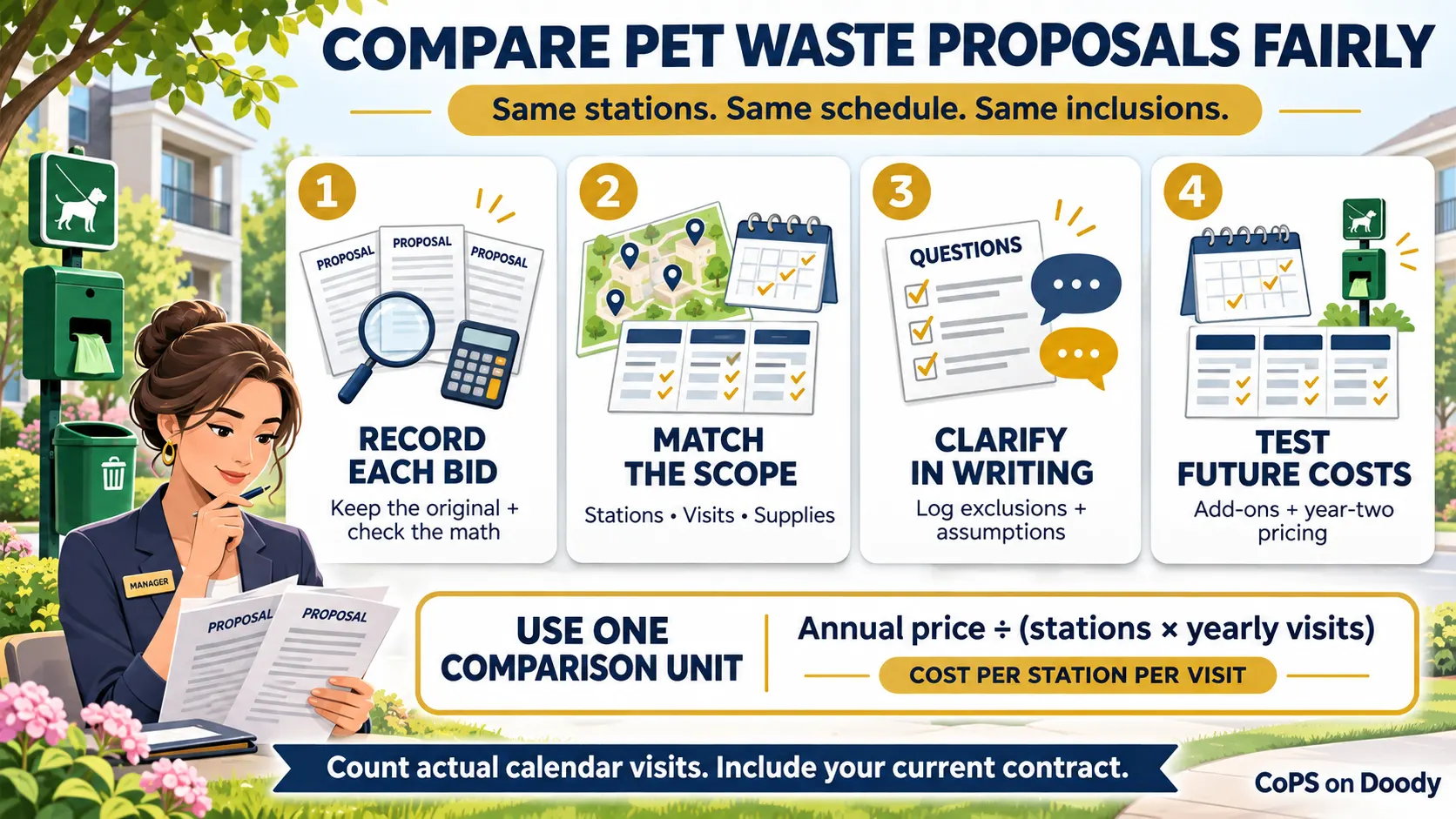
A bid tabulation records each bid exactly as it arrived. Bid leveling adjusts those bids so every price describes the same work. Keep both. The tabulation shows what each vendor offered; the leveled table shows what the board is actually choosing between.
Two questions run side by side, and they're easy to mix up. Is the bid complete, meaning it prices everything you asked for? And is the bidder qualified, with the insurance, the experience, and the references you need? Texas's transportation department makes this distinction in its local government guidance, separating a responsive bid from a responsible bidder. A complete bid from an unqualified vendor is still out. A qualified vendor with an incomplete bid gets a written question.
You also need something to compare against. Federal highway guidance calls the agency's own estimate "the contracting agency's benchmark for analyzing bids." For a community association, the best benchmark is usually the current contract, leveled the same way as the new bids.
Put each bid in a column exactly as quoted: the price, its unit, the stations it lists, and the visits it assumes. Then check the arithmetic. Multiply the unit price by the stations and the visits, and see whether you get the bid's own total. One example is a cover page that multiplies a per-visit price by four visits a month. That shortcut leaves out four or five visits a year.
If you sent everyone the same specification, most bids will line up on stations and frequency. If you didn't, this is where the differences show. A bid that lists 10 stations when the community has 12 isn't comparable until it's priced for all 12.
Convert each bid to two numbers: the annual recurring price and the cost per station per visit. Station count and visit frequency drive the work, so they're the right basis for comparison. The federal acquisition rules describe units like this as "rough yardsticks" used "to highlight significant inconsistencies that warrant additional pricing inquiry."
Per station per visit is a unit you calculate. In seven public pet waste contracts and requests for proposals we reviewed, dated 2019 to 2026, six folded station service into a larger lump sum or monthly price, and the only separate pet waste bid was priced per cleaning. So don't expect bids to arrive in this unit. Convert them.
Count the visits from the calendar, not from a rule of thumb.
Two calendar details matter. First, a 52-visit year averages 4.33 visits a month, not four, so multiplying a per-visit price by four understates a weekly program by almost 8% over the year. Second, a per-visit bill swings month to month. Weekly Friday service in 2027 has five visits in January, April, July, October, and December, so those invoices run 25% higher than a four-visit month. Budget from the annual figure, not from one month's invoice.
Holidays matter too, especially on a Monday route: six observed federal holidays fall on Mondays in 2027. Ask each bidder whether its visit count is the number of visits delivered, with holiday and weather days moved to another day, and get the answer in writing.
Keep one-time costs, such as new stations or installation, in their own row. Show them as a year-one total next to the ongoing annual price.
Anything a bid assumes, leaves out, or prices on a different basis goes in a log, with your written question and the bidder's written answer. In a 2023 article on CAI's HOAresources site, Steve Cousino, CMCA, AMS, put it plainly: "Never make assumptions about what is or is not included."
Three rules keep the log fair:
Station count and frequency should explain most of a price. If a bid moves for another reason, such as a per-home rate, a fuel surcharge, or a monthly minimum, convert it, log it, and ask what drives it.
A low base price doesn't tell you what the contract costs as the community changes. Compare the prices for adding a station, adding a visit, and replacing a station or dispenser, and any price increase stated for year two.
The federal acquisition rules warn about "unbalanced pricing," where one line item is significantly overstated or understated even though the total looks fine, and list separately priced base and option quantities among the setups where that risk is greatest. They also say "unreasonableness of price includes not only the total price of the bid, but the prices for individual line items as well," and they evaluate option years by adding them to the base. For a pet waste contract, that means two quick tests:
The CAI Foundation's 2023 best practices report on maintenance says good specifications include unit costs for unforeseen conditions. Ask for those prices up front, and they become part of the comparison instead of a surprise later.
Here's the method for a sample townhome community in Loudoun County with 12 numbered stations, asking for weekly service. The figures are placeholders for illustration only. They aren't market prices or anyone's actual quotes, and the same math works for an apartment community in Gwinnett County.
The bids as received:
The log:
The bids, leveled:
As quoted, the monthly figures ran from $400 to $1,040, more than two and a half times apart. Leveled, the three annual prices sit within $540 of each other, a spread of under 9%. All of the gap came from four things: two stations left off, a different frequency, bags billed separately, and a four-visit month.
Then run the growth test. Each bid also quoted a price to add a station:
Bid B's figure includes its bag estimate raised in proportion, marked as an estimate in the log. Bid A is the lowest price for 12 stations, and Bid C is the lowest for 14. If the board expects to add stations, that belongs in the recommendation.
If you score price the way our service specification suggests, the lowest leveled price scores 5 and the others score 5 × (lowest ÷ theirs): Bid A 5.00, Bid C 4.81, Bid B 4.60. That's one factor among several. Add the two-year total if any bid states an increase, then weigh the service factors in the table below.
Copy this into a spreadsheet, one column per bid, and add a column for your current contract. Fill in the price rows only after the stations, visits, and inclusions match.
A few of those rows rarely separate one bid from another. Liner replacement appears in six of the seven public contracts we reviewed, and the exact pickup distance around a station is a small factor, so confirm them and don't score them. The response window matters more. CoPS on Doody, for reference, commits to a three-business-hour issue response. Whatever window a bidder offers, it belongs in the written service terms, and so does how a frequency change is made: a written proposal showing the new rate.
Give the board one page: the leveled table, the log with every answer, the growth test, and your recommendation in a sentence or two. Show alternates, such as twice-weekly service, as options with their own prices, so the board decides frequency separately from the provider. If you recommend a bid that isn't the lowest leveled price, give the reason in facts, such as the growth test or the response window.
Two governance notes. First, check your governing documents and any board purchasing policy for how many bids you need and who signs. The association statutes in Virginia, Maryland, and Georgia, and DC's condominium act, don't set a bidding requirement. Florida does, for comparison: it requires competitive bids for condominium contracts above 5% of the total annual budget, including reserves, and both of its statutes say the association doesn't have to accept the lowest bid. Second, if any director has a connection to a bidder, disclose it, record it in the minutes, and have that director step out of the vote.
Not under the association statutes in Virginia, Maryland, or Georgia, or DC's condominium act. Your governing documents or a board purchasing policy may require them, so check those first.
Neither on its own. Convert both to an annual price from the calendar, then to a cost per station per visit. A per-visit price multiplied by four a month leaves out several visits a year.
Yes. Add it as another column and level it the same way. It's the benchmark the new bids are measured against, and it shows whether a new bid costs less for the same job or simply covers a smaller one.
Check what it leaves out before anything else: stations, visits, bags, and add-on prices. Then ask the bidder in writing what drives the difference. The Federal Trade Commission gives homeowners the same advice: if there's a big difference among estimates, ask for an explanation.
No. Price is one factor. Choose on the whole picture, and write down the facts behind the decision.
Comparing contractor bids apples-to-apples is arithmetic plus a few written questions. Record each bid as received, convert it to an annual price and a cost per station per visit using the real calendar, log every assumption with the bidder's answer, and test the add-ons and the second year. Then put our proposal through the same worksheet as everyone else's.
Sources, all retrieved 2026-10-05 to 2026-10-06.
Federal Acquisition Regulation 15.404-1, 14.404-2, 15.306, and 52.217-5 (FAC 2026-01), https://www.acquisition.gov/far/15.404-1
23 CFR 635.102 and 635.114, https://www.ecfr.gov/current/title-23/chapter-I/subchapter-G/part-635
Federal Highway Administration, Guidelines on Preparing Engineer's Estimate, Bid Reviews and Evaluation (Oct. 7, 2021), https://www.fhwa.dot.gov/programadmin/contracts/ta508046.cfm
Texas Department of Transportation, Local Government Projects Policy Manual, Bid Opening and Tabulation
BYU-Idaho, Construction Estimating, Bid Leveling Guide, https://books.byui.edu/construction_estimat/bid_leveling_guide
CAI Foundation, Best Practices: Community Association Maintenance (2023), https://foundation.caionline.org/wp-content/uploads/2023/06/BestPracticesCAMaintenance.final2_.pdf
Nate Falger, "Doing it right: Tips for Hiring HOA Contractors," CAI HOAresources (Feb. 8, 2023), https://hoaresources.caionline.org
Jennifer Olson, "Board Relations: Avoiding Conflicts of Interest," CAI HOAresources (Apr. 22, 2024), https://hoaresources.caionline.org
Code of Virginia Title 55.1, Chapters 18, 19, and 21, https://law.lis.virginia.gov/vacode/title55.1/
Maryland Code, Real Property Titles 11 and 11B
D.C. Code Title 42, Chapter 19, https://code.dccouncil.gov
O.C.G.A. Title 44, Chapter 3
Florida Statutes §§ 718.3026 and 720.3055 (2026), http://www.leg.state.fl.us/statutes/
Federal Trade Commission, How to Avoid a Home Improvement Scam (2022, updated 2025), https://consumer.ftc.gov/articles/how-avoid-home-improvement-scam
Public pet waste station contracts reviewed (Waters' Edge Metropolitan District, CO, 2026; City of Moorpark, CA, 2025; NC DOT, 2026; Huntley Park District, IL, 2024; City of Lubbock, TX, 2024; City of Indio, CA, 2023; Hillsmere Shores Improvement Association, MD, 2019), listed in the CoPS source ledger (rfp-scope-norms-2026-10).