Engage residents with specific pet waste actions and sustainability claims backed by evidence.
June 15, 2026
Community
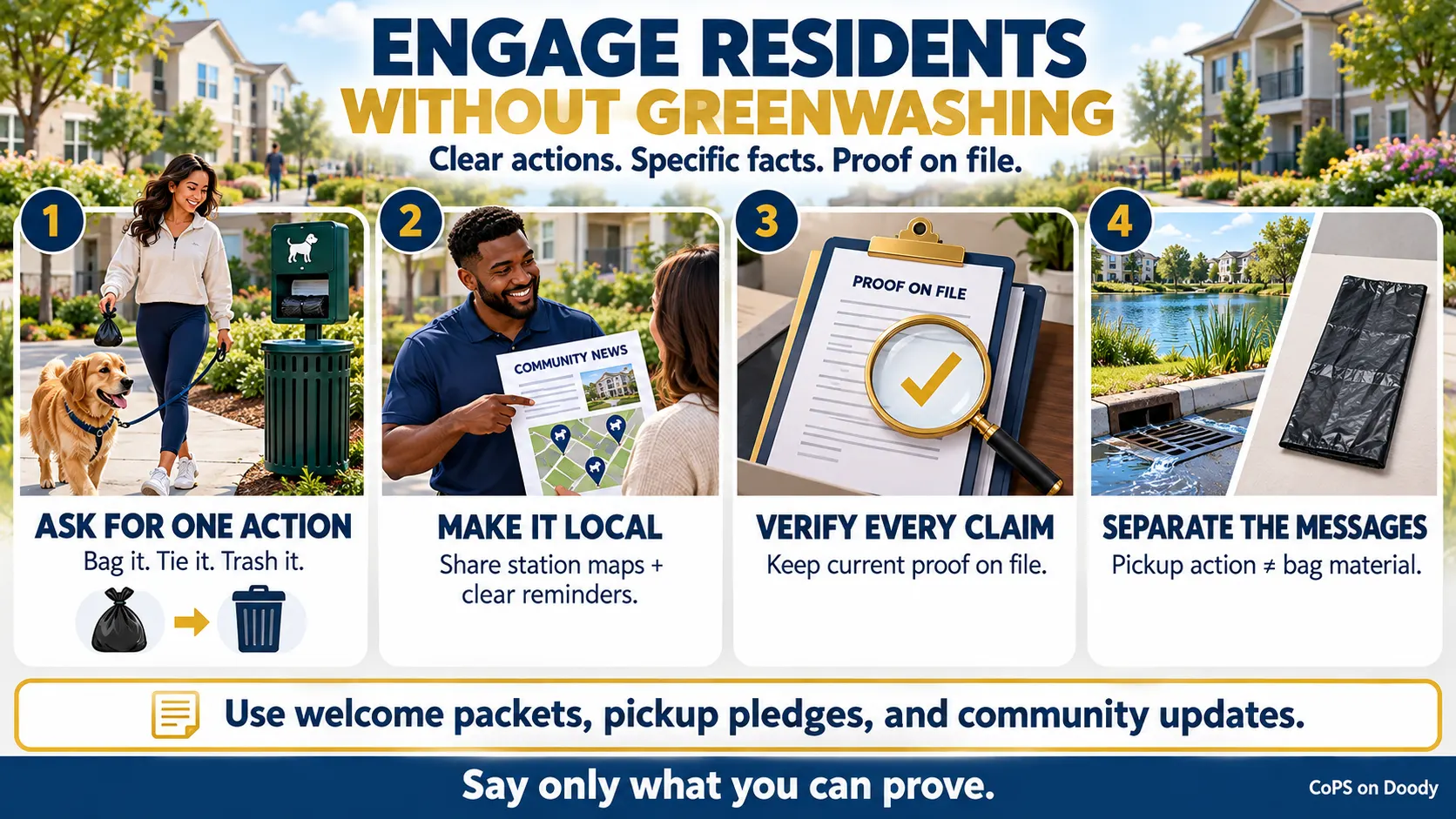
The resident engagement ideas that hold up on pet waste and the environment ask residents to do one specific thing and make only environmental statements you can prove. A newsletter item on where storm drains lead, a welcome-packet page, a pickup pledge, a county speaker, a watershed cleanup, and a board update built on your own counts all qualify, as long as the wording stays specific.
Greenwashing happens when a message implies more than the community can show. The Federal Trade Commission's Green Guides are the clearest public test, and the FTC has already applied them to dog waste bags. Let us walk you through what the FTC has said, which words carry risk, what the bag label actually means, what local agencies tell residents, and the wording we'd use for each idea.
What counts as greenwashing in a community?
In a community, greenwashing is often an accident: wording copied from a supplier's box into the newsletter, or a leasing page that calls the whole property green. Either one claims more than the community can back up.
The federal yardstick is the FTC's Guides for the Use of Environmental Marketing Claims, 16 CFR Part 260. They cover environmental claims about a product, package, or service in any marketing, whether made in words, symbols, logos, or pictures. The Guides don't bind anyone on their own, but the FTC can act under the FTC Act when a claim is inconsistent with them. The current Guides date from 2012; the FTC asked for public comment in 2022, held a workshop in 2023, and hasn't published a revision as of October 2026.
Whether the Guides reach your association depends on what you publish. They're written for marketers, so a board newsletter to its own owners may not count, while an apartment community's leasing page is much closer. Either way, they show how the FTC thinks reasonable people read a green claim, which makes them a sound standard. For your own community's obligations, ask association counsel.
What the FTC has already said about dog waste bags
In February 2015, FTC staff sent warning letters to 20 marketers of dog waste bags about their "biodegradable" and "compostable" claims. The FTC explained:
On composting, it added that "dog waste is generally not safe to compost at home, and very few facilities accept this waste. Therefore, compostable claims for these products are generally untrue."
The Green Guides themselves use a trash bag as their example. Under § 260.8, an unqualified "degradable" claim for an item that goes to a landfill is deceptive if the item doesn't completely decompose within a year, and the Guides' first example is trash bags. The FTC has enforced the rule: it brought six cases over plastic biodegradability claims in 2013, including one over shopping bags, and in 2015 it ruled that ECM BioFilms made false and unsubstantiated landfill break-down claims, a ruling a federal appeals court let stand in 2017.
Some states restrict these words on products outright. These laws apply to sellers, not boards, but a community that repeats a supplier's claim passes it on to every reader.
Selling plastic products labeled "biodegradable," "degradable," or "decomposable"; "compostable" requires a recognized standard
$500, then $1,000, then $2,000
California Public Resources Code § 42357
Selling a product labeled with those terms or implying it breaks down in a landfill; "compostable" labels need certification
$500, then $1,000, then $2,000
Washington RCW 70A.455 (since July 1, 2020)
Selling plastic products labeled with those terms
Up to $2,000, $5,000, then $10,000
Which green claims carry the most risk?
Broad words and break-down words carry the most risk. In the FTC's own 2012 research, 27% of consumers read unqualified "green" and "eco-friendly" claims as meaning a product has no negative environmental impact at all, and readers took "sustainable" to mean everything from "durable" to "long-lasting," which is why the FTC declined to define it.
Claim
What the rules say
Say this instead
"Eco-friendly," "green," "earth friendly"
§ 260.4: unqualified general environmental claims suggest far-reaching benefits, and marketers shouldn't make them
Name one fact you can prove, such as the bag certification below
"Biodegradable"
§ 260.8: deceptive for items that go to a landfill or incinerator unless they fully decompose within a year
"Please bag it and put it in the can." Make no break-down claim
"Compostable"
§ 260.7: needs proof the whole item becomes usable compost, with a qualification where facilities aren't available; the FTC says these claims are generally untrue for dog waste bags
Leave composting out; agencies in both metros say pet waste goes in the trash
"Recyclable"
§ 260.3(c) and § 260.12: the Guides call a "recyclable" claim on a trash bag deceptive, because there's no meaningful benefit
Leave it out
"Plant-based" or "made from renewable materials"
§ 260.16: readers may assume recycled, recyclable, and degradable too; name the material and qualify the amount
"41% of the organic carbon in these bags comes from renewable sources, as certified by USDA"
A seal with no explanation
§ 260.6: a seal that doesn't say what it certifies implies a general benefit; USDA limits use of its label to certificate holders and their representatives
Describe the certification in words, and use the label only in materials your supplier provides
Leaf or globe images, "Be part of sustainable living" slogans
§ 260.4: images alone can imply a general environmental benefit
Use a plain station sign with a specific request
"USDA BioPreferred bags" or "USDA-approved bags"
USDA's rules say "BioPreferred" may not describe a product, and the label may not imply USDA endorsement
"USDA Certified Biobased (41%)"
"Every bag cuts our carbon footprint"
§ 260.3(c): don't overstate or imply a negligible benefit
Leave it out unless you have a measured result
"Sustainable"
No section of its own; the FTC found too many meanings to define it
Describe the action: "Picking up keeps pet waste out of our storm drains"
What does "USDA Certified Biobased (41%)" mean?
It means testing verified that 41% of the organic carbon in the bag is new carbon from renewable sources, such as plants, rather than old carbon from petroleum. Under USDA's rules, the percentage refers to the organic carbon portion of the product, not the bag's total weight. A third-party lab measures it with the ASTM D6866 test, the percentage must appear on the label, and certification is renewed every five years; USDA's annual audits in between are desk audits that don't involve retesting.
USDA is just as clear about what the label doesn't say. Its FAQ calls the program "a single-attribute program," says participation can't be used to support a claim that a product is plant-based, and says more biobased content "does not necessarily indicate superior performance, safety, or environmental impact." USDA's 2026 brand guidelines give the approved form: "contains (x%) USDA certified biobased content."
Whoever supplies your bags, including us, ask for the certificate or the USDA BioPreferred catalog listing, check the date, and file it with your program records. If the bags change, update the wording.
Keep the water message and the bag message apart
Picking up after a dog and putting the bag in a can is what protects local water. The bag's material is a separate fact about purchasing. Keep the two in separate sentences.
The EPA's 2023 pet waste fact sheet says stormwater can carry pet waste left on the ground into nearby streams, lakes, and rivers, and it calls pet waste a leading source of nutrient and bacteria pollution in urban streams. Local facts bring it home. In Fairfax County, storm drains lead toward the Occoquan Reservoir and the Potomac River, the area's drinking water. Montgomery County reports elevated bacteria in the Rock Creek, Cabin John, and Anacostia watersheds. In Gwinnett County, storm drains are separate from the sewer system and flow directly to local waterbodies, and the National Park Service says the Chattahoochee River provides 70% of metro Atlanta's drinking water. The CDC adds that dog poop can carry germs that make people and animals sick, and that it should be picked up especially in areas where children may play.
So write them as two facts. Avoid "Our green bags protect the Potomac." Write "Picking up after your dog keeps pet waste out of the storm drains that lead to the Potomac," and, in a separate sentence, "Our station bags are USDA Certified Biobased (41%)."
What DC-metro and Atlanta agencies tell residents
Every agency we checked gives residents the same instruction, so your messages can repeat it with confidence.
Where
What the agency says
Washington, DC
DOEE: put pet waste in the trash or flush it; don't compost it; never leave bags on the ground or in a storm drain. DC's food waste drop-off program doesn't accept dog feces.
Montgomery County, MD
Bagged dog waste can go in the household trash, never in storm drains or the woods
Fairfax County and Arlington, VA
Bag it with household garbage; pet waste belongs in the trash
Metro Atlanta
The Metropolitan North Georgia Water Planning District: "Scoop the poop, bag it, tie it closed, and toss it in the trash." Gwinnett and Cobb say the same.
If your community runs a food-scrap or compost program, say plainly that pet waste and pet waste bags don't go in it.
Resident engagement ideas, with honest wording
Each idea gives residents a reason to act and one specific thing to do. Fill in the bracketed details with facts you can source.
Idea
Honest wording to use
Leave out
Newsletter: "Where does the rain take it?"
"Pet waste left on the grass washes toward our storm drains, which lead to [local stream or reservoir]. Please pick up every time."
"Our green community protects the Bay."
Newsletter: "What's in our station bags?"
The sample bag wording above, word for word
"Plant-based bags" or any break-down claim
Welcome packet page
A station map, plus: "Bag it, tie it, and put it in any station can or your household trash, never a storm drain."
Any claim that the bags break down
Pickup pledge card
Modeled on Cobb County's pledge: "I pick up after my dog and put the bag in a trash can."
A prize for the "greenest" pet owner
County speaker or quiz
Invite your county's stormwater educators; Montgomery's DEP works with associations on pet waste education, and Frederick County's staff visit communities and offer a pet waste quiz in English and Spanish
Claims the county endorses your program
Watershed cleanup day
"We're joining [event] on [date] to pick up litter along [stream]." In the DC metro, look for the Potomac River Watershed Cleanup (Alice Ferguson Foundation) or the Anacostia Earth Day cleanup; around Atlanta, Rivers Alive, Georgia's annual fall cleanup
"Our community is saving the river."
Board update
Your own counts: stations, service frequency, complaints logged each quarter, and the bag certificate on file with its date
"Our program is fully sustainable."
Before-and-after resident survey
"Two minutes: Where do our storm drains lead? Where is your nearest station?" Ask again in six months.
"Most residents pick up," before you've measured it
Audit of what's already posted
Run every sign, web page, and packet through the worksheet below
Station signs with leaf graphics or "sustainable living" slogans
Messages that work
Research on pet waste outreach is thin, so claim modestly: a 2011 systematic review found no good-quality studies of dog-fouling interventions. What exists points in a consistent direction.
Lead with neighbors. In the 2026 Northern Virginia Clean Water Partners survey of about 500 residents, 91% of dog walkers said they always or usually pick up, and their top reasons were "it's what good neighbors do" (25%) and water pollution (22%), ahead of the law (19%). In the 2015 Raleigh survey, courtesy ranked first and fines last.
Use a measured local norm, never a negative one. Messages describing what most local people do outperform purely environmental appeals (Goldstein, Cialdini, and Griskevicius, 2008), and adding approval to a norm message keeps it from backfiring (Schultz and colleagues, 2007). A Northern Virginia community can honestly say most of the region's dog walkers pick up, because it was measured. Never post that too many residents don't. At Petrified Forest National Park, a sign saying many visitors took wood was followed by more theft than a sign simply asking people not to.
Teach the storm drain fact. In the same Northern Virginia survey, 18% thought storm drains lead only to a treatment plant, and 33% said both, so "our storm drains go straight to [stream]" is news to many residents.
Put the prompt where the action happens. The EPA's social marketing guide calls bag dispensers and cans at dog areas good behavior prompts, and a 1993 office recycling study found a prompt placed right at the bin worked far better than one a few meters away. A stocked station with a short sign is the prompt.
Talk with owners where they walk. A 2022 Baltimore County pilot that used commitments, norms, prompts, and conversations across more than 12,000 households saw stream bacteria fall in three of four target areas, and talking with owners at pet-related spots worked about as well as going door to door.
A claim audit worksheet
Run every environmental line in a newsletter, sign, web page, or packet through this worksheet, then file it with the proof.
Item and location
Current wording
Rule it touches
Replacement
Proof on file
Date checked
Before anything goes out, ask five questions:
☐ Does it name one specific thing, such as a certification, a percentage, or a local fact?
☐ Can we show the proof today: a certificate, an agency web page, or our own count?
☐ Does it describe the whole item, or only part of it? (41% biobased is not "made from plants.")
☐ Could a resident read in a benefit we didn't state, such as a bag that breaks down?
☐ Are the water message and the bag message in separate sentences?
Frequently Asked Questions
What is greenwashing, with an example?
Greenwashing is a green claim that promises more than the product or program can show. The FTC's 2015 warning letters to dog waste bag marketers are a clear example: "biodegradable" and "compostable" bags that end up in landfills, where they don't break down within a year.
Can we tell residents our pet waste bags break down?
No. The Green Guides say an unqualified break-down claim is deceptive for items that go to landfills or incinerators, and used pet waste bags go in the trash. Tell residents where the bag goes instead.
Can residents compost dog waste?
Not through community or municipal compost. DC's food waste drop-off excludes dog feces, the FTC says very few facilities accept it, and agencies in both metros say to put it in the trash.
Do the FTC Green Guides apply to a community newsletter?
They may not, since they cover marketing, but they show how the FTC thinks people read green claims, so they're a sound standard. An apartment leasing page is closer to marketing. Ask association counsel about your own situation.
Do biobased bags help keep pet waste out of our streams?
No. Picking up and putting the bag in a can keeps pet waste out of storm drains. A bag's biobased content is a separate fact about what the bag is made of.
What message gets more residents to pick up?
A short, positive, specific request at a stocked station, built on what neighbors do. Residents in Northern Virginia and Raleigh ranked being a good neighbor and courtesy above fines.
Bottom Line
Ask residents to do one specific thing, give them a reason they already care about, and make only environmental statements you can prove today. Keep the water message about pickup and the bag message about material, use the trash instruction every agency gives, and audit what's already posted. If a resident asks where a claim came from, you should be able to hand over the source.
Dave Jensen is a commercial pet waste management leader with over 17 years of experience and CEO of CoPS on Doody. He built multi-million dollar sales programs, created the first CAI- and CAMICB-approved continuing education course on pet waste management, and has trained thousands of community association professionals nationwide.
Thank you! Your submission has been received!
Oops! Something went wrong while submitting the form.
Related Articles
What Actually Happens When You Switch Pet Waste Providers