

Most property managers in DC and Atlanta are not ignoring pet waste. They are actively trying to manage it. They send notices. They add fines to the community rules. They remind residents at annual meetings. They hired someone to service the stations. And yet the complaints keep arriving, the stations keep overflowing, and the problem never fully resolves. The reason is not effort. The reason is approach.
There is a specific set of mistakes that appear in almost every community property struggling with chronic pet waste complaints mistakes that are invisible when you are inside them, because they look like reasonable decisions. Assigning the work to your landscaper looks reasonable. Sending a reminder notice looks responsive. Installing stations and assuming residents will use them looks sufficient. None of these decisions are wrong in intent. All of them routinely fail in outcome.
This article names the five most common pet waste management mistakes across DC metro and Atlanta communities, explains why each one fails, and describes what replacing each mistake with the right operational decision actually looks like.
Washington DC metro and Atlanta metro are meaningfully different pet waste service markets and understanding that difference matters before naming the mistakes, because the path to each mistake looks different in each city.
In DC metro, dedicated pet waste service providers have existed long enough that most property managers know the category exists. The mistakes in DC tend to come from inertia staying with a low-performing incumbent vendor because switching feels like more work than the complaints justify, or failing to distinguish between a franchise model built for residential consumers and a commercial specialist built for managed properties.
In Atlanta, the picture is different. According to CoPS on Doody's own market observations, many Atlanta-area communities use landscaping companies or cleaning crews to handle pet waste station servicing not because they chose this deliberately, but because they did not know a dedicated commercial option existed. In Atlanta, the foundational mistake happens before the service call is ever made: the wrong category of vendor is hired for a job that requires a different kind of accountability.
This is the most common mistake and the one with the highest downstream cost. A landscaper's job is to maintain the grounds. A cleaning company's job is to clean the building. When either of these vendors is assigned to service pet waste stations as an add-on task, what the property gets is a vendor doing their primary job adequately and doing the add-on task whenever it fits the schedule, the route, and the available time.
The accountability structure is entirely different from a vendor whose primary business is commercial pet waste station service. A landscaper does not receive complaints when a station overflows. A landscaper does not credit the property when a service is missed. A landscaper does not send service completion notifications. And a landscaper does not adjust frequency when dog-walker traffic spikes in spring or summer. The work gets done eventually but not on the schedule the property actually needs, and not with the visibility that lets you verify it.
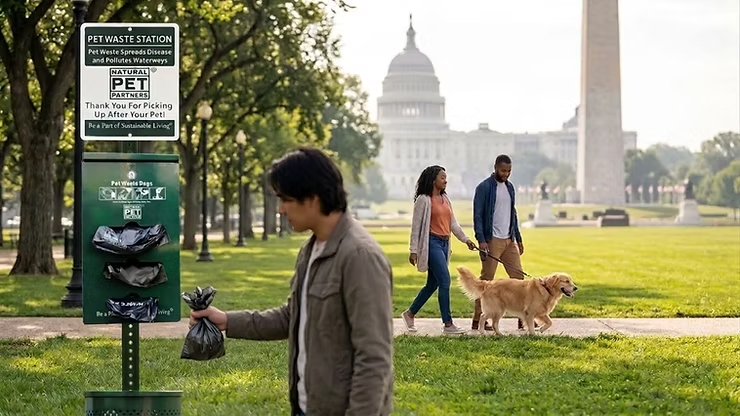
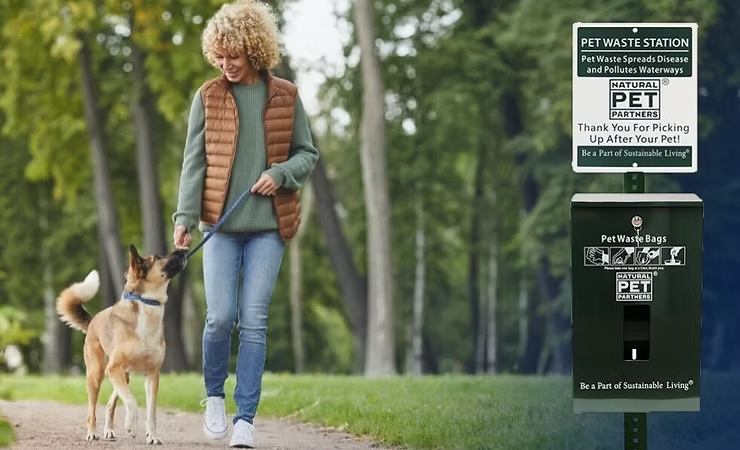
The second most common mistake is a misunderstanding of what a pet waste station actually does. A station is infrastructure. It does not manage itself. The decision to install stations and then assign their maintenance as a low-priority task for maintenance staff or landscapers is one of the most expensive half-measures a community can make, because it creates the appearance of a solution without producing the outcome.
This mistake shows up consistently in buyer language. The most frequently heard phrase from communities entering the market for dedicated service is: 'We have stations, but people aren't using them.' The unspoken follow-up is almost always the same: the stations are empty, overflowing, or both and have been for long enough that residents have stopped bothering.
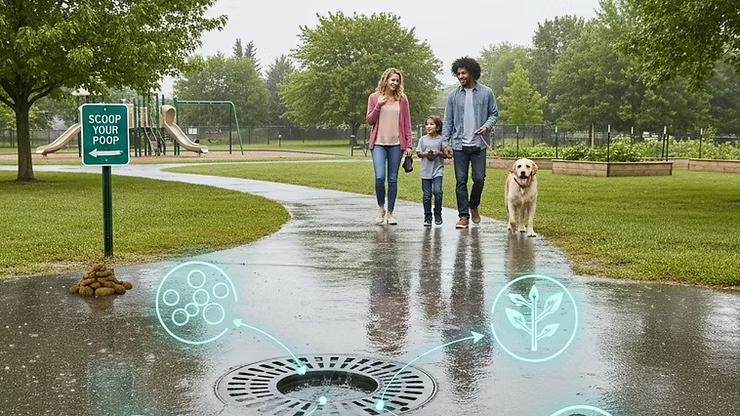
Fines, notices, pet registration programs, community rules updates, and resident education campaigns are all legitimate property management tools. None of them solve a pet waste problem that is rooted in operational failure. When stations are understocked, poorly positioned, or infrequently serviced, adding enforcement pressure does not fix the station system. It produces more resident friction.
The communities that rely most heavily on enforcement tend to be the ones with the weakest underlying service infrastructure. The connection is causal. When the system fails to make compliance easy, enforcement becomes the substitute and enforcement, in a multi-resident community without dedicated code enforcement staff, is a mechanism with extremely limited reach.
Price is a legitimate evaluation criterion. It is not the right primary criterion for a commercial pet waste service that directly affects resident satisfaction, property reputation, and lease renewal conditions. The communities that select vendors primarily on monthly rate tend to make this choice once and then spend significantly more managing the consequences of the relationship than they saved on the contract.
The hidden costs of a low-price vendor with poor service accountability include: time spent by the property manager on complaint triage that should be the vendor's responsibility; the reputational cost of consistently substandard common area conditions; and in some cases, the full switching cost of onboarding a new provider mid-season after a vendor relationship fails. When these costs are calculated honestly, the price advantage rarely survives contact with the actual service record.
The most structurally embedded mistake is the one that enables all the others: managing pet waste reactively, rather than proactively. A reactive model responds to complaints. A proactive model prevents them. In practice, almost every community that struggles chronically with pet waste complaints is operating in reactive mode and has been for long enough that reactive management feels like the normal state of the function.
A proactive model has three defining characteristics that a reactive one lacks. It uses service data completion reports, station inspection records, restocking logs to manage vendor performance before complaints arrive. It adjusts service frequency based on observed demand rather than waiting for overflow events to signal the need for change. And it connects station condition directly to resident satisfaction tracking, rather than treating them as separate management functions.
The communities across DC metro and Atlanta that have the cleanest common areas, the fewest resident pet waste complaints, and the most manageable vendor relationships share a consistent operational profile. They have a dedicated commercial pet waste service provider not a landscaper, not a maintenance team add-on, not a general cleaning company. They receive service completion notifications after every visit. They have a defined response window for issues. They pay a flat monthly rate with no surprise charges. And they are not locked into a long-term contract that prevents them from making a change if the service quality does not meet expectations.
This is not a complex model. It is a set of clearly defined expectations, matched by a vendor structure that is built to meet them. The operational shift from a reactive, misassigned-vendor model to a dedicated managed service is not a major undertaking. For most properties, the transition from first inquiry to first service can be completed in under two weeks.
The clearest diagnostic is the service record. Ask your current vendor for service completion reports for the past 90 days. If they cannot produce them, the accountability gap is structural. If the records show consistent servicing but complaints remain high, the next question is placement and frequency not resident behavior. A community where stations are reliably serviced, properly placed, and stocked at the right frequency almost always sees complaint volume drop without any change to community rules or enforcement approach.
It depends on the service level agreement you have in place. If your landscaping contract specifies service completion reporting, a defined frequency calibrated to your pet population, a missed-service credit policy, and a response window for between-visit issues then the structure can work. In practice, most landscaping contracts do not include any of these terms for the pet waste add-on, because it is not the landscaper's core service. That gap in accountability is what produces the chronic service inconsistency that drives complaints.
In the Atlanta market, the first qualification is commercial specialization. Verify that the provider's primary business is commercial property pet waste management not residential backyard cleanup, not general janitorial, and not landscaping maintenance with station servicing added. Ask for references from apartment communities or HOAs in the Atlanta metro specifically. Ask what their service completion reporting process looks like and how they handle a missed visit. These questions will quickly distinguish a commercial specialist from a generalist trying to capture a new revenue line.
Most communities see a measurable reduction in complaint frequency within the first 30 days of consistent, properly-serviced station management. The initial improvement tends to be rapid because the most common complaint triggers empty dispensers and overflowing bins are addressed immediately with the first service cycle. The second phase of improvement, which reflects a rebuilding of resident compliance habits after a period of station failure, typically stabilizes within 60 to 90 days.
Yes. A month-to-month service with flat-rate pricing is compatible with annual HOA budget planning because the monthly cost is fixed, predictable, and does not fluctuate based on usage. The board can approve the annual expense as a line item with full cost certainty. The no-contract structure benefits the HOA, not just the property manager; it provides the board with the option to make a vendor change at any point without penalties, which is exactly the kind of low-commitment, low-risk procurement posture that HOA boards with fiduciary responsibility tend to prefer.
The five mistakes covered in this article are not random. They cluster together because they all originate from the same root decision: treating pet waste management as a low-priority task that can be absorbed into an existing vendor relationship or resolved through resident communication. That decision is understandable. It is also consistently wrong.
Pet waste station management is a dedicated operational function with specific service requirements, accountability structures, and performance metrics. Properties that treat it that way have more reliable stations, fewer resident complaints, and more manageable vendor relationships. Properties that do not are still sending notices, still fielding complaints, and still wondering why nothing changes.
The path from the second group to the first is shorter than most property managers expect. A free community assessment, a 72-hour proposal, and a first service within seven days of signing. No contract required.



.png)

.png)
.png)

