

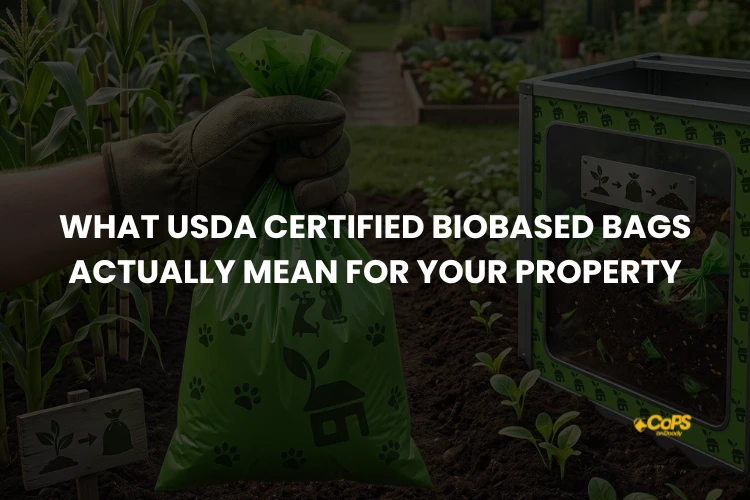
The phrase 'eco-friendly' appears on almost every bag of dog waste bags sold in the United States today. It appears on products made with petroleum plastics, on products made with plant-based resins, and on products that are a mixture of both. It is a marketing term with no regulatory definition, no independent verification requirement, and no enforceable standard. It is often used broadly in marketing and may not tell buyers exactly what has been verified.
USDA Certified Biobased is not the same thing. It is a federal government certification program run by the U.S. Department of Agriculture, administered through the BioPreferred Program, backed by third-party laboratory testing, and tied to a specific, verifiable percentage of renewable biobased content in the product. It is not a marketing claim. It is a documented material specification that can be looked up, cited, and verified by anyone who wants to check.
For property managers and HOA boards in DC metro and Atlanta, this distinction matters not because it changes how pet waste stations work, but because it changes what you can say to your residents, what you can document in your vendor RFPs, and whether your sustainability-related procurement commitments rest on a verifiable foundation or on language borrowed from a product label.
The USDA BioPreferred Program was established under the Farm Security and Rural Investment Act of 2002 and expanded by subsequent federal farm bills. Its primary purpose is to increase the purchase and use of biobased products in federal procurement and to create a voluntary certification standard that manufacturers can use to document and communicate biobased content to buyers across all markets, not only federal ones.
The program does two things. First, it designates product categories for preferred federal procurement meaning that federal agencies are required to give procurement preference to biobased products in designated categories when they are available at a reasonable price and performance. Second, it operates a voluntary product certification program that allows manufacturers to apply for and display the USDA Certified Biobased Product label on products that meet the required biobased content threshold for their category.
The certification is not self-reported. Manufacturers who apply for USDA Certified Biobased status must submit products for independent laboratory testing against ASTM International standard D6866, which measures the actual percentage of carbon in the product that derives from renewable biological sources rather than fossil fuel sources. The testing is conducted by accredited third-party laboratories. The certification must be renewed periodically, and the product's biobased content percentage is listed publicly in the USDA BioPreferred product catalog.
When a pet waste bag or liner carries the USDA Certified Biobased Product label, it means the following, specifically: a defined percentage of the product's total organic carbon content has been independently verified to derive from biological, renewable sources typically plant-based feedstocks such as corn starch, sugarcane, or similar agricultural materials rather than from petroleum-derived fossil fuel feedstocks.
The percentage matters. The USDA does not set a single minimum biobased content threshold for all products. Instead, it sets category-specific minimum thresholds based on what is technically and commercially feasible for each product type. For bags and film products in the USDA BioPreferred system, the minimum biobased content to qualify for certification is typically set at the category level, and the certified percentage appears on the product label and in the catalog entry. A bag certified at 41% biobased content has had 41% of its total organic carbon content verified as renewable. The remaining percentage may include conventional plastic components, additives, or other materials.
The most important operational point for property managers and HOA boards is this: USDA Certified Biobased is a material origin certification, not a disposal or end-of-life certification. It tells you where the product's biobased content came from. It does not tell you what happens to the product after it is used. These are separate questions with separate certification systems.
The operational relevance of USDA Certified Biobased certification for community properties falls into three distinct areas: procurement documentation, resident communication, and vendor evaluation. Each one rewards specificity in ways that vague sustainability language cannot match.
A growing number of property management companies, HOA management firms, and local government property operators in DC metro and Atlanta are operating under sustainable purchasing commitments either as internal policy or as a requirement from a parent organization, local government mandate, or management company standard. When these commitments require documentation of responsible material choices in vendor procurement, USDA Certified Biobased certification provides exactly the specificity that 'eco-friendly' packaging cannot.
A sustainable purchasing policy that specifies USDA Certified Biobased products in the pet waste station service category has a verifiable, third-party-sourced basis for that specification. The certification number, the catalog entry, the biobased content percentage, and the ASTM testing standard are all documentable in a vendor RFP or procurement record. This is not possible with products that carry only self-declared sustainability claims.
When a pet waste service vendor makes material claims about the bags they use whether biobased, compostable, biodegradable, recycled content, or any other sustainability descriptor the evaluation process is the same: ask for the certification, not the claim. The following table gives property managers and HOA boards the specific questions to ask and how to interpret the answers.
The practical applications for property managers and HOA boards in DC metro and Atlanta are straightforward. The certification framework exists, the verification path is public, and the language required to communicate it accurately to residents, boards, and procurement reviewers is available. Here is how to put it to work.
The primary environmental benefit is the substitution of petroleum-derived raw materials with renewable, plant-based alternatives in the product's manufacturing feedstock. Petroleum is a finite, fossil resource with extraction and processing impacts. Plant-based feedstocks such as corn starch or sugarcane are renewable and remove carbon dioxide from the atmosphere during growth. The net environmental impact depends on the full product lifecycle manufacturing, transport, use, and disposal and USDA Certified Biobased certification documents one part of that lifecycle: the renewable origin of a verified percentage of the product's biobased content. It does not make claims about the other lifecycle stages.
No, and it is important not to overclaim this. USDA Certified Biobased bags represent one documented material choice among many that determine a property's overall sustainability profile. The accurate claim is that the property uses independently verified, plant-based materials in its pet waste station service a specific, documented choice that can be cited and verified. This is meaningfully better than an unverified 'eco-friendly' claim, but it does not constitute a comprehensive sustainability program on its own. Framing it as one verified element of responsible property management is both accurate and credible.
Generally, yes though the cost difference varies by product and procurement volume. The relevant framing for HOA boards and property managers is that the cost premium, where it exists, is part of the service price and should be reflected in the vendor's flat-rate monthly pricing. A vendor who uses certified biobased materials and prices that into their service rate is providing transparent cost accounting. A vendor who claims to use certified materials but prices at commodity plastic rates may be substituting products without disclosure which is exactly why asking for the certification number, not just the marketing claim, matters.
USDA Certified Biobased is a specific, verifiable, federally administered certification for a specific property of a product: the renewable origin of a measured percentage of its biobased content. It is not a comprehensive sustainability credential, not a compostability certification, and not a substitute for an end-of-life disposal strategy. What it is, for property managers and HOA boards, is something far more useful in a procurement and communication context than any unverified marketing term: a claim with a source, a standard, a percentage, and a public catalog entry that anyone can check.
When evaluating pet waste service providers, the question is not whether they use 'eco-friendly' bags. The question is whether they can produce a USDA BioPreferred catalog entry for the product they use in your stations. That is a ten-second verification that separates a documented material commitment from a packaging claim. It is also the difference between something you can cite in a board meeting and something you cannot.




.png)

.png)
.png)

