
Put dog waste stations where residents already walk their dogs: at community entrances and building doors, along the main walking routes, at the edges of the lawns where dogs stop, at mailbox clusters, and on the paths into the pool, playground, or dog park. A good spot is easy to see from the walk, lit after dark, reachable from the pavement, and easy to service, and it sits on common area the association controls.
There is no formula for how many stations a community needs or how far apart they should be. That depends on how much common area sits in convenient places, how residents walk, the layout, foot traffic, and how closely the homes are built. Let us walk you through how we judge a spot on a property walk, and what to check before anything goes in the ground.
Residents use a station that's on their way. When one isn't, some leave the waste where it is, and some pick it up and then carry the bag around looking for a can.
In a 2015 survey by a North Carolina State University graduate student (757 usable responses, mostly from Raleigh), the most common reason people gave for not picking up was a lack, or a perceived lack, of bags or a place to put the waste. The EPA's pet waste fact sheet tells local programs to look for that barrier, such as people who clean up at home but leave bags on the ground in a park because no bags or receptacles are available. Keep America Beautiful's 2009 national study of littering behavior found a related pattern with general litter: the likelihood of littering rose steadily the farther people were from a receptacle.
Placement also decides where waste builds up. A 2025 study of public parks in Dublin, Ireland, found the heaviest roundworm egg contamination at park entrances, followed by playgrounds. The CDC says dog poop can carry germs that make people and animals sick, including roundworm, hookworm, and Campylobacter bacteria, and that it should be picked up "especially in areas where children may play." Rain also carries waste left on the ground into storm drains and streams, the EPA notes.
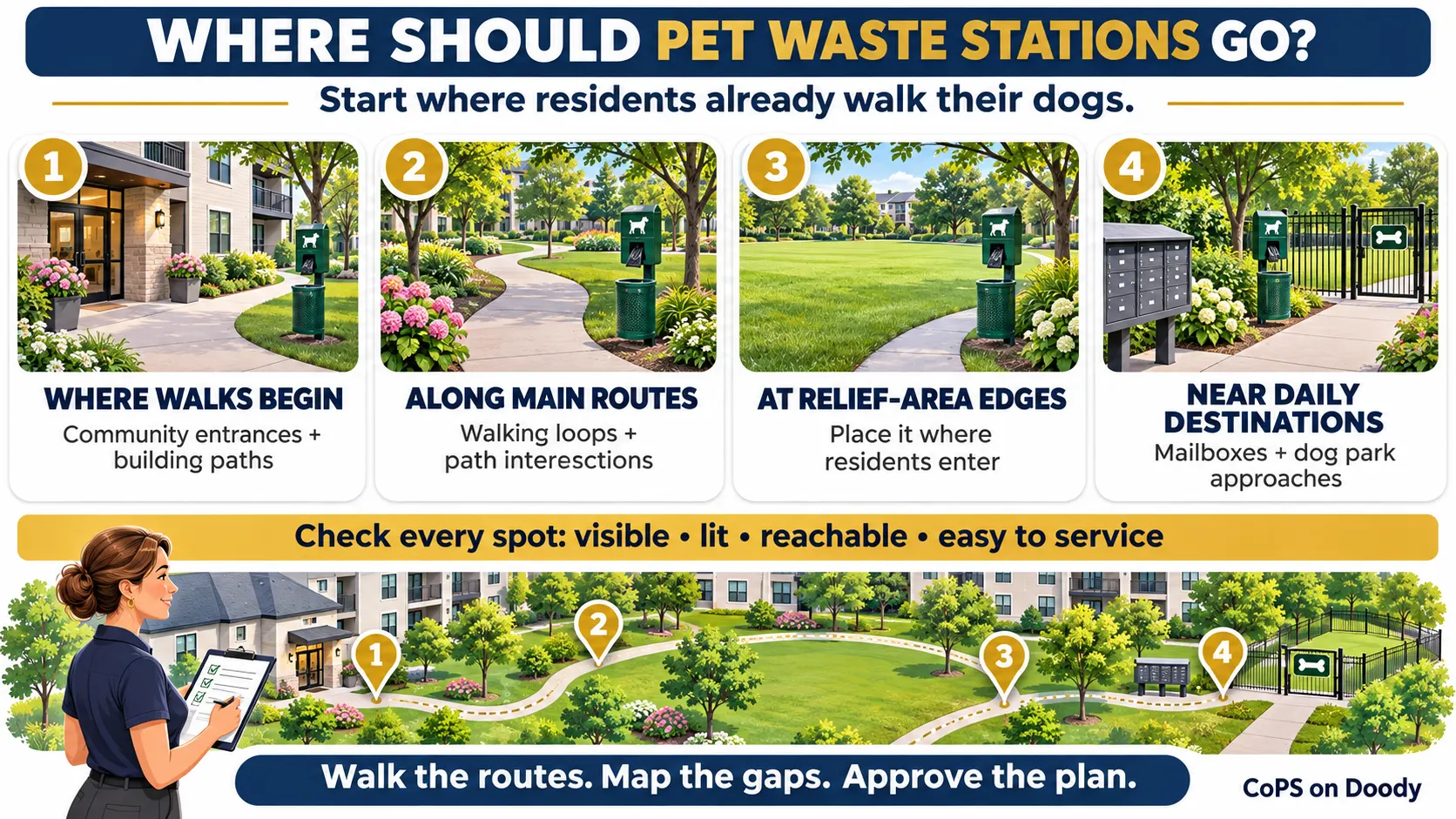
The best locations are the places every dog walker passes and the places where dogs stop.
Entrances and main routes come first because they reach the most residents. Public guidance points the same way. The University of Maryland Extension's guide to installing a pet waste station says to site stations where pet walkers are most active, such as access points to open space, dog parks, and heavily traveled sidewalks, where the station is highly visible. The Fairfax County Park Authority's 2020 Dog Park Study recommends stations near a park's primary entrance, at path intersections, and near parking, and it says homeowners associations may use its guidelines as an optional design resource.
The wooded-edge row comes from the Raleigh survey, where the most common write-in reason for not picking up was that the dog went into woods, ivy, or tall grass.
You don't have to guess where the relief areas are, because waste on the ground shows you. The Raleigh study suggested the same first step: find the problem areas, then ask whether bags and receptacles are really missing there or residents simply don't know about them.
Check each proposed spot on site, at the time of day residents use it.
Set the station where a walker sees it before reaching it, out in the open where other residents pass, not behind shrubs or around the corner of a building. Prince William County's police department, in its crime prevention design guide, recommends lighting pedestrian walkways and keeping shrubs along them at 3 feet or lower so views stay open. Those habits also help residents find a station. Keep it out of drivers' sightlines at street corners and driveway exits.
For several months a year, both the after-work walk and the before-work walk happen in the dark. In early December the sun sets at 4:46 p.m. in Washington and 5:29 p.m. in Atlanta, and in mid-January it doesn't rise until 7:25 a.m. in Washington and 7:42 a.m. in Atlanta, according to the U.S. Naval Observatory. In the Raleigh survey, rain or darkness was the third most common write-in reason for not picking up. Choose a spot within the light of an existing pole or building fixture, so residents can find it at 6 p.m. in December.
Put the station beside the walk on firm, level ground, so a resident can pull a bag and open the can without stepping into mulch or wet grass, and without the station narrowing the walk. The 2010 ADA Standards for Accessible Design make a useful reference:
The simplest approach is to set the post back far enough that nothing overhangs the walk at all. Fairfax County's dog park study also calls for bag dispensers mounted at ADA height.
Which rules legally apply depends on the property. Justice Department guidance says the ADA doesn't cover strictly residential facilities, but it does cover places of public accommodation within them, such as a rental office, and common areas open to people other than residents and their guests. The Fair Housing Act requires accessible common use areas at covered multifamily buildings first occupied after March 13, 1991: buildings of four or more units with an elevator, and the ground-floor units of other buildings with four or more. Detached homes, duplexes, triplexes, and multistory townhouses without elevators aren't covered. Joint HUD and Justice Department guidance treats garbage dumpsters, the closest comparison to a station, as common use spaces that must sit on an accessible route. Any resident with a disability may ask for a reasonable accommodation. Ask association counsel which rules apply to your community.
Ask your landscaper where the mowers turn. A station at the edge of a bed or beside a walk is easier to mow and trim around than one standing alone in open turf. In the DC metro, look at where snow gets plowed and shoveled each winter, so a station at the end of a walk doesn't end up buried. Keep cans away from patios, front doors, and bedroom windows. A can beside someone's patio may draw complaints, especially in an Atlanta summer.
The technician has to reach the station on every visit with bags and liners, and carry the waste out. Fairfax County's dog park study notes that putting receptacles and dispensers inside a fenced dog area makes users more likely to dispose of waste but makes emptying and restocking harder for maintenance staff. A locked gate or a steep slope adds work to every visit, so weigh that before choosing the spot.
Before a location is final, confirm four things. The association controls the land. No right-of-way or easement covers it, or the holder has approved it in writing. It sits outside any stream buffer, or the county has approved it. Underground utilities have been marked. Start with the plat or site plan, which should show lot lines and recorded easements. A grassy strip that looks like common area may belong to a homeowner's lot, the county, or the state.
The grass strip between a sidewalk and a public street may be right-of-way. In Virginia, state regulations say no work or nontransportation use of any kind may take place on right-of-way under VDOT's control until VDOT gives written permission. In Gwinnett County, planning guidance says accessory structures are prohibited in the right-of-way, and landscaping there needs the county transportation department's approval. Elsewhere, ask the county or city before you put a station at the curb.
Fairfax County doesn't allow non-fence permanent structures, such as buildings, sheds, walls, or decks, in storm drainage easements without its prior written approval. Gwinnett County's water department has a form for requesting an encroachment into an existing easement. If the plat shows an easement where you want a station, ask the easement holder first.
A stream buffer is protected land along a stream where new structures, paving, and digging are limited or need approval. None of the rules below names pet waste stations, so the county or city decides how a station is treated.
Plan new stations outside the buffer, on the path before it reaches the water, and ask the county or city before putting anything inside one.
Contact 811 before anyone digs. The one-call center notifies the utilities, and they mark their public lines. They don't mark private lines, such as sprinkler or irrigation lines and landscape lighting, so the association needs a private locating company for those.
If installation slips past that window, submit a new request. When we install stations, we set each one in the ground in concrete, and we always have underground utilities marked first.
No formula answers either question. The number depends on the common area available in convenient locations, residents' walking patterns, the community's layout, foot traffic, and the density of homes. Every community is different, and that is why we visit every community. Counting dogs won't give you the number. Covering the community will.
Montgomery County's Department of Environmental Protection, which has installed stations in association common areas through its pet waste program, sets the number with each association after an onsite evaluation.
Aim for coverage instead of a number:
Walk every route at the times residents walk their dogs, early morning and early evening, with the site plan in hand. Number the existing stations and trash cans on the plan first, then record each stop. Walk it at least once yourself, even if someone else will make the recommendations.
Mark the trash cans because residents use them. In a 2014 UK survey of dog walkers, 57% said they would put dog waste in a general litter bin when no dog waste bin was available, so cans on a route show where residents already expect to drop a bag.
Under "What you saw," note waste on the ground, worn grass, old stations, damaged dispensers, and cans that are full. Residents sometimes put household trash in stations. A can that keeps filling with it is worth writing down, because it changes what that location needs.
Once the locations are agreed upon with the community, put them on one map and take it to the board. Everyone sees the same plan before anything is installed, and the map becomes the record of where every station is. Include:
After the board approves it, share it. The EPA suggests posting maps that lead residents to stations along common walking routes and putting educational signs next to the stations. A newsletter item with the map tells residents where the new stations are.
If the plan includes new stations or moving old ones, our pet waste station installation page explains how installation works. Keeping stations stocked, clean, and working once they're in is covered in our guide to pet waste station maintenance.
On a route residents already walk with their dogs, such as an entrance, a main walking loop, or the edge of a lawn where dogs stop. Choose a spot a walker sees from the approach, can find after dark, and can reach from the walk.
There's no standard distance, and no ratio sets the count. Both depend on the community's layout, walking patterns, foot traffic, the density of homes, and where convenient common area exists. Aim for coverage: every regular route passes a station, and waste on the ground far from any station marks a gap.
It depends on the property. The ADA reaches places like a rental office and common areas open to the public, and the Fair Housing Act covers common use areas at many multifamily buildings first occupied after March 13, 1991. Use the 2010 ADA Standards as a design reference either way, and ask association counsel which rules apply.
Yes. Whoever installs the station should submit the locate request within the notice window in the table above. 811 doesn't mark private irrigation or lighting lines, so arrange a private locator for those.
The location is agreed upon with the community and approved by the board, underground utilities are marked, and the post is set in the ground in concrete. Our installation page explains how it works.
Put it on the path into the play area, at the edge, not beside the equipment or seating. In a 2025 study of Dublin parks, entrances and then playgrounds had the heaviest roundworm egg contamination, and the CDC asks dog owners to pick up especially where children may play.
The best locations for dog waste stations are the places residents already pass and the places where dogs stop. Test every spot on site: a walker should see it, find it after dark, and reach it from the walk, and a technician should be able to service it. Confirm the ground is the association's to build on, have the lines marked, walk the community when dogs are out to find the gaps, and put the agreed-upon locations on a map the board approves.