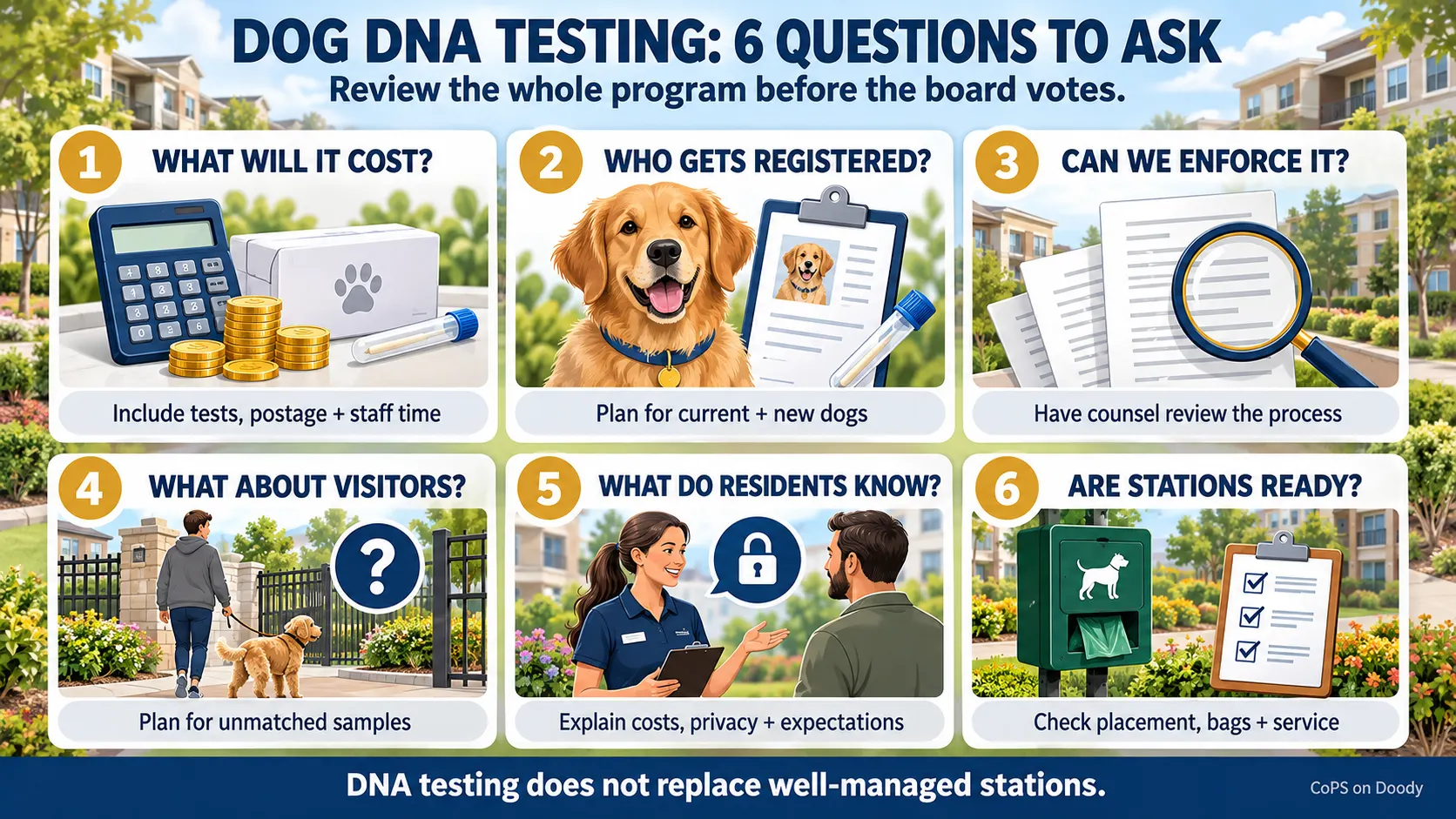
Dog poop DNA testing matches a waste sample found on community grounds to a dog registered with a cheek swab, so the community can identify the owner and enforce its rules. It can work, but six problems decide whether it will in your community: cost and who pays, getting every dog registered, your legal authority to fine, dogs that aren't in the registry, resident relations and privacy, and the fact that DNA doesn't fix stations that are hard to reach or poorly serviced.
The concern behind a DNA proposal is real. The CDC lists roundworm, hookworm, Giardia, Campylobacter, and Salmonella among the germs dogs can carry, and it says dog poop should be picked up, especially in areas where children may play. Let us walk you through how a program works, how well it works, and what to weigh before the board votes.
Vendors describe the same basic steps. The lab does the matching; the community does everything else.
PooPrints, run by BioPet Laboratories, recommends getting most of a community's dogs registered before testing any waste, and building registration into move-in. Mr Dog Poop says each community runs its own program while the company acts as the lab, and that it emails the community when a sample matches.
The lab method is well established. PooPrints says it builds each profile on 16 genetic markers, calls a match only when every marker aligns with no discrepancies, and works in a lab accredited under ISO/IEC 17025:2017, the international standard for testing labs. It also says it extracts valid DNA from 90% of waste samples submitted. Mr Dog Poop says that when a sample doesn't yield enough markers, it reports no match rather than guess.
Timing matters too. PooPrints says results come back within 10 business days, and Mr Dog Poop says waste samples returned to its lab more than two weeks after collection can't be used, so samples should be fresh and shipped promptly.
No independent study we could find has measured it. The figures you'll see come from vendors: PooPrints says communities can reduce unscooped waste by up to 96%, and Mr Dog Poop says 85% of its customers report three or fewer piles found on the property after their first year. Mr Dog Poop also says plainly that a program can fail at some properties. Treat those as vendor claims.
Local governments that looked at DNA programs reported more mixed results. A 2021 Belfast City Council report concluded that DNA testing has worked in private gated communities but is impracticable and expensive for a city unless registration becomes a legal requirement. A Stockton Council report in England warned that unless a large share of owners register their dogs, a positive match is unlikely. An Irish council's pilot tested 10 waste samples against just 50 registered dogs before officials judged the cost prohibitive. The London borough of Barking and Dagenham reported a drop of about half in dog fouling in its pilot parks, without a published method. The pattern is consistent: registration rate decides whether matches happen, and a gated or closed community has the best chance.
The lab charges for every dog registered and every sample tested, and the community pays for a sample whether or not it matches. The board then decides who carries that cost.
PooPrints doesn't post prices; it quotes each community, and its resident FAQ says it doesn't charge residents directly and that analysis fees are set at the community level. Mr Dog Poop publishes prices, but its pages show more than one schedule, so get a written quote.
The rates page also lists a $100 setup fee for properties with fewer than 25 dogs, a $25 minimum annual fee, and return postage paid by the community. Here's what the same first year costs under two of those schedules, with placeholder counts you can replace:
Neither total includes postage, certified mail for hearing notices, staff time, or counsel's review of the new rule. After the first year, registration drops to new dogs only.
The money can come from the association's budget (every owner pays, including owners without dogs), a registration fee for dog owners if your documents allow one, or fines once the steps in Problem 3 are complete, though unmatched samples leave no one to charge.
In apartment communities, any fee belongs in the lease's pet addendum, within landlord-tenant law:
A DNA program can match only the dogs in its registry, so it works only as well as your registration rate. Mr Dog Poop names the usual gaps: new dogs never swabbed or swabbed incorrectly, staff turnover, and residents who don't know the program exists. It recommends building registration into move-in and lease renewal.
Registration is harder in a community association than in an apartment community. Owners don't pass through a leasing office, dogs arrive between move-ins, and tenants in rented homes may never see the association's notices. In Virginia, where the documents provide for charges, an association can charge an owner for violations by the owner's family, tenants, and guests, so owners who rent out their homes need to know the rule covers their tenants' dogs. Decide ahead of time what happens when a resident won't register a dog; if your rule requires registration, a refusal is a violation of its own.
A registration plan should include:
A match identifies the dog. The power to fine has to come from your governing documents, and the fine has to follow your state's notice and hearing steps. Counsel can tell you whether a DNA requirement can be a board rule or needs an amendment to the declaration.
Three details change the math. Virginia's $50 cap is lower than some per-sample lab fees, so fines may not cover even the matched tests. In Maryland, the first match against a resident will often lead to a letter rather than a fine, and the staff member who collected the sample may need to attend a hearing. In Georgia, associations under the Property Owners' Association Act or the Condominium Act, and since 2024 associations in planned subdivisions of 15 or more lots outside those acts, may fine only as their instrument provides, and from January 1, 2027, SB 406 bars associations that aren't registered with the Secretary of State from collecting fines or fees, which would include a DNA registration fee.
Waste from a visitor's dog, a dog walker passing through, or a resident's dog that was never registered comes back as no match, and the community still pays for the test. Mr Dog Poop lists the usual reasons a sample doesn't match: the dog lives elsewhere, the waste came from a raccoon, possum, or cat, or the sample was collected poorly or too late. It also says a property with heavy traffic from outside dogs needs to solve that before any matching program can work.
That weighs more on a townhome community in Loudoun or Gwinnett with public sidewalks and a trail connection than on a mid-rise condominium with one relief area. Your rule needs a visitor policy. Published examples show the options: one Howard County, Maryland association treats a dog as residing in the community if it spends 84 or more hours a week there, offers temporary registration for foster dogs, and has the association pay for tests that don't match a registered dog. A Fairfax County condominium's sample resolution requires registration for pets visiting beyond a week. Train collectors to send only fresh samples from areas residents' dogs use, because every sample is billed.
Most residents already pick up after their dogs. In a 2024 survey of about 500 Northern Virginia residents, 87% said they always or usually pick up on walks. Some of them will feel they're paying, swabbing, and being watched because of a few neighbors, so explain the program before you adopt it.
Answer the privacy questions up front. State and federal genetic privacy laws, including Virginia's and Maryland's and the federal Genetic Information Nondiscrimination Act, define genetic data in human terms, so a dog's DNA falls outside them. That makes the vendor's own terms the ones that matter. BioPet's privacy policy says it doesn't collect human genetic data or sell personal information, but it keeps ownership of the genetic profiles its lab produces, may store or destroy samples at its discretion, may use pet DNA in de-identified form for research and product development, and may share information with service providers, including property management platforms. Residents can ask to have their personal information deleted. PooPrints also says its waste test doesn't identify breed, to prevent misuse in communities with breed restrictions.
Send the vendor's privacy policy with your announcement, and cover why the board is considering the program, what residents must do and by when, what it costs them, how a match is handled, and what the community is doing on its side, starting with the stations.
Assistance animals need their own process. The Fair Housing Act still requires reasonable accommodations, and Virginia law bars a pet fee, deposit, or added rent for an assistance animal in rental housing. Ask counsel before charging any DNA fee for one.
A DNA program finds out who didn't pick up. It doesn't put a station on the route people walk, keep bags in the dispenser, or empty a can before it fills. If those basics aren't right, the board is enforcing a rule residents may find hard to follow, and the owner you fine may say so at the hearing. Mr Dog Poop makes a similar point: results depend heavily on staff enforcing the program, collecting good samples, and keeping residents informed.
Before the board votes, walk every station:
A managed station program keeps stations stocked, emptied, inspected, and clean on a regular service schedule, and on a Community Walk we look at every station's placement, condition, and supplies.
DNA programs do work in some communities. They tend to fit where:
A phased approach can test the idea for less. The Howard County association above adopted a two-phase policy in 2024: photo registration of every dog first, with DNA registration only if the waste problem continued.
Bring this table to the meeting where DNA is on the agenda, and fill in the last column before anyone votes.
PooPrints quotes each community. Mr Dog Poop's site listed $34.95 to $44.95 per dog and $34.95 to $79.95 per waste sample in October 2026, depending on the page. Postage, certified mail, and staff time are extra, and unmatched samples are billed too.
The lab method is reliable: PooPrints matches on 16 genetic markers in an ISO-accredited lab and reports valid DNA from 90% of samples. Accuracy in practice depends on fresh samples and a complete registry.
Often, if its documents allow it and the board adopts the rule the way state law and the documents require. Counsel can tell you whether a board rule is enough or the declaration needs an amendment.
Generally, yes, through the lease's pet addendum, within landlord-tenant law. In DC, rental pet-fee limits are now in effect, so ask counsel whether a DNA fee counts as a pet fee, and handle assistance animals separately.
Only if its documents authorize fines and it follows the state's process. Virginia requires notice, a chance to correct, and a hearing, and caps a single charge at $50. Maryland requires a cease-and-desist demand first. From January 1, 2027, Georgia associations must be registered with the Secretary of State to collect fines or fees.
The community still pays for the test, and there's no one to charge. Common causes are a dog from outside the community, an unregistered dog, another animal's waste, or a sample collected poorly or too late.
Dog poop DNA testing can identify the owner behind the waste, and in a closed community with high registration it can settle a stubborn problem. It also adds a cost line, a registration job, a legal process, and a resident-relations project, and it can't reach dogs outside the registry. Fix the stations first, check your documents and your state's steps with counsel, price the program with unmatched samples included, and then decide.
Sources, all retrieved 2026-10-05 to 2026-10-07.