
If your own staff handle pet waste, the most useful number you don't have is how many hours it takes. Many communities haven't measured it. The work comes in small pieces: ten minutes restocking a dispenser here, fifteen minutes on a complaint there. Small pieces are exactly what people underestimate. A two-week time log, filled in as the work happens, replaces the guess with a number the board can trust.
This guide covers what to count, how to set up the log so it's accurate, and how to turn two weeks of minutes into an annual figure. It includes task codes, a staff log, an office log for complaint and ordering time, a summary sheet, and a cost sheet.
Time recorded as the work happens may be more reliable than an estimate made later, especially for short, repeated tasks. Bureau of Labor Statistics researchers note that time-diary data "are generally considered to be more accurate because of the short, typically 1-day, recall period" and because every activity in the day has to add up. Research on workplace time studies points the same way: estimates made afterward tend to be poor at durations. A log kept by your own staff isn't a formal time study, but it's much closer to one than a guess, and for pet waste, where the job is a string of five- and ten-minute pieces, that difference matters.
There's a second problem. The person asked to estimate usually knows only their own share. The maintenance tech doesn't see the twenty minutes the office spent answering a resident's email about an empty dispenser, and the manager doesn't see the extra loop the crew drives on Friday to restock bags. A log that every person fills in catches both.
Give every task a code, so the log is fast to fill in and easy to total. These eight cover what most communities do in-house.
| Code | Task | What it includes |
|---|---|---|
| R | Restocking | Refilling bag dispensers at stations |
| E | Emptying | Emptying station cans, replacing liners, hauling bags to the dumpster, including gloving up and washing hands |
| G | Ground pickup | Picking up waste left on lawns, paths, beds, and parking areas, including gloving up and washing hands |
| T | Travel | Walking or driving between stations on a round, and to and from the supply room |
| S | Supplies | Ordering, receiving, and storing bags and liners |
| X | Repairs | Fixing or replacing posts, lids, dispensers, cans, and signs |
| C | Complaints and communication | Answering resident emails, calls, and walk-ins; writing reminders and notices |
| V | Coordination | Talking with the landscaper, vendor, or board about pet waste |
Use one code per line, and use the codes the same way for every person. Time spent at a station is R, E, or G; time spent getting from one station to the next is T. If a task doesn't fit, write it in the notes rather than inventing a new code halfway through.
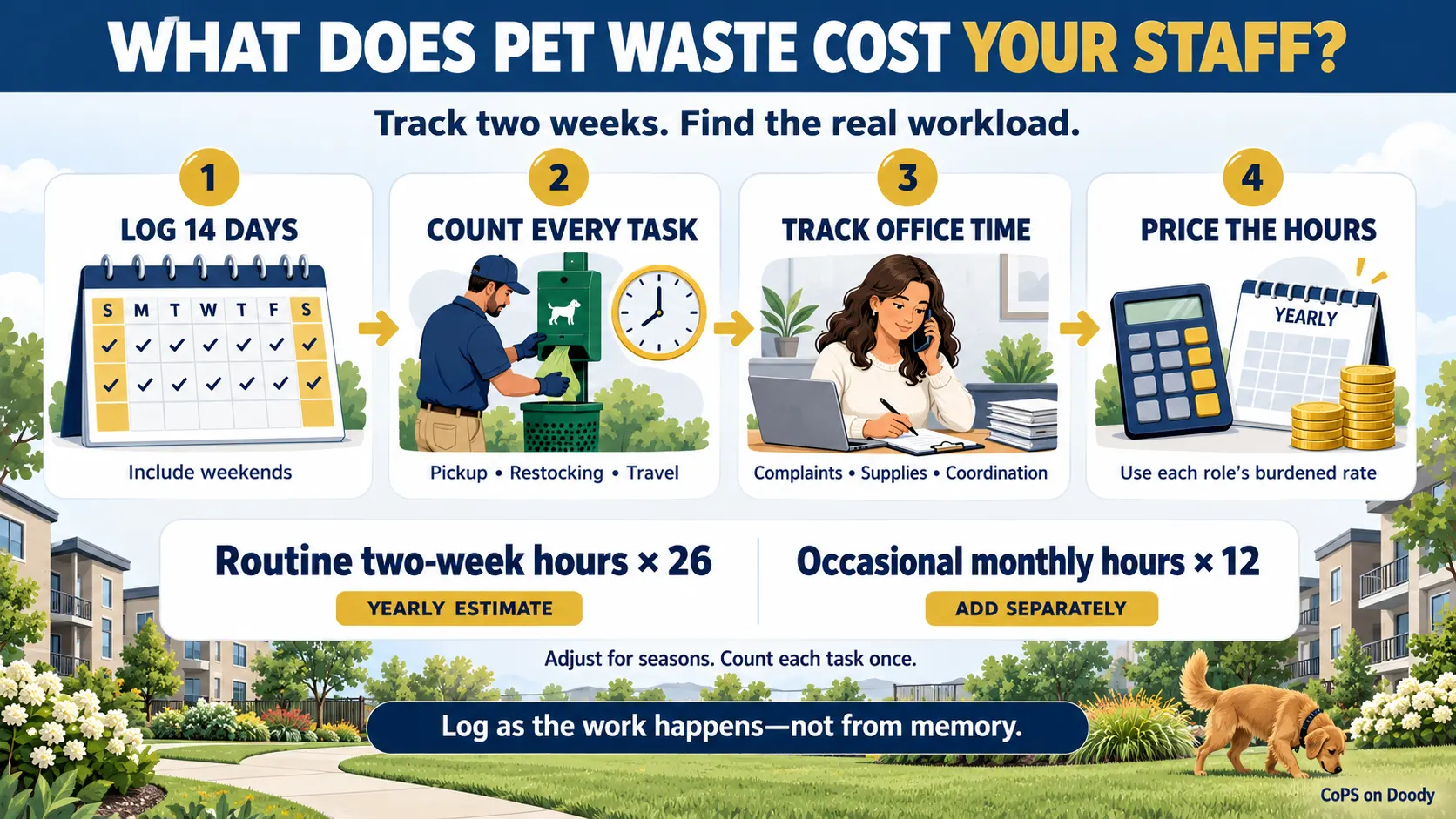
Avoid weeks with a holiday, a major event, or a crew member on vacation. Two full weeks, weekends included, capture every regular service day and show what happens to stations over the weekend. The federal American Time Use Survey gives weekend days half its sample for a similar reason, so weekends are measured as well as weekdays.
Each person writes down the start and end time of each pet waste task when it happens, on a pocket card, a clipboard at the shop, or a note on their phone. Round to the nearest five minutes.
The walk or drive from one station to the next is part of the job, and it's easy to forget. Log it as travel.
The manager, assistant manager, or front desk keeps its own log of complaint and communication time, plus the time spent ordering, receiving, and storing bags and liners. That time usually costs more per hour than maintenance time, so it needs its own line.
Explain that you're measuring the work, not grading anyone, and that an honest log is more useful than a fast one. One practical point: the time staff spend filling in the log is work time. For nonexempt staff, which usually means hourly staff, it counts as hours worked under federal wage rules, so build a minute or two per entry into the plan. Don't add logging time to the pet waste totals. The log is a management study, and it sits alongside your payroll time records rather than replacing them.
Write down weather, a broken station, or a resident event. The notes explain the outliers when you total it up.
Some work happens less often than every two weeks: the monthly supply order, a post that needs resetting, a quarterly talk with the board. Two weeks may not catch them. Check invoices, work orders, and email for the last few months, and work out a monthly average for each one. It goes on its own row in the summary. If one of these tasks happens to fall inside your two weeks, leave it out of the two-week total and count it on that row instead, so it isn't multiplied by 26.
One sheet per person per week. Keep it on a clipboard or a phone note, and fill in a line every time you do pet waste work.
| Date | Start | End | Minutes | Task code | Station or location | Notes |
|---|---|---|---|---|---|---|
| Example: [Mon, date] | 7:40 | 7:55 | 15 | R | Stations 1 to 4 | Station 3 out of bags |
| Example: [Mon, date] | 7:55 | 8:05 | 10 | T | Stations 1 to 4 | Walking between stations |
| Week total |
Keep one copy at the front desk, and have everyone who handles a pet waste contact, order, or conversation add a line.
| Date | Minutes | Task code (C, S, V) | How it came in | Location mentioned | What we did | Handled by |
|---|---|---|---|---|---|---|
| Example: [Tue, date] | 15 | C | Maple Ct. loop | Replied; asked crew to restock Station 6 | [Name] | |
| Example: [Thu, date] | 20 | S | Online order | All stations | Ordered bags and liners for the month | [Name] |
| Week total |
At the end of the two weeks, add the minutes by task code and by role, and convert to hours.
| Task | Maintenance and grounds staff (hours) | Office and management (hours) |
|---|---|---|
| R Restocking | ||
| E Emptying | ||
| G Ground pickup | ||
| T Travel | ||
| S Supplies | ||
| X Repairs | ||
| C Complaints and communication | ||
| V Coordination | ||
| Two-week total | ||
| Weekly average (÷ 2) | ||
| Estimated yearly hours (two-week total × 26) | ||
| Occasional tasks from records (monthly average × 12) | ||
| Total yearly hours |
Annualize it with care. Multiplying two weeks by 26 gives a full-year estimate, but pet waste work isn't the same every month. If you logged in a busy season, the yearly figure may run high; if you logged in winter, it may run low. The best fix is a second two-week log in the opposite season, then average the two. If you only do one, note the season next to the number when you present it.
An hour of staff time costs more than the hourly wage. Benefits, paid time off, and payroll taxes all ride on top of it. Based on U.S. Bureau of Labor Statistics figures, private employers paid 42.9 percent on top of wages in June 2026, counting overtime and bonuses. The figure was 45.8 percent for installation, maintenance, and repair jobs, and about 30 percent for service jobs, which include groundskeepers. Price the hours with a burdened labor rate, not the wage. Our guide to calculating the fully burdened labor rate for grounds staff walks through it step by step.
Then the math is short:
| Line | How to calculate it | Your figure |
|---|---|---|
| Staff time | Yearly staff hours (R, E, G, T, X) × staff burdened rate | |
| Complaints and resident communication | Yearly C hours × the burdened rate of whoever logged them | |
| Ordering, stocking, and coordination | Yearly S and V hours × the burdened rate of whoever logged them | |
| Bags, liners, gloves, and shipping | Monthly supply spend × 12 | |
| Yearly in-house cost | Add the four lines | |
| Of which: benefits, paid time off, and payroll taxes | For each role, (burdened rate − hourly wage) × yearly hours | |
| Cost per station | Yearly cost ÷ number of stations |
Keep the complaint line separate when you present it. A manager's time doesn't appear on any pet waste budget line, so it may be the figure that surprises the board.
If your staff handle pet waste, gloves and handwashing are part of the job, and so is the time they take. The CDC advises washing hands with soap and running water after contact with dog waste, "even if you use a bag," and after touching garbage. Federal workplace safety rules also require employers to assess the workplace for hazards that call for protective equipment, provide the right equipment, and train staff on when and how to use it. Keep gloves and bags stocked where staff start their rounds. Washing up is part of the emptying or pickup time, so log it under E or G.
Put it in front of the board as a budget line, with the hours and the cost side by side and the complaint time on its own line. A number your own staff produced is hard to argue with. Then request a proposal to compare these figures, even if you don't plan to change anything.
Two full weeks, weekends included, is long enough to catch every regular service day and the weekend gap, and short enough that people keep logging carefully. Repeat it in a second season if you can.
Yes. Tell them what you're measuring and why. The goal is an accurate picture of the work, and people log more accurately when they know the purpose.
This log is built for in-house staff. If pet waste is in your landscaper's contract, the cost is set by the contract, so see taking pet waste off the landscaper's contract. The office log still applies, because resident complaints land on the manager either way.
Log them the same way. Volunteer time may not cost the association money, but it tells you how much work a volunteer program is carrying, and what it would take to replace it if the volunteers stop.
Yes, as its own line, with gloves and shipping included. Use your actual purchase records for the last few months and convert to a monthly average.
Pet waste work hides in small pieces, and small pieces are easy to underestimate. Two weeks of honest logging, by everyone who touches the work, including the office, turns it into hours you can total, annualize, and price. Use a burdened rate, keep the complaint time on its own line, and bring the number to the board with the season noted.