

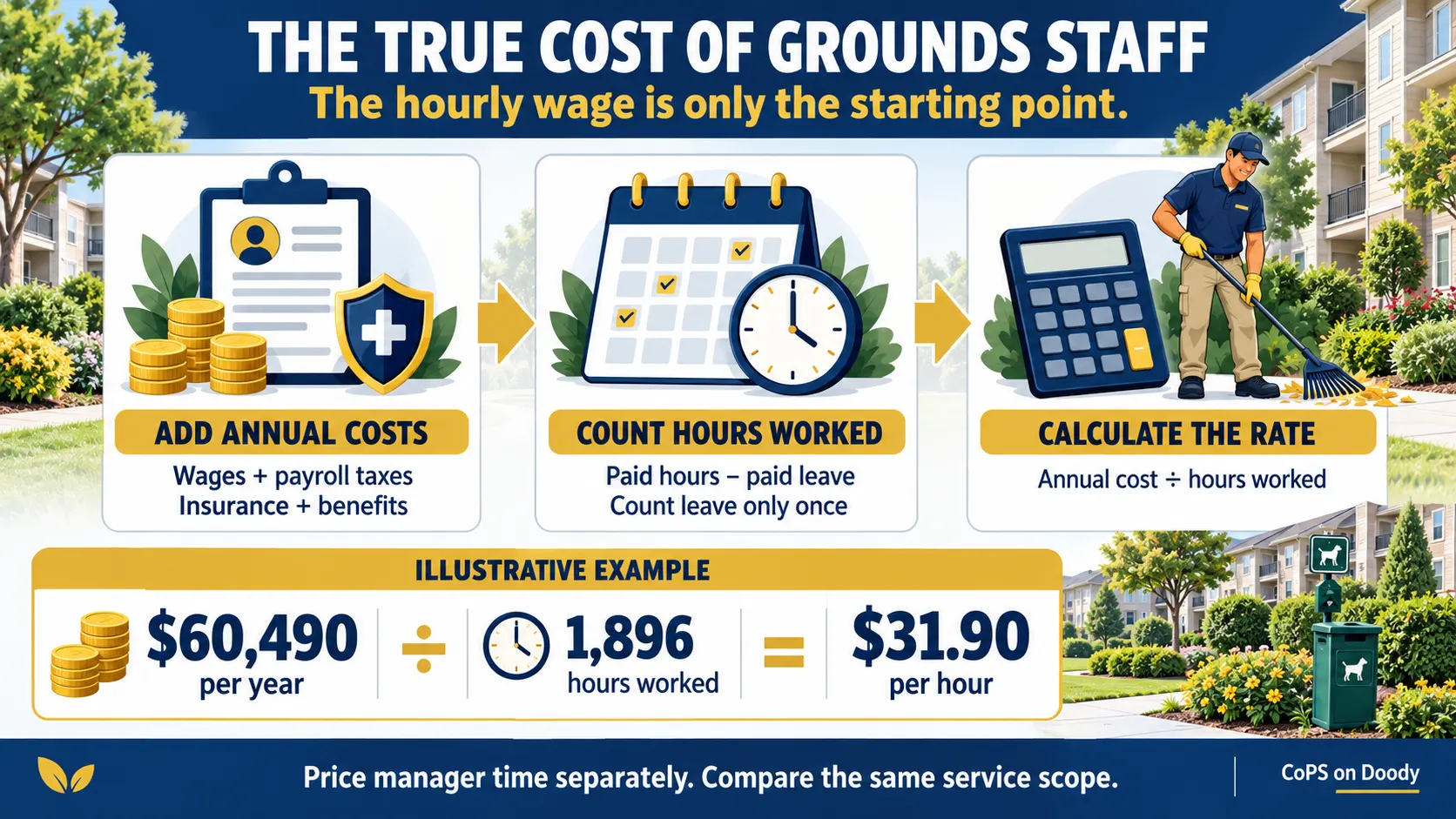
A fully burdened labor rate is what one hour of an employee's work actually costs the community: the hourly wage plus the employer's payroll taxes, insurance, benefits, and paid time off, divided by the hours the person actually works. The formula is short: total yearly cost of the employee ÷ hours actually worked in a year. Based on U.S. Bureau of Labor Statistics figures for June 2026, private employers paid about 43 percent on top of wages. The figure was about 46 percent for installation, maintenance, and repair jobs, and about 30 percent for service jobs, the group that includes groundskeepers. So a $22 wage costs somewhere around $29 to $32 an hour once the burden is added. Your own payroll decides where in that range.
If your community has its own grounds or maintenance staff, the burdened rate is the number you need before you can price any task they do, from mulching to emptying pet waste stations. This guide gives you two ways to get it: a quick benchmark method that takes two minutes, and a worksheet built from your own payroll that takes about half an hour. Both come with 2026 figures for Virginia, Maryland, DC, and Georgia.
These terms get used loosely. Here's how this guide uses them.
The comparison mistake to avoid: setting your staff's base wage beside a vendor's bill rate. The fair comparison is your full in-house cost for the work (burdened staff hours, the manager's time, supplies, and any overhead you count) against a vendor's price for the same scope.
The Bureau of Labor Statistics measures what employers pay on top of wages in its Employer Costs for Employee Compensation survey. In June 2026, private-industry employers paid an average of $32.82 an hour in wages and $14.07 in benefits, so benefits were 42.9 percent of wages. For installation, maintenance, and repair occupations, the figure was $15.41 on $33.61 in wages, or 45.8 percent. Groundskeepers fall in a third group, service occupations, where benefits averaged $5.47 on $18.26 in wages, or about 30 percent. That group also includes many part-time jobs with few benefits, so if your grounds staff are full time with health insurance and paid leave, your burden is likely closer to the maintenance figure. The worksheet below settles it.
So the quick method is one line:
For maintenance occupations, the 45.8 percent broke down like this in June 2026
The benchmark is a national average across employers large and small. A small association that offers no retirement plan and a modest health contribution may run well below it; one with a generous benefits package may run above it. When the number matters, use the worksheet.
Pull the employee's pay rate, your benefit costs, your paid leave policy, your state unemployment rate notice, and your workers' compensation policy, then work down this worksheet. Use a full year for every line.
If your staff are on the management company's payroll and billed back to the community, start from the payroll reimbursement invoice instead, including any administrative fee. The tax rates and the workers' compensation policy in that case are the management company's, not the association's.
Two notes on the worksheet. First, line N is the easiest step to skip. If an employee is paid for 2,080 hours but takes two weeks of vacation, eight holidays, and five sick days, they actually work 1,896 hours, and every one of those hours carries the cost of the time off. The Bureau of Labor Statistics draws the same line: paid hours include holidays, sick leave, and vacation, which aren't hours worked. Second, don't count paid leave twice. The worksheet already captures it by dividing by hours worked, so don't also add it as a cost line.
These are the employer's shares, on top of what's withheld from the employee's pay.
Grounds and maintenance staff earn well under the Social Security wage base, so the 6.2 percent applies to every dollar they're paid. The full FUTA credit depends on paying state unemployment tax in full and on time. None of Virginia, Maryland, DC, or Georgia had a FUTA credit reduction for 2025, and none is on the Labor Department's list of potential reductions for 2026.
State unemployment tax. Each state charges its own tax on each employee's wages, up to a wage base. New employers get a set rate. Established employers get a rate notice from the state each year based on their own history, so use your notice if you have one.
DC paid leave tax. DC employers also pay a Universal Paid Leave tax of 0.75 percent of each covered employee's wages, with no wage cap, and it can't be withheld from pay. For the $22 employee in the example below, that's about $343 a year. Maryland's paid family and medical leave contributions aren't due in 2026, because state law delayed their start.
Workers' compensation. Premiums are usually set as a rate per $100 of payroll. The rate depends on your state, the class code your carrier assigns to the job, and your claims history. In-house staff at an apartment community or HOA may not be classed the same way as a landscaping contractor's crew, so ask your carrier or agent which class code covers your staff and what rate applies. It's a real cost, and it isn't on the pay stub.
Health insurance. For full-time staff, this is usually the largest benefit. In KFF's 2025 Employer Health Benefits Survey, the average yearly premium was $9,325 for single coverage and $26,993 for family coverage, and covered workers paid an average of $1,440 and $6,850 of that. That leaves an average employer share of about $7,885 for single coverage and $20,143 for family coverage. Use your own plan's figure: the employer's share per enrolled employee, per year.
All of these figures are for planning. Confirm your own rates with your payroll provider or accountant.
This is the worksheet filled in for a full-time maintenance and grounds employee at a Georgia community, paid $22.00 an hour. The workers' compensation rate is illustrative, and the health insurance line uses the national average employer share for single coverage. Your figures will differ.
The lines are rounded to the nearest dollar, so they add to a dollar more than the total.
The same employee with no health insurance or retirement contribution costs $27.02 an hour, a multiplier of 1.23. Benefits are the biggest swing in the number, which is why one benchmark rarely fits every employer.
If you're setting a budget figure rather than costing a specific person, start from the local median hourly wage. These are the May 2025 Occupational Employment and Wage Statistics medians, the most recent the Bureau of Labor Statistics has published, for the Atlanta-Sandy Springs-Roswell and Washington-Arlington-Alexandria metro areas.
Two cautions. The medians cover every industry, not only apartment and HOA employers, and the employer-cost percentages in this guide are national figures. Your own payroll figures are the better guide.
A lot of in-house work isn't done by the crew. Residents email the office, the manager writes the reminder notice, someone orders the bags and checks the delivery. That time belongs at the manager's burdened rate, which is usually higher than the crew's. Using the 1.43 private-industry multiplier for both roles, an hour of management time costs about $48 and an hour of maintenance time about $34 at national medians. With local medians, it's about $53 against $34 in the Atlanta metro, and about $64 against $39 in the DC metro.
When you cost any task, keep the two on separate lines. Folding the manager's hours into the crew rate understates the cost whenever the manager's rate is higher.
Once you have the rate, any recurring task can become a budget line. For pet waste, keep four lines, and pull out the payroll cost so the board can see it.
If you don't know the hours, measure them. Our two-week pet waste time log gives you the log sheets, task codes, and the math to turn two weeks into a yearly figure. Then request a proposal to compare these figures.

It's the full hourly cost of an employee to the employer: wages plus payroll taxes, insurance, benefits, and paid time off, divided by the hours the employee actually works.
The Bureau of Labor Statistics put private-industry benefit costs at 42.9 percent of wages in June 2026, a multiplier of about 1.43. The figure was about 1.46 for installation, maintenance, and repair jobs and about 1.30 for service jobs, which include groundskeepers. Your own figure depends mostly on your health insurance contribution, retirement plan, and paid leave policy.
No. It's the employer's own cost for an hour of work. A contractor's bill rate adds overhead and profit on top, which is why the two aren't directly comparable.
Put each cost on its own row, as in the worksheet above: wages, each payroll tax, workers' compensation, insurance, retirement, and other benefits. Sum them, subtract paid leave hours from paid hours to get hours worked, and divide the total by hours worked.
Often, because part-time staff may not get health insurance or retirement contributions. But Social Security, Medicare, and workers' compensation still apply, and unemployment taxes are charged on the first several thousand dollars of each person's wages, so they weigh more heavily on lower-paid and part-time workers as a share of pay.
If the employee regularly works overtime, include the expected overtime pay in yearly wages (line C). Payroll taxes apply to it too.
Those are overhead rather than labor burden. Many employers keep them separate and add them as a second step when they need the full in-house cost. Whatever you choose, say so when you present the number.
An hour of staff time costs the community far more than the hourly wage. For a quick figure, multiply the wage by a federal benchmark: 1.43 on average, 1.46 for maintenance jobs, or 1.30 for the service group that includes groundskeepers. For an exact one, add every employer cost from your own payroll and divide by the hours the person actually works. Keep the manager's time on its own line at its own rate, and compare like with like: your full in-house cost for the work against a vendor's price for the same scope, never your base wage against a bill rate.
Sources (all retrieved 2026-10-02):