Program management is the seventh of the Seven Elements of a community pet waste program, and it's the element most communities score lowest on. Usually that's because every person involved owns a piece of the program, and nobody owns the whole thing. The vendor services the stations, the landscaper mows around them, the manager answers complaints, and the board approves the budget line. Nobody steps back once a quarter to ask whether the program is still working.
The fix is simple to describe and easy to skip: name one owner, give that person a short charter, put reviews on the calendar, and keep one file. This guide covers each step, with a RACI chart, a one-page program charter, an annual calendar, and a handoff checklist for when the owner changes.

The Seven Elements framework puts it in one line: the strongest programs are actively managed, not simply maintained. In practice, a managed program does five things.
Asset managers have a vocabulary for that last point. The EPA's guide to asset management for small water systems defines it as "a process for maintaining a desired level of customer service at the best appropriate cost," and builds it around five plain questions: what is the current state of the assets, what level of service is required, which assets are critical, what is the best life-cycle cost strategy, and how will it be paid for over the long term. Apply those questions to a community's stations, and they're the questions a pet waste program owner should be able to answer. The same guide says a plan should be reviewed at least once a year.
The difference shows up in how problems surface. In a maintained program, the first sign of trouble is a resident's email to the board. In a managed program, the owner usually sees it first, in the quarterly review, the complaint log, or the annual walk.
Every party involved in a community pet waste program has a reasonable view of its own job. The trouble is in the space between those jobs.
None of these people is doing anything wrong. But if nobody is assigned to look at the whole program, the problems that belong to nobody, like a station that's in the wrong place or residents who were never told where stations are, can go years without anyone noticing.
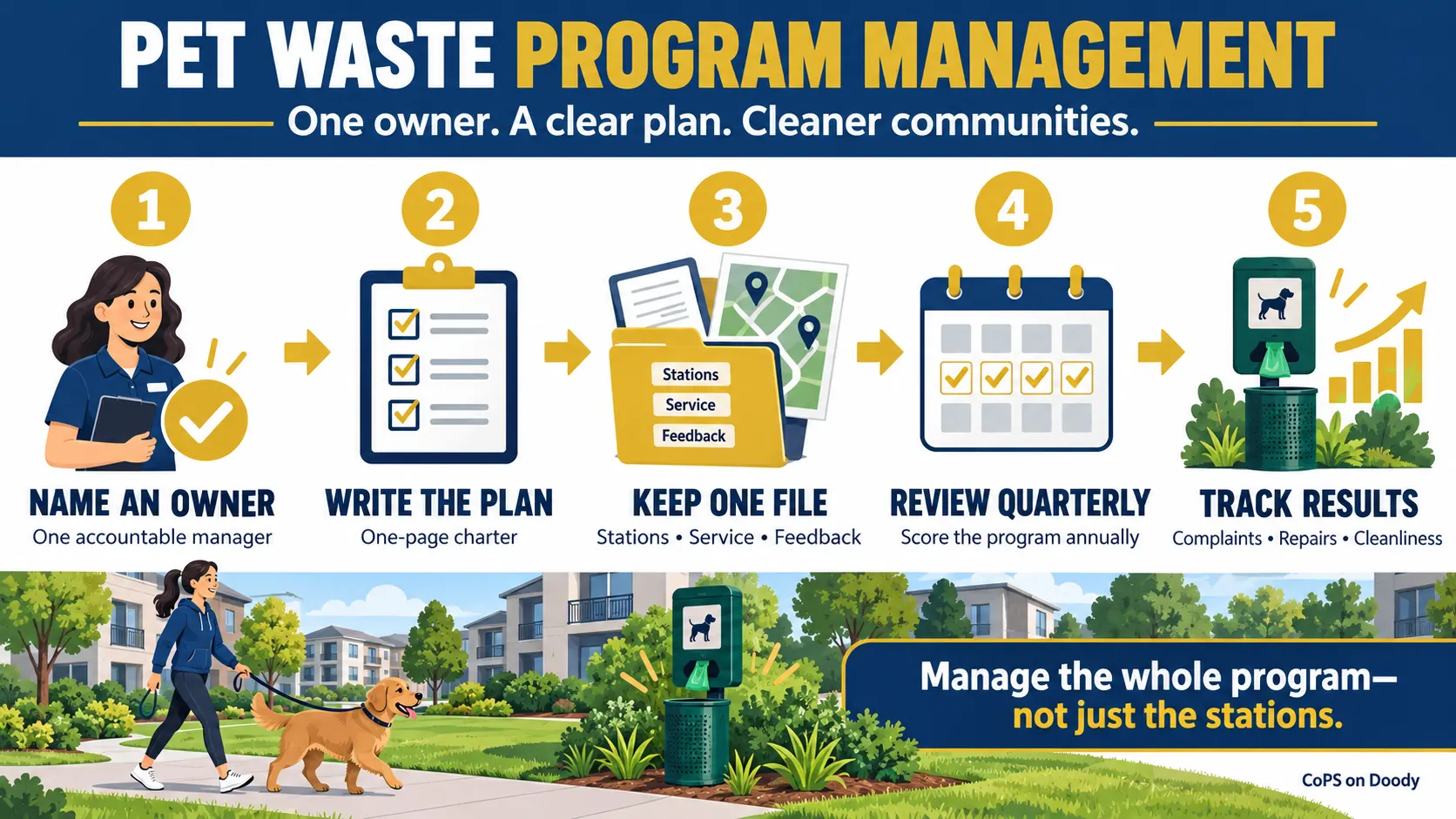
Every program needs one accountable owner: the person who answers for the program as a whole, even when other people do the work. In most associations, that's the community manager, with one board member named as liaison so the board has a single point of contact. In an apartment community, the property owner or regional manager plays the board's role.
Project managers use a RACI chart for exactly this problem: it shows who is Responsible for doing each piece of work, who is Accountable for the outcome, who is Consulted, and who is Informed. Guidance from the U.S. Department of Health and Human Services puts the central rule plainly: success requires making only one person Accountable, so that "the buck stops there."
Delegating the work may not delegate the responsibility. Virginia defines a common interest community manager's services to include "executing the resolutions and decisions of an association" and arranging services on its behalf. Maryland's Condominium Act lets the bylaws delegate the council's powers to a managing agent. Georgia's Nonprofit Corporation Code lets a board create committees, but says delegating to a committee doesn't by itself satisfy a director's own standards of conduct. The board can hand the program to the manager, but it's wise to confirm someone is actually managing it. Ask your association's counsel how these rules apply to your community.
Fill in the names for your community. R is responsible for doing the work, A is accountable for the outcome (only one per row), C is consulted before decisions, and I is informed after.
The board is accountable for the two decisions it actually makes: the budget and the contract. The manager is accountable for everything else. The vendor answers for its own service under the contract, but it isn't the Accountable party on any row, because it doesn't control the whole program.
A charter puts the owner's job in writing, so it survives a board election or a change in management. It's the same idea as the written mission statement a CAI blog post on committees recommends for every association committee, applied to one program. Keep it to one page.
The file is what lets the program outlive any one manager. Keep it in a shared location the board liaison can reach.
☐ Station inventory: number, location, install date, condition, and a map
☐ Service terms, the current contract, and the vendor's certificate of insurance
☐ Vendor scorecards and any corrective-action notes
☐ Complaint log, with dates, locations, and how each was resolved
☐ Resident communications sent, with dates
☐ Seven Elements scores, one sheet per year
☐ Replacement schedule and budget history
☐ Board decisions about the program, with meeting dates
Put the reviews on the calendar, or they tend not to happen. This calendar assumes a fiscal year that starts in January; shift it to match yours.
Each quarter, the review itself can be short. The quarterly program review post walks through one, and turning an approved budget into an action plan covers the start of the year.
Activity is easy to count: visits completed and bags restocked. Outcomes are what the board actually cares about: fewer complaints and cleaner common areas. Communities don't create value through activity. They create value through outcomes.
Track a short list every quarter:
Then summarize the quarter in a program health snapshot the board can read in a minute.
The EPA's stormwater guidance on pet waste programs makes the same case from the public side. It suggests establishing a baseline first, through surveys or "analyses of complaint calls," then evaluating the program continuously, including by tracking "the number and nature of complaint calls," and changing the design if results don't improve. A community program can borrow that logic with far less paperwork: count complaints by location each quarter, and see whether they go down.
Management changes are when programs go unowned. A new manager inherits a community, the stations keep getting serviced, and nobody reviews anything until a complaint lands. A short handoff keeps that from happening.
☐ The outgoing owner walks the community with the incoming owner, or the incoming owner walks it within 30 days.
☐ The program file is handed over, and the incoming owner confirms they can open everything in it.
☐ The vendor is told who the new owner is and how to reach them.
☐ The charter is updated with the new owner's name and the next review dates.
☐ The board liaison confirms the handoff at the next board meeting.
A good vendor makes the program owner's job easier. Expect your pet waste provider to report problems before residents do, to tell you when a station is in the wrong place or a receptacle is too small for its traffic, to put service commitments in writing, and to walk the community with you once a year. If your vendor doesn't do those things, the vendor scorecard is where to write that down.
The board is accountable for the budget and the contract. Day-to-day program management is usually delegated to the community manager, as the board's agent, under the management agreement. Name one owner in writing so there's no doubt.
Less than handling the complaints that come from not doing it. A quarterly review takes under an hour once the file exists, and the annual walk takes 30 to 60 minutes plus scoring.
Yes, and it matters more, because the person doing the work is also the person reporting on it. Keep the owner and the staff role separate, and keep the same file and calendar.
The contract covers what the vendor does on each visit. Program management covers everything else: whether the stations are in the right places, whether residents know the rules, whether equipment needs replacing, and whether the whole program is still working.
Name an owner, set one review date, and walk the community. The first Seven Elements walk gives you a baseline, and the file starts with what you find.
Pet waste programs rarely fail all at once. They drift, a station here and a missed reminder there, because everyone owns a piece and nobody owns the whole. Naming one owner, writing a one-page charter, keeping one file, and putting four reviews a year on the calendar together make up most of the fix. The rest is measuring outcomes and handing the program off cleanly when people change.
Here is the cleaned-up version with corrected spacing and line breaks for better readability:
Sources (all retrieved 2026-10-02):