
The Dabbler Checklist™ asks community managers ten yes-or-no questions about their pet waste provider. We tell managers to hold every provider to it, including us, so we answered all ten about our own service. The main thing we found is that a sales call can't answer most of these questions. You need a document, or a walk of the property.
Below is each question, what a good answer looks like from any provider, and what we could show. We answered the way the checklist asks you to: using only what's on the property or what a provider can put in writing.
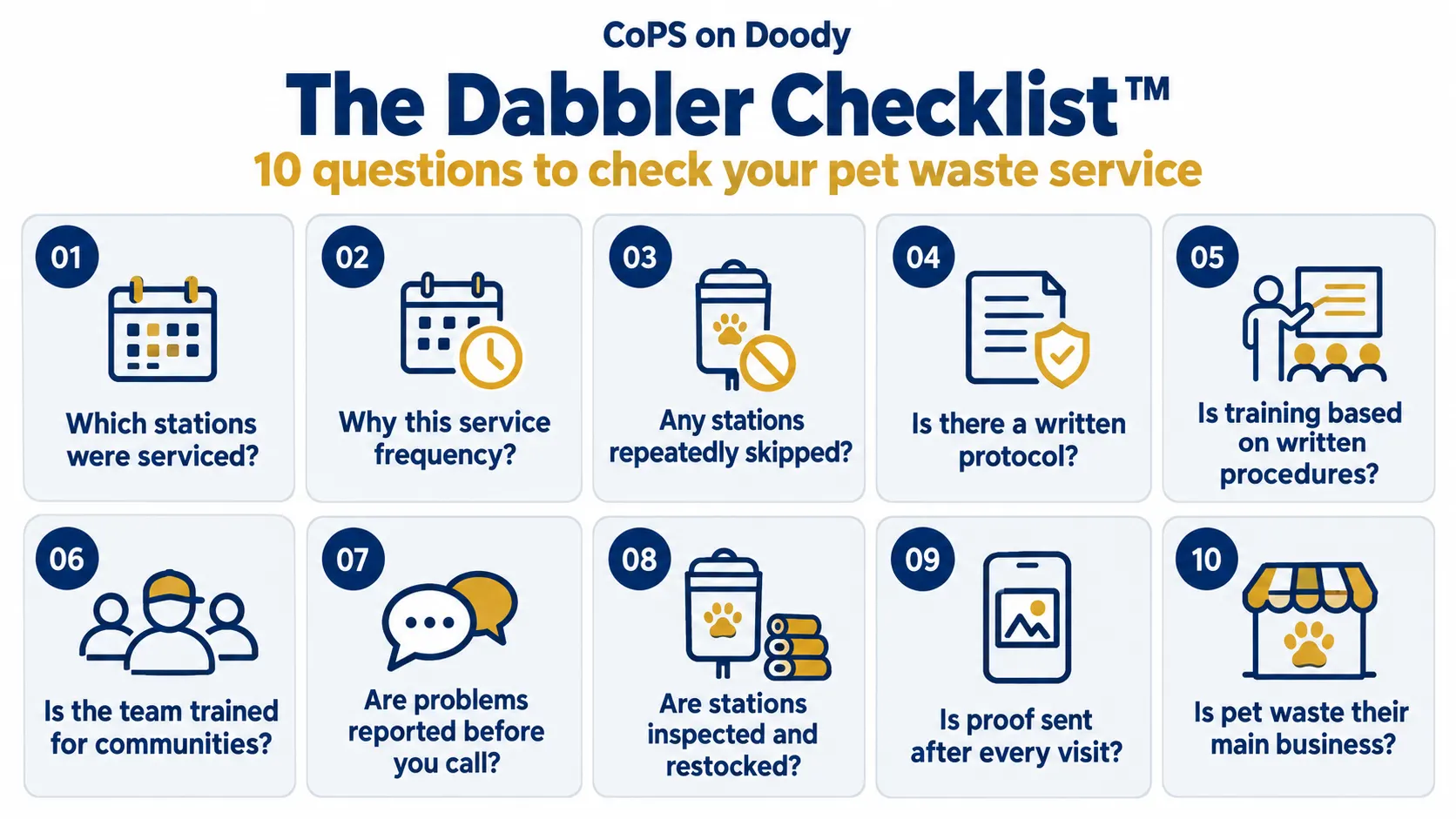
A good answer is a record by station and by date that you can see without having to ask twice. Our answer: after each visit, the community receives a completion notice for the stations on the schedule.
Frequency should come from walking the property and seeing how fast each station fills, with a reason you can repeat to your board. Our answer: we walk every community before we recommend a frequency, because every community is different. If a station needs a different frequency later, we tell the community in writing, with a proposal showing the new rate. We never change it quietly.
You can only answer this one on the property. Walk the stations a day or two after a scheduled visit and look at each one. Our answer: every station in the service agreement is on the schedule for every visit, in every season, and each visit covers the ground within six feet of the station as well as the can.
A written protocol says what happens at every station on every visit: what is inspected, what is restocked, what is recorded, and what happens when something is wrong. If a provider has one, they can send it to you. Our answer: ours is called the Community Cleanliness Protocol, and every client receives it before the first service day.
Ask what the training is called and how the provider checks that technicians meet it. Our answer: every CoPS technician earns Gold Star Certification before servicing a community and follows written procedures for each step of the visit. In the words of our training manual, "Good enough is not the standard. Consistent excellence is."
Working in a community means working around residents, children, other vendors, a board, and a manager. That's a different job from a backyard route. Our answer: we service communities only, not backyards, and our technicians are trained for that setting.
Your provider is at the stations more often than anyone on your staff, so it should usually be the first to spot damage and tell you. Our answer: we report damaged stations and recommended repairs to the community, and we commit to a three-business-hour issue response for problems you report between visits.
Look at the dispensers. A station should never run out of bags. Our answer: every visit includes restocking bags, replacing the can liner, picking up waste on the ground near the station, and inspecting the station itself, down to tightening loose hardware.
An invoice shows what you were billed for, which isn't the same as what was done. Ask to see a visit record from a recent month before you rely on it. Our answer is the same completion notice, sent after every visit rather than once a month with the bill. For what a useful record should include, see our guide to pet waste proof of service.
Ask what else the company does and who services your community. Our answer: CoPS on Doody specializes in professional pet waste management for community associations, apartment communities, and public spaces, and the people who service your stations work on communities, not residential routes.
Answering the ten ourselves showed us where each answer lives. Some questions need a document, some need a walk, and some come down to how a company is organized. That matters for you, because it tells you what to ask for.
When a provider can show you the document or walk the stations with you, you have an answer. When they can only describe it, write the question down and ask for it in writing.
It's free at copsondoody.com/dabbler-checklist. It's one printable page you can take on your next service walk.
A "no" or an unclear answer marks a place where service isn't being verified. Bring it to your provider and ask them to show you the answer in writing. Many providers can fix a gap once they know it matters to you.
Yes, with one change: ask for samples. A new provider can't show you your own records yet, but they can show you their protocol, a sample record from another community, and how their technicians are trained.
Because we ask managers to hold every provider to the same standard. Here's the standard. Evaluate every provider against it, including us.
The Dabbler Checklist™ asks ten questions about proof of service, frequency, skipped stations, written protocols, training, community experience, proactive reporting, station accountability, documentation, and specialization. When we answered all ten about our own service, the lesson was where each answer comes from: five need a document, two need a walk, and three depend on how the company is organized. Ask your provider for the document or the walk, and you'll know where your service stands.


.png)



.png)
.png)

