

Five questions, asked in your first conversation with a pet waste provider, tell you most of what you need to know: who will service your community, how often each station gets serviced and why, what you receive after each visit, who reports a problem first, and what the provider puts in writing before the first visit. Each question lines up with one part of The Specialist Standard™, and each answer is something you can check later.
Ask them of any provider you're considering, and of the one you have now. We hope you'll ask us every one.
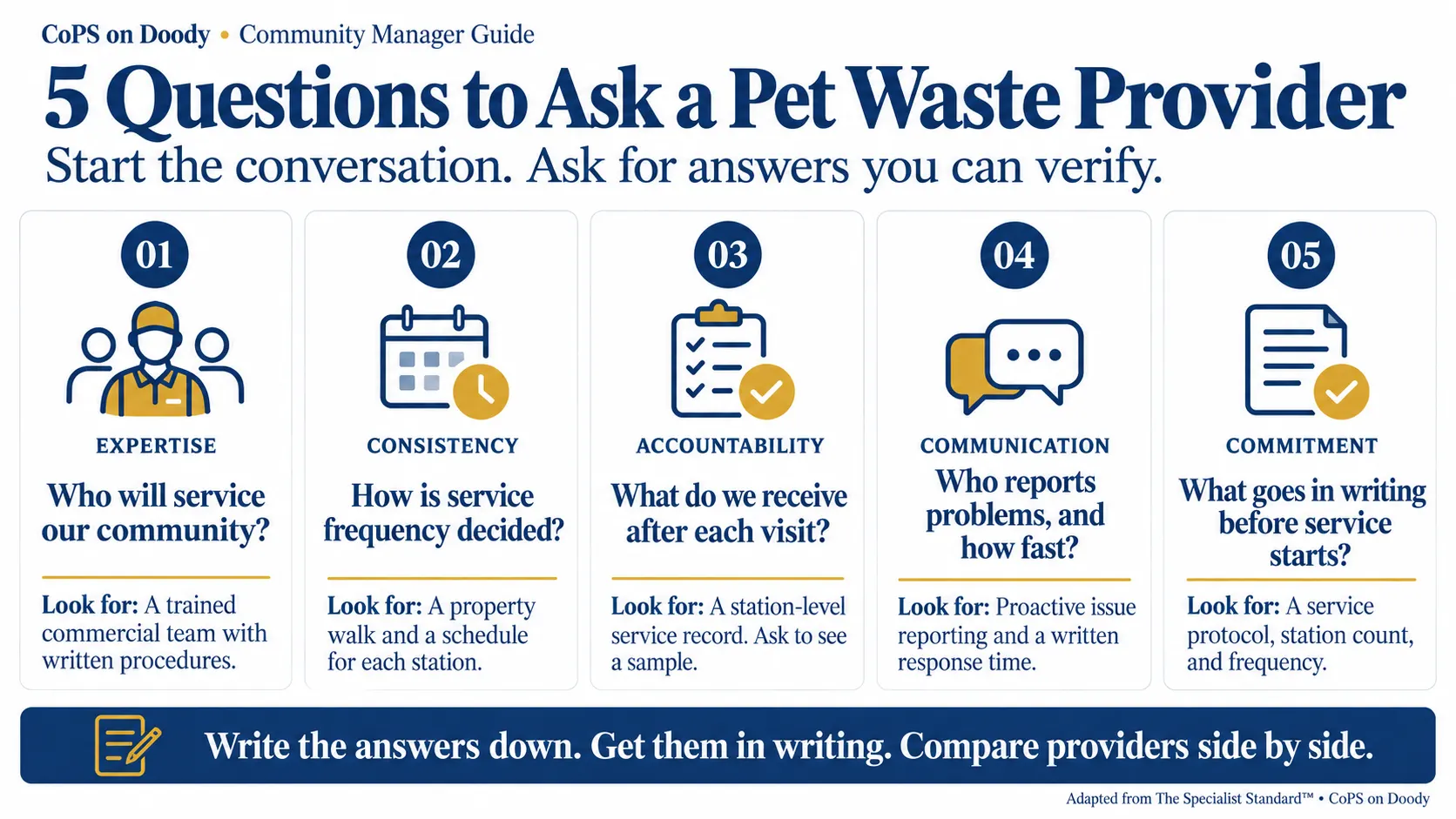
This is the expertise question, and it's the first one we'd ask any provider. It tells you whether pet waste is the company's main work or a service added to something else.
Follow-up: "What separates your technicians from a lawn crew or a janitorial team that also picks up pet waste?" A provider that has thought about this will have a specific answer.
This one covers consistency. Frequency should come from looking at your community: where residents walk their dogs, how fast each station fills, and how the property is laid out. Every community is different, so the answer should start with a walk of the property.
More service isn't automatically better service. Ask what problem a higher frequency is meant to solve.
For accountability, ask about the record. You want something that shows what was done at each station, and the invoice doesn't.
A sample takes a minute to send. If a provider can't show you one, ask why. Our guide to pet waste proof of service covers what a useful record includes.
This one tests communication. Damage and overflow are easiest to catch on a service visit, so the provider should usually be the one reporting them. It should also have a stated response time for problems you report.
CoPS on Doody, for reference, commits to a three-business-hour issue response.
Commitment is about what exists on paper before service starts: what happens at every station on every visit, how often, and how problems get handled. A specialist's standard should hold for as long as it services your community.
Ask all five in the first conversation and write the answers down in the provider's own words. Then ask the provider to confirm the important ones in writing, especially the frequency, the record you'll receive, and the response time. Written answers are the ones you can point back to later.
If you're comparing several providers, put their written answers side by side. Our guide to comparing pet waste proposals shows how to line up price and scope. If you decide to change providers, How to Switch Pet Waste Companies covers the handoff.
These five come from The Provider Interview Guide™, which has 15 questions in total, with a specialist's answer and a follow-up flag for each.
A first call is short, and these five cover the parts of service that are hardest to see on a proposal. Save the rest of the 15 in The Provider Interview Guide™ for the follow-up meeting.
Yes. The answers tell you whether your current service meets The Specialist Standard™, and they give your provider a fair chance to show you the paperwork behind the service you already pay for.
Treat anything that isn't in writing as unconfirmed. A provider confident in its service usually has the protocol, the sample record, and the response time on paper already.
Yes, all five, in writing. We built the guide for community managers to use on every provider they're considering, including us.
Five questions in the first conversation separate a pet waste specialist from a dabbler: who services the community, how frequency is set, what you receive after each visit, who reports a problem first, and what goes in writing before the first visit. Each one covers one part of The Specialist Standard™, and each answer can be checked afterward. Write the answers down, ask for them in writing, and compare providers on what they can show you.


.png)



.png)
.png)

