
A pet waste dabbler is a company that services pet waste stations as a side job. In community associations and apartment communities, it's usually one of four kinds of business: a janitorial or property maintenance company, a landscaper, a residential pet waste service, or a company that sells stations and offers service with them.
None of them are bad businesses, and many do their main job very well. Pet waste just isn't that job. On a property with dozens of stations, the gap may show up in ways you can see on a walk. Let us walk you through each type, the signs to look for, and what to ask.
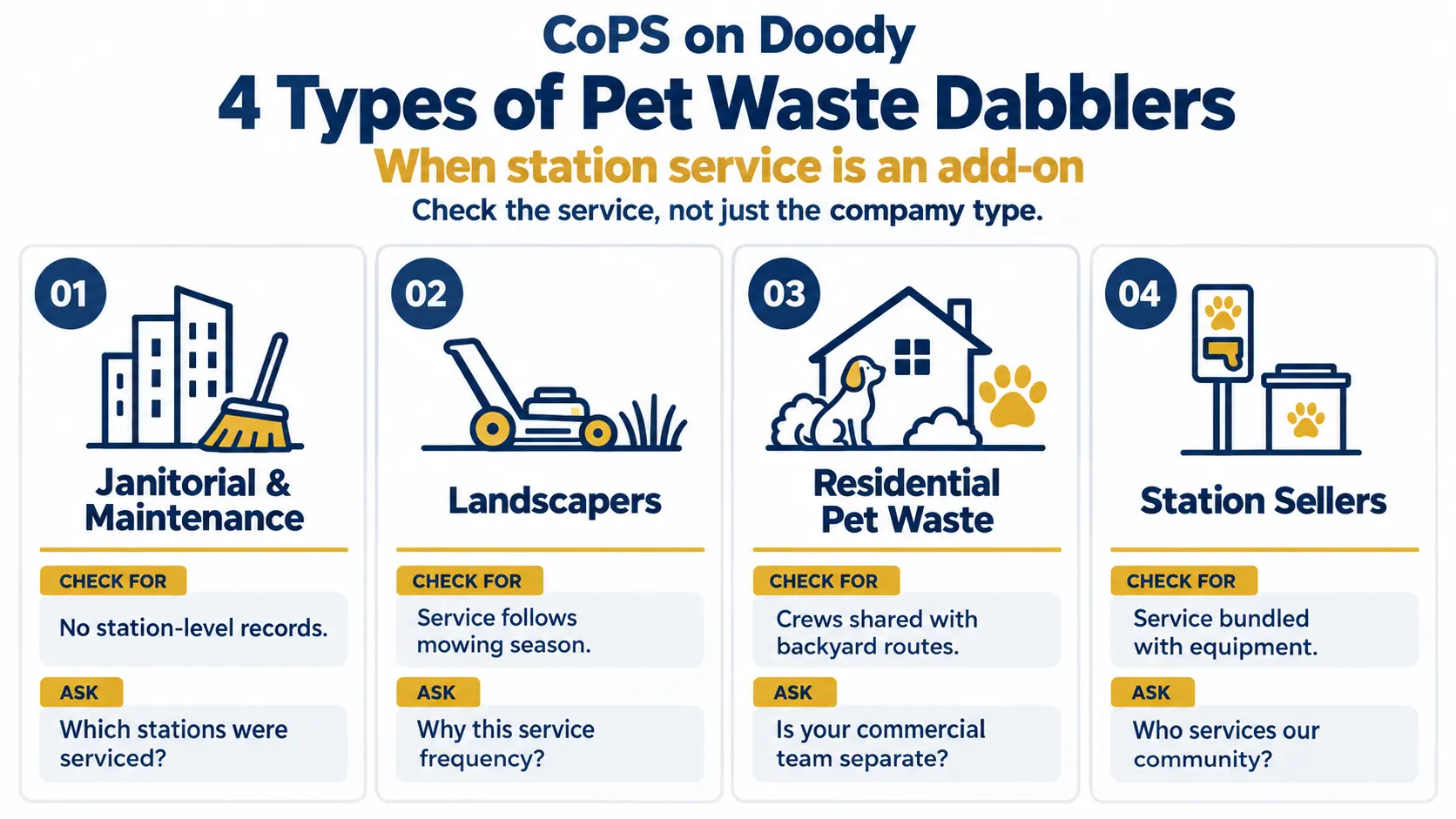
A dabbler offers pet waste service without the systems, training, or station-level records that community work requires. The word describes how the work fits into a company's business. It says nothing about how hard anyone works.
Station service looks simple from the parking lot. On a community with 30 or 40 stations, it comes down to consistency: every station serviced on every visit, in every season, at a frequency set by how fast each one fills, with someone keeping track. A company organized around other work may never have had a reason to build that system.
These companies already work on the property. They clean the clubhouse, the fitness center, and the common areas, so adding the stations to their contract is convenient for everyone. Their crews are trained for building upkeep and indoor cleaning. Route-based station service, station locations, and station-by-station records usually sit outside that training.
What you may notice:
Landscape crews are on site every week during the growing season, so stations often get folded into the landscaping agreement. The crews know turf, beds, and irrigation. Their calendar follows the mowing season, while residents walk their dogs all year.
Plenty of landscapers can empty a can. Servicing every station neatly and correctly, every week from January to December, takes a different setup.
What you may notice:
These companies know pet waste. Their core work is backyards. A single-family yard is one client and one gate. A community association may have dozens of stations, a board, a manager, and residents who notice an overflowing can before anyone else does. Commercial work needs its own scheduling and records, and a lot more communication with the client. A company built on residential routes may bring residential habits to commercial work.
What you may notice:
Some companies sell the equipment (stations, bags, and signs) and offer service as part of the order. Making a good product and servicing a community every week are different skills. A seller without its own field operation may not have the scheduling and supervision that keep service steady over the life of a contract.
The equipment can show it too. Stations designed by people who never service them may have:
Natural Pet Partners, the product design arm of Foresight USA, works the other way around. CoPS technicians find problems in the field, and NPP designs stations to solve them.
The root cause is the same in all four: there's no system built to account for each station on each visit. Without one, a skipped station can go unnoticed, frequencies drift, and you hear about problems from residents before you hear from the provider.
Recognizing a type is not a reason to switch providers. Some communities are well served by companies whose main business is something else. Start with the provider you have, and ask them to show you three things in writing: how they decide how often each station is serviced, what record you receive after each visit, and how they tell you about a problem between visits.
If the answers are clear and match what you see on the property, that's a good sign. If they aren't, two free resources can help. The Dabbler Checklist™ gives you ten yes-or-no questions to answer on your next property walk. The Specialist Standard™ describes what good service looks like in five areas you can check. For the full picture of each type, with the warning signs and five questions to ask your current provider, download The Dabbler Problem™ Field Report.
No. The word describes how pet waste fits into a company's business, not the quality of its main work. A landscaper may do excellent grounds work and still treat the stations as an add-on.
Some do. Ask them the same questions you would ask any provider: how they set the frequency for each station, what record you get after each visit, and who reports problems. Answers you can see in writing tell you more than answers on a sales call.
For a specialist, pet waste service for communities is the main business. The provider can show you a written service procedure, a record of each visit, and technicians trained for community work. The Specialist Standard™ lists five areas to check.
It's free at copsondoody.com/dabbler-problem-field-report. It covers each type in more detail and ends with five questions to ask your current provider.
Four kinds of companies commonly service pet waste stations as a side job: janitorial and maintenance companies, landscapers, residential pet waste services, and station sellers. None of them are bad businesses, and some handle stations well. Each type leaves its own signs on a property, and they share a root cause: no system for accounting for every station on every visit. Ask your provider to show you how service is scheduled and recorded, and how problems get reported to you. The answers will tell you what kind of provider you have.


.png)



.png)
.png)

