

Five things separate a pet waste specialist from a provider that does it on the side: consistency, accountability, communication, expertise, and commitment. Each one is something you can check on your property or in writing. Together they make up The Specialist Standard™, a benchmark you can use when comparing any provider.
We didn't write the standard to describe ourselves. It describes good service, whoever provides it. Here's the standard. Evaluate every provider against it, including us.
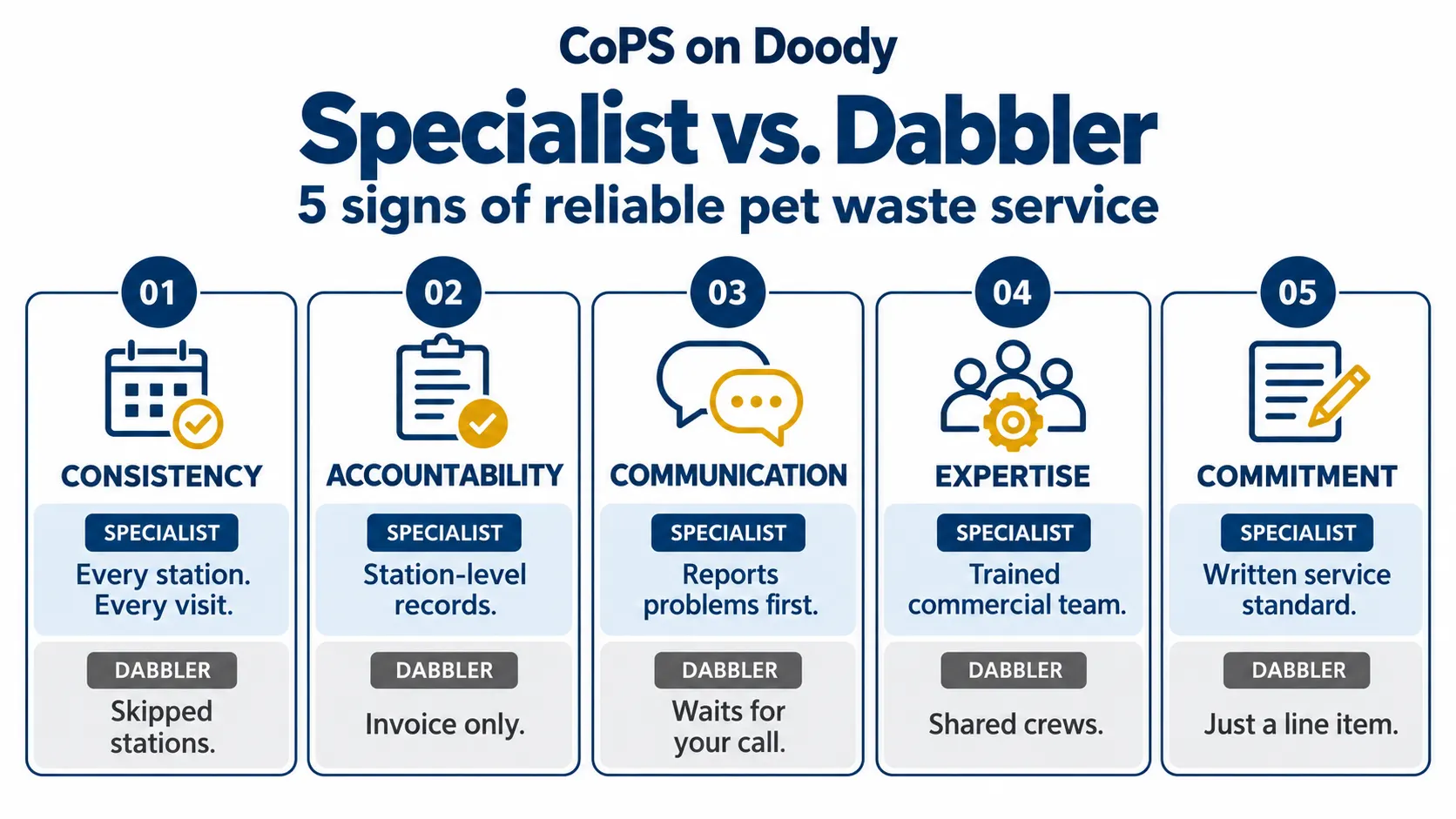
Consistency means the service doesn't depend on the season or on who shows up. Every station on the schedule gets a complete visit, and the frequency for each station has a reason behind it.
A specialist services every station on every visit, year-round, at a frequency set after walking the property. A dabbler's service may follow another calendar, such as the mowing season or a residential route, and the same station can be skipped visit after visit.
Check it: walk the stations a day or two after a scheduled visit. Every one should look serviced, including the ground around it.
Accountability means you can see what was done at each station. A crew showing up at the property doesn't tell you that, and neither does an invoice. A record of the visit does.
A specialist keeps a record of each visit, station by station, and works from a written protocol that says what gets inspected, restocked, and recorded. A dabbler may send an invoice and little else, and the stations themselves can give it away: a dispenser packed full so it doesn't need attention for weeks is a sign that nobody is looking at each station.
Check it: ask for the record from the last visit and compare it to what you see on the property. Our guide to pet waste proof of service covers what a useful record includes.
The people who service your stations every week see a broken lid, a leaning post, or a station that keeps overflowing before anyone else does. Communication means they tell you.
A specialist flags damaged stations and recommended repairs before you have to call, explains every recommendation in writing, and commits to a response time for problems you report. CoPS on Doody, for reference, commits to a three-business-hour issue response. A dabbler tends to respond only when the manager calls.
Check it: think back to the last time your provider reported a problem you didn't already know about.
"Anyone can do the job. Not everyone does it right." That line comes from our technician training manual, and it's the difference this dimension measures.
A specialist sends a team trained for commercial community work, following written procedures for each step of the visit, and its main business is pet waste service. A dabbler shares crews with residential routes or other trades, and the training covers that other work. At CoPS, every technician earns Gold Star Certification before servicing a community.
Check it: ask who will service your community and what else that team services.
Commitment means the provider puts its standard in writing before the first visit and holds to it for as long as it services your community. As our training manual puts it, "Good enough is not the standard. Consistent excellence is."
A specialist gives you a written service standard before the first visit, and its technicians are held to written procedures. For a dabbler, pet waste may be one line in a broader contract, with no standard of its own.
Check it: ask your provider for its service standard in writing. If pet waste is only a line item in a larger contract, that is your answer.
Use the table on your next property walk. Where the answer is a document or something you can see on the property, the standard is being met. Where it's a verbal reassurance, ask for it in writing.
The stations at your community were designed by someone. The question is whether that someone has ever had to service one.
Natural Pet Partners, the product design arm of Foresight USA, designs stations around what CoPS technicians find in the field. That's where features like these came from:
CoPS identifies problems in the field, and NPP designs the solutions.
It's a two-page reference guide that defines best-in-class pet waste management in five areas: consistency, accountability, communication, expertise, and commitment. Each area comes with markers you can check on your own property. It's free at copsondoody.com/specialist-standard.
Yes, and many do. A landscaper may be very consistent in summer, or a residential company may know pet waste well but keep no station-level records. The standard is useful because it shows you exactly which areas to ask about.
The Dabbler Checklist™ shows you where service isn't being verified today. The Specialist Standard™ shows you what it should look like. Use the checklist first, then the standard when you compare providers.
We hold ourselves to it, and we ask you to check us the same way you'd check anyone: ask for the document, or walk the stations with us.
Five things separate a pet waste specialist from a dabbler: consistency at every station in every season, accountability you can see station by station, communication that reaches you before residents do, expertise from a team built for community work, and a commitment in writing before the first visit. None of them depend on a sales pitch. Each one can be checked on your property or in a document. Hold every provider to the same five, including us.


.png)


.png)
.png)

