
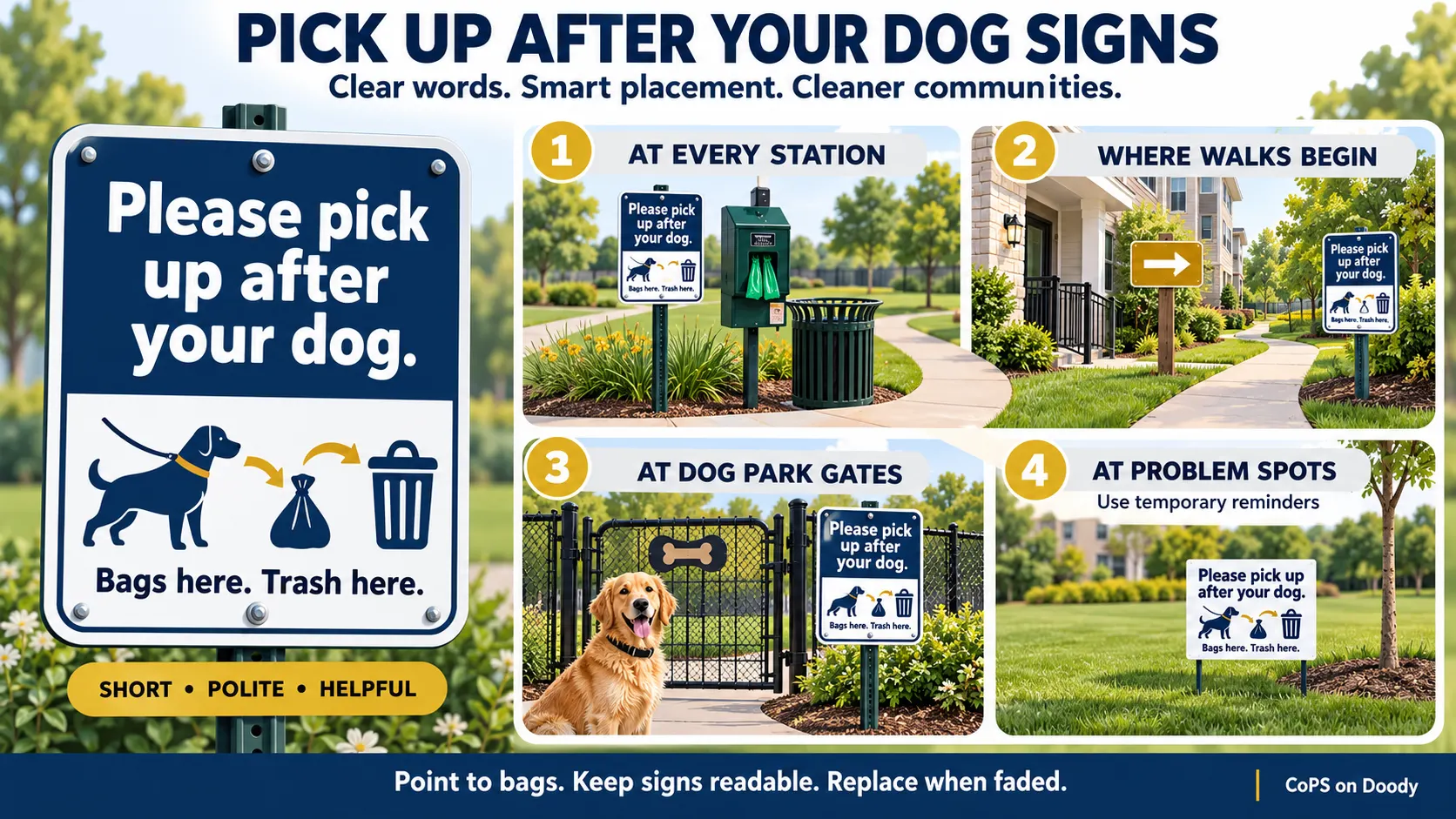
The "pick up after your dog" signs that work in a community say one thing, say it politely, and sit where the decision gets made: at the station, where walking routes begin, and at the spots where waste keeps turning up. A good sign tells a resident what to do and where the nearest bags are. A bad one scolds, threatens a fine the association may not be able to impose, or cites a county law that doesn't reach private common areas.
This guide covers what to say, what to leave off, where to put signs, and how big to make them, with ready-to-use wording for station, wayfinding, dog park, stormwater, and bilingual signs, plus a placement plan you can take to your board.
Five rules cover almost every sign a community needs.
One message per sign. "Please pick up after your dog" is a complete sign. Adding the leash rule, the hours, the fine, and a thank-you turns it into a paragraph nobody stops to read.
Say the action, not the problem. "Please pick up after your dog" works better than "Dog waste is a problem here." Tell people what to do.
Tell them where the bags are. The most useful words on a sign are often "Bags and trash 50 feet ahead." A sign that points to a solution works as a reminder; one with no station in sight reads as a scolding.
If you cite a rule, cite your own. Your declaration or rules are what the association can enforce. More on county codes below.
Keep the tone respectful. Most residents already pick up. The sign is for the ones who forget, and shaming language tends to irritate the people who were doing the right thing all along.
The research backs these rules up. In a well-known field experiment at Petrified Forest National Park, a sign saying many past visitors had taken petrified wood was followed by far more theft, about 7.9% of marked pieces, than a simple "please don't" sign, at 1.67%. Telling people that many others misbehave makes misbehaving sound normal. For dog waste specifically, a North Carolina State University survey of 757 Raleigh residents found that people preferred positive appeals to responsibility and community, rated guilt-based messages poorly, and said humor did little to persuade them. The biggest barrier they named was not having a bag or a trash can nearby. In Albuquerque, residents who had seen the "There Is No Poop Fairy" campaign signs were more likely to report picking up after their dogs. And in the United Kingdom, Keep Britain Tidy reported an average 46% drop in dog fouling at trial sites that used glow-in-the-dark "watching eyes" signs. That's a campaign's own reported result, but it lines up with peer-reviewed research suggesting that images of eyes can reduce littering.
Pick the sign type, then the wording. Keep the community name and logo small; the message is what people need to read.
If a meaningful share of your residents speak Spanish at home, a bilingual sign reaches more of them for little added cost. The share is higher than many boards expect. According to the Census Bureau's 2020 to 2024 American Community Survey, about 20% of Gwinnett County residents age 5 and older speak Spanish at home, along with about 18% in Montgomery County, Maryland, 14% in Fairfax County, and 11% in Loudoun County. In Montgomery, Fairfax, and Gwinnett, roughly two in five residents speak a language other than English at home.
Have a fluent speaker in your community or your sign vendor check the final wording before you order.
Fines you can't impose. In the NC State survey, respondents rated a specific, stated fine as more persuasive than a vague threat. But a fine on a sign sets an expectation. If your association can't actually levy it, or can't levy it without notice and a hearing, the sign undermines your credibility the first time someone asks whether the fine is real. In Georgia, an association can fine only if its governing documents grant that power. In Virginia, the statute caps violation charges at $50 for a single offense or $10 per day for a continuing one. Our HOA violation letter templates walk through what each jurisdiction requires before a fine.
County codes that don't apply. It's tempting to put an ordinance number on a sign for weight. Check first whether it reaches your property. County rules in our markets don't all reach private common areas, and at least one county's animal control ordinance has no pickup requirement. Here's what we found.
The safest sign cites your community's own rule, which the association adopted and can enforce. In Virginia, for example, the board has statutory power to adopt rules for the use of common areas, and those rules must be reasonably published or distributed throughout the development. A sign can reinforce that notice; ask counsel whether it satisfies the publication requirement.
"Lots of people don't pick up." It sounds like a call to action, but the Petrified Forest research suggests it does the opposite: it tells readers the behavior is common.
Shaming or threats. "We know who you are," photos of offenders, and "violators will be prosecuted" make a community look hostile to the residents who follow the rules, and they promise consequences nobody is going to deliver.
Jokes at residents' expense. A light, friendly line can work. A joke that mocks the reader usually doesn't, and it's the sign people photograph and post online.
Gross-out detail. Bacteria counts and disease warnings rarely change behavior on a two-second read, and they make a common area feel dirty. Keep the message about what to do.
The best spot for a sign is wherever someone is about to decide whether to pick up. In a community, that means four kinds of places.
At every station. A sign on or beside the station tells residents what it's for and makes the station easier to spot. It's also the first thing to check on a property walk: a faded or missing station sign makes the whole station easier to ignore.
Where walking routes start. Building exits, trailheads, community entrances, and the gates to common lawns. This is where a resident decides which way to walk, and a sign there can point them to the nearest station.
At relief areas and dog park gates. Anywhere dogs gather. Put the sign outside the gate, so people see it before they go in.
At problem spots, temporarily. Where waste keeps showing up, a sign pointing to the nearest station is a cheap first fix. If the problem continues, ask whether a station belongs there.
Public stormwater guidance points the same way. The EPA recommends posting signs where people bring their pets, placing educational signs next to pet waste stations to explain what they're for, and posting maps along walking routes that lead people to the stations. Minnesota's Pollution Control Agency recommends signs at park entrances and on the bag dispensers themselves, noting that signs act as on-site reminders.
At a true hot spot, more than one sign can help. Keep Britain Tidy's trial used roughly one sign every 25 meters, about 80 feet, at its problem sites.

No sign standard was written for pet waste signs, but three common references are useful.
Letter height. The United States Sign Council's rule of thumb is that one-inch capital letters are legible at about 30 feet, an average that varies with the font and conditions, and the federal traffic sign manual uses the same ratio, one inch per 30 feet, as a minimum for road signs. So a sign meant to be read from 30 feet along a path needs capitals at least an inch tall. One meant to be read from 60 feet across a parking lot needs two inches. A message set entirely in capitals is harder to read than mixed case, so if you use all caps, make the letters a little taller.
Mounting height. The traffic sign manual puts post-mounted signs on shared-use paths at least 4 feet from the ground to the bottom of the sign, and at least 2 feet back from the edge of the path. Keep Britain Tidy's trial mounted signs at roughly eye height. For most station and route signs, aim to put the message between about 4 and 6 feet up, where someone walking a dog naturally looks.
Accessibility. The 2010 ADA Standards set rules for signs that give information about a site's facilities: a non-glare finish, strong contrast, no script or decorative fonts, minimum character heights, and characters at least 40 inches above the ground. Strictly residential areas are generally outside the ADA's public-accommodation rules, but areas open to the public, like a leasing office, are covered. Following the ADA's visual rules costs nothing extra and makes signs easier for everyone to read. Ask counsel whether they're required at your community.
Use high contrast. Dark letters on a light background, or the reverse. Avoid busy backgrounds and thin script fonts.
Pick durable material. Aluminum or a weather-rated composite holds up outdoors. Paper and laminated sheets fade within a season.
Replace when faded. Add sign condition to your monthly walk. A sun-bleached sign suggests nobody is paying attention.
Start with one sign at every station, one where each main walking route begins, and one at each relief area or dog park entrance. Add temporary signs at problem spots, and take them down once the problem is solved, so they don't become part of the scenery. If you find yourself adding a sign every month, step back and look at station placement and resident communication instead.
To see whether a new sign is working, count the waste at a problem spot on the same weekdays for a week before you post it, then again a few weeks later. The EPA suggests the same before-and-after approach for public pet waste programs.
☐ Get board approval, and architectural review approval if your documents require it for common-area signs.
☐ Mark every sign location on a site map.
☐ Have underground utilities marked before anyone digs a post hole.
☐ Confirm the rule section number you're citing is current.
☐ Order bilingual versions where they make sense.
☐ Add every sign to your sign inventory, so the monthly walk checks it.
A sign works as a reminder when the station is there and stocked, when residents have heard the expectation through the newsletter and the welcome packet, and when the association follows up consistently on the few people who still don't pick up. If you're writing the reminder, our 12-month HOA newsletter calendar has ready-to-paste pet corner paragraphs, and our guide to where pet waste stations should go covers the station side.
Take this to your board with the site map. It doubles as the sign inventory for your monthly walk.
One short, polite instruction, such as "Please pick up after your dog," plus where to find bags and a trash can. If the sign cites a rule, cite your community's own rule section.
The available evidence suggests they can help, especially when they're positive and point to a nearby station. Residents who'd seen Albuquerque's campaign signs were more likely to report picking up, and UK trials of "watching eyes" signs reported large drops in dog fouling at problem sites. Signs work best alongside stations in the right places and regular reminders.
Only if your association can actually impose that fine under its documents and state law, and only with the amount your fine schedule sets. Otherwise, cite the rule and leave the fine to your enforcement process.
That depends on your community's sign rules and architectural guidelines, which often regulate signs on lots. Point owners to the rule, and if the problem is on a common-area route, address it with a station or a community sign instead.
If a meaningful share of residents speak another language at home, a bilingual sign is an inexpensive way to reach them. Check your community's demographics or ask your leasing office.
The evidence on humor is thin: Raleigh residents said it did little to persuade them. A friendly, light line won't hurt as long as it doesn't mock anyone, but keep the instruction clear first.
"Pick up after your dog" signs work when they're short, polite, and placed where residents make the decision: at the station, where routes start, at relief areas, and at problem spots. Point to the bags, cite your own rule if you cite anything, size the lettering for the distance, and replace signs when they fade. Then let the stations, the reminders, and the enforcement process do the rest.
Sources (all retrieved 2026-10-02):