
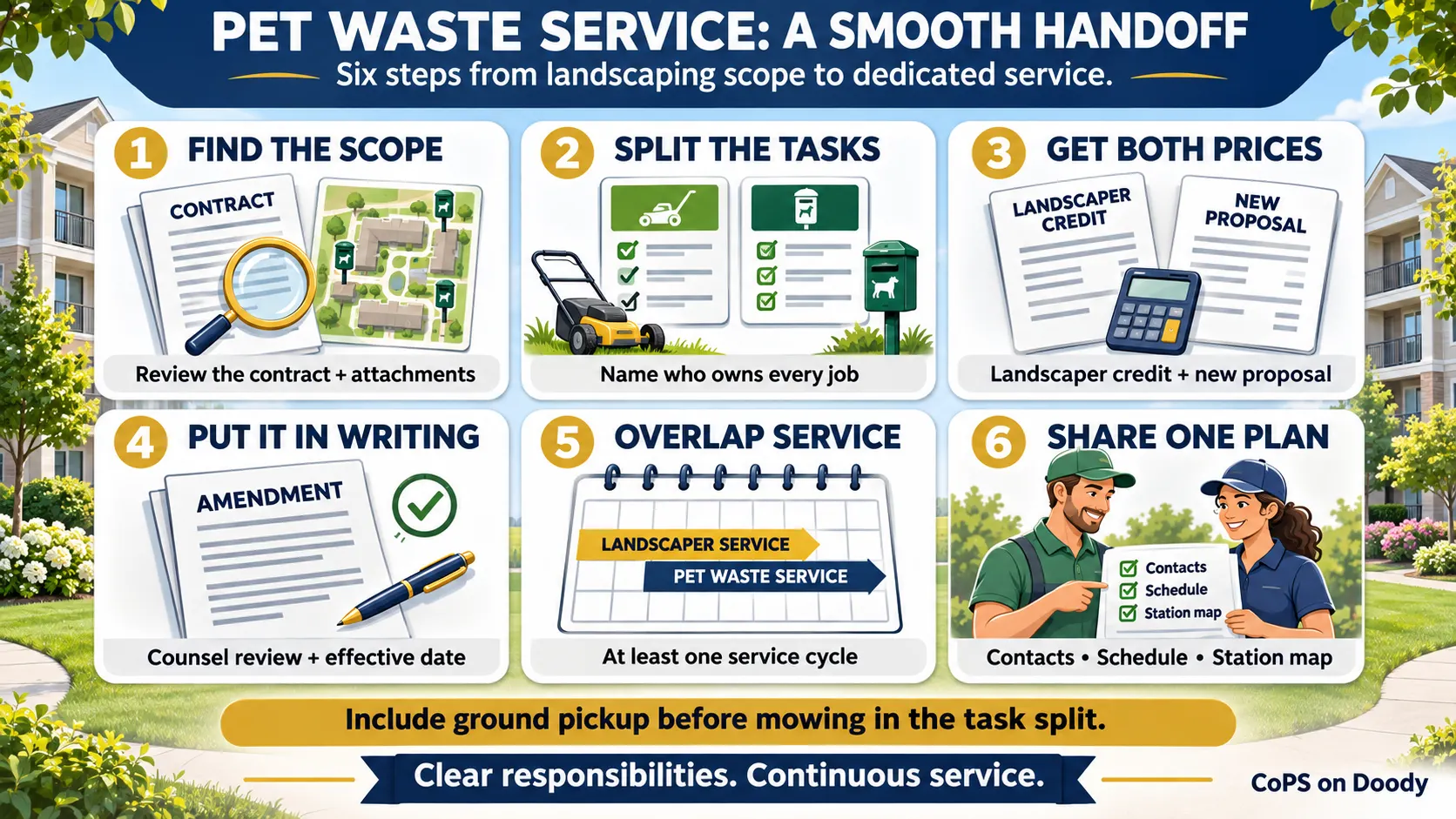
In many communities, pet waste station upkeep lives inside the landscaping contract, as one line in the scope or as something the crew just started doing. Moving it to a dedicated provider is mostly paperwork, and careful paperwork helps avoid a week where nobody owns the stations. Find what the contract says now, decide exactly which tasks move, put both prices in front of the board, amend the contract in writing, overlap the start and end dates, and give both vendors one page that says who does what.
Your landscaper may handle this well. Pet waste is still its own kind of work, with its own schedule, supplies, and standards, and many landscaping contracts were never written to define or measure it. This guide walks through the handoff in six steps, with a scope inventory, a task split, sample amendment language, a transition timeline, and a coordination sheet.
A common reason is that nobody can say what the community is getting. When pet waste is folded into a landscaping scope, it often has no stated frequency, no supply standard, and no record of what was done on each visit. It may move with the landscaping season rather than with how fast the stations fill. Plenty of landscapers handle this well, and practices vary by operator, so ask rather than assume.
Ask the same five questions of whoever holds the work now, and of anyone you're considering.
The other reason is cost. When the work was never priced on its own, nobody can say what it costs. Step 3 puts both numbers on paper.
Read the landscaping contract, including every exhibit and attachment. Search for these words: pet waste, dog waste, station, dispenser, bags, receptacle, trash, litter, debris, and common area cleaning. Take your time on this step. The CAI Foundation's 2023 best practices report on community association maintenance says projects usually go wrong when the scope of work is inadequate. Then fill in this inventory.
If the contract never mentions pet waste and the crew does it anyway, write that down too. Work that isn't in the contract is work the community is relying on without any written commitment behind it.
Decide, task by task, who owns what after the handoff. Ambiguity is where gaps come from: if the landscaper thinks the new provider is picking up ground waste and the new provider thinks it's limited to the stations, the waste stays on the lawn until someone complains.
A split that works for many communities:
Settle the pre-mowing pickup in writing. Landscape maintenance specs routinely require the crew to clear trash, sticks, and debris before each mowing. The regional specification guidelines from the Landscape Contractors Association of Maryland, DC, and Virginia say so, and so do Gwinnett County's grounds bids. Most say nothing about pet waste, and some say outright that it isn't the landscaper's job: one 2026 public landscape request for proposals assigns station emptying to the contractor and then states that pet waste in landscaped areas isn't the contractor's responsibility. If your new provider's scope covers only the stations and your landscaper's covers only litter, nobody owns the waste on the grass. Where you can, schedule the provider's service day before mow day.
Check the season, too. Some landscaping scopes tie station service to mowing visits. If yours does, ask what happens to the stations in the months the crew doesn't mow, and make sure the new provider's schedule covers all twelve.
The board needs two figures in writing before it decides.
The landscaper's credit. Call the landscaper first to explain the change, then ask for the price adjustment in writing. If the pet waste work was priced as its own line, the credit is simple. If it wasn't, ask the landscaper to state what portion of the price covered it. The answer, or the lack of one, is useful either way.
The new provider's proposal. Ask for a written proposal for the same scope, using your task split from Step 2, so the two numbers describe the same work.
Don't assume the change saves money; it may or may not. What the community should get for the price is a written scope, a regular service schedule, a stated response window for problems between visits, and a provider who answers for the stations alone. If your own maintenance staff also service some stations, our two-week pet waste time log and the guide to calculating a burdened labor rate will help you price that part. Confirm who signs for the association once the board approves.
Remove the tasks from the landscaping contract with a written amendment, signed by both parties, that names exactly what's leaving the scope, states the price adjustment, and sets an effective date. Before you draft it, read the contract's own sections on changes, notice, and termination, because they control how the amendment works.
If you want precise vocabulary, federal contracting rules offer a useful model. They define a contract modification as "any written change in the terms of a contract," and call removing part of the unfinished work a partial termination. Your association isn't bound by those rules, but the logic carries over: the change is written, signed by both parties, and specific about what's removed and when.
Use this sample language as a starting point, and have your association's counsel review it before anyone signs.
The safest handoff overlaps. Have the new provider start before the landscaper stops, so at least one service cycle is covered twice rather than not at all. That overlap cycle is paid for twice, so put it in the board packet.
The two vendors will share the same common areas every week. One page, sent to both, heads off a lot of friction.
The storm drain line has a regulatory basis. Fairfax County's pollution prevention guidance for landscapers says not to blow leaves or grass clippings into storm drains, and Gwinnett County's commercial landscaping guideline says yard waste must never be blown, swept, or dumped into storm drains or streets, under the county's illicit discharge ordinance. Pet waste travels the same route. The EPA notes that stormwater can carry pet waste left on the ground into nearby streams, lakes, and rivers.
At the next meeting, give the board the signed amendment, the credit, the new provider's proposal, the start date, and your notes from the Day 7 and Day 30 walks. Residents usually don't need a notice unless something they see will change, like new station signs or a new number to report problems. If it does, a short paragraph in the next newsletter is enough.
Often, yes, but it depends on the contract. Read its sections on changes, notice, and termination. Many contracts allow scope changes by written amendment signed by both parties. If yours doesn't address it, ask counsel before you act.
Not automatically. Ask for a written credit for the tasks that are leaving the scope. If the work was priced as its own line, the credit should match it. If it was never priced separately, ask the landscaper to state what it represents, and negotiate from there.
Whoever your coordination sheet says. Write it down. A common split is that the pet waste provider picks up pet waste in common areas on its service day, and the landscaper removes general litter and debris before mowing. Where you can, schedule the provider's service day before mow day.
Check who owns them. If the association paid for them, they're usually association property, but confirm it in the contract and say so in the amendment. If the landscaper owns them, set a removal date that falls after the replacements are in.
In Montgomery County, Maryland, the Department of Environmental Protection has installed stations for qualifying HOAs and maintained them for up to a year before the community takes over. If that's your situation, plan the handoff the same way: a station inventory, a start date, and one owner in writing. Check the county's current program terms first.
That's a separate decision. Some communities move common-area trash service along with pet waste, and some leave it with the landscaper. Either works, as long as it's written down.
Moving pet waste off the landscaping contract is a paperwork job. Find the language, draw the line task by task, get both prices in writing, amend the contract, overlap the vendors, and give both of them one page that says who does what. Do those six things, report back to the board, and residents should barely notice the change.
Landscape Contractors Association MD-DC-VA, Landscape Specification Guidelines, Part 2: Exterior Landscape Maintenance, https://cdn.ymaws.com/www.lcamddcva.org/resource/resmgr/Docs/d_lca_pt2_Exterior_Landscape.pdf
Gwinnett County, GA, Invitations to Bid BL023-24 (Feb. 6, 2024), https://www.gwinnettcounty.com/static/upload/bid/780818/BL023-24%20INV.pdf, and BL029-25 (Feb. 26, 2025), https://www.gwinnettcounty.com/static/upload/bid/801391/BL029-25%20INV.pdf
Battlefield Green Community Association (VA), Landscaping Scope of Work (2017), https://battlefieldgreenonline.com/wp-content/uploads/2018/01/BGCA_2017_Landscaping_Scope_of_Work.pdf
Waters' Edge Metropolitan District, Landscape Maintenance RFP 2026.01, https://www.watersedgemetrodistricts.org/files/d89d84ca3/2026+-+WEMD+-+Landscape+Maintenance+RFP.packet.pdf
CAI Foundation, Best Practices: Community Association Maintenance (2023), https://foundation.caionline.org/wp-content/uploads/2023/06/BestPracticesCAMaintenance.final2_.pdf
Federal Acquisition Regulation 2.101, Definitions, https://www.acquisition.gov/far/2.101, and 43.103, Types of contract modifications, https://www.acquisition.gov/far/43.103
Fairfax County DPWES, Pollution Prevention for Landscapers, https://www.fairfaxcounty.gov/publicworks/stormwater/pollution-prevention-landscapers
Gwinnett County Department of Water Resources, Commercial Landscaping and Lawn Care BMP Guideline, https://www.gwinnettcounty.com/static/departments/water/pdf/commercial-landscaping-lawn-care.pdf
U.S. EPA, Stormwater Best Management Practice: Pet Waste Management, EPA-832-F-21-032E (Feb. 2023), https://www.epa.gov/system/files/documents/2023-01/bmp-pet-waste-management.pdf
Montgomery County DEP, Pet Waste, https://www.montgomerycountymd.gov/propertycare/pet-waste