Before we ever write a number, we walk the property. Every community is different, and a proposal written from a unit count or a map can only guess at how many stations you need, where they belong, and how often they should be serviced. The walk replaces the guess with what we actually see.
That's why we call the Community Walk a service step, not a sales step. It's the same way we look at a community on every visit, and you get the findings whether or not you ever hire us.
Two communities with the same number of homes can need very different programs. What matters is the common area residents actually use, how they walk their dogs, and how the community is laid out. None of that shows up on a unit count.
Our price comes from the number of stations and how often they're serviced. If the station count or frequency is wrong, the price is wrong too, and you find out after you've signed. Walking first means the number on the proposal is built on your community, not on an average.
The walk also tells us why a problem is happening. An overflowing station may need more frequent service, or residents may be using it for household trash. It happens more than you think, and the fix is different.
A CoPS team member walks the community. Most of the time we walk it on our own and then send our recommendations. Some managers like to come along and point out the spots residents ask about. Either way works.
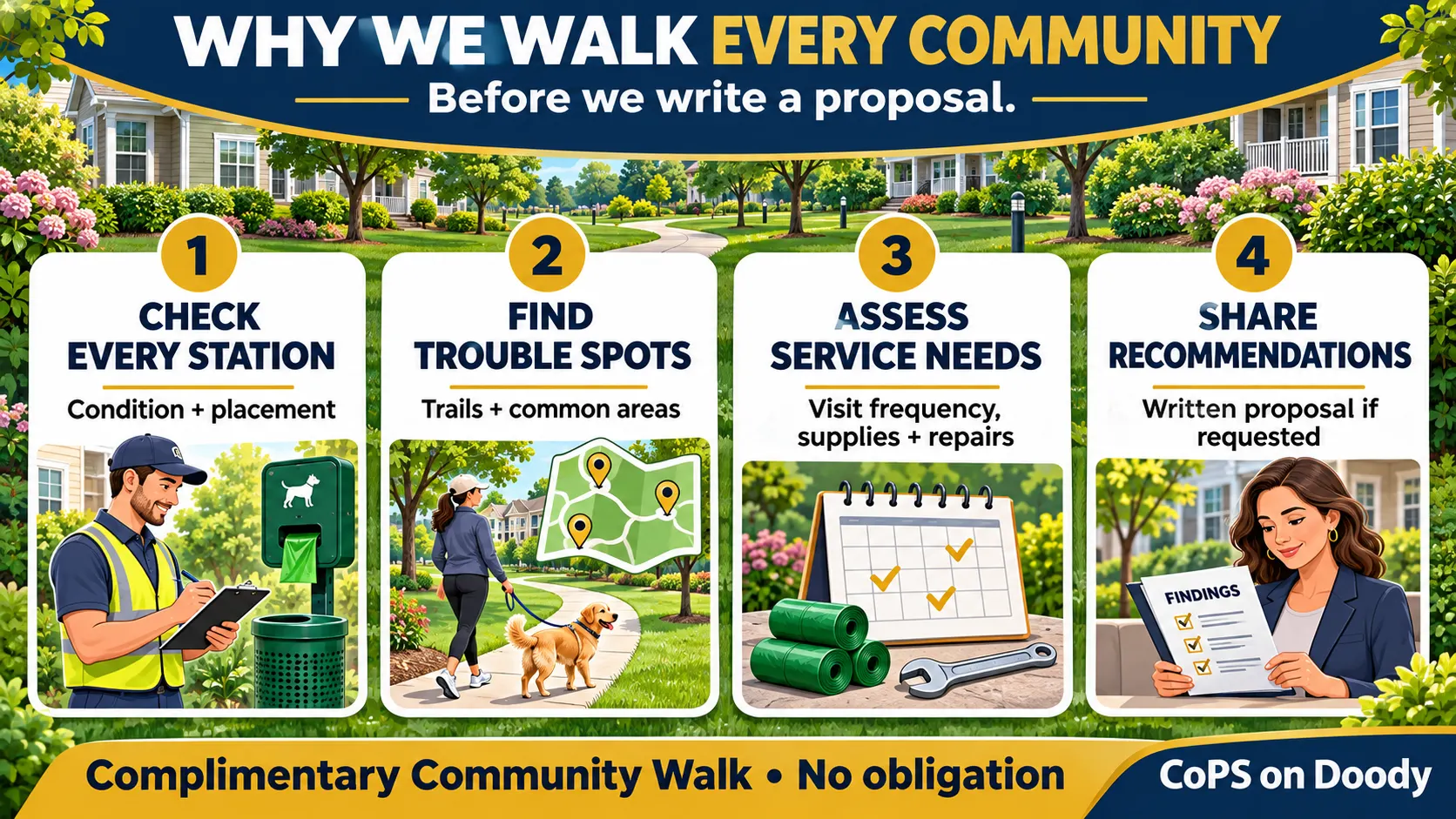
On the walk, we look at:
We document what we find, station by station. If a station is old or in the wrong place, we'll say so and suggest the model and location that suit it.
To prepare, it helps to send a sample address in the community, a map of the community's boundaries, and the locations of any existing stations or trash cans.
You receive our recommendations: what's working, what we'd change, and why. If you'd like a proposal, it states the stations, the service frequency and one flat monthly figure, so your board can see exactly what it's approving.
That's the end of the ask. If you're happy with your current provider, the walk gives you an outside view of your program to share with them. If you're comparing providers, use The Specialist Standard™ to hold every proposal to the same benchmark, including ours.
If you'd rather look first on your own, our guide to assessing your pet waste program covers what to check on your own.
Yes. It's complimentary, with no obligation and no pitch. Any community in our DC metro and Atlanta metro service areas can request one.
No. Most of the time we walk the community on our own and send you our recommendations. You're welcome to join us if you'd like to.
No. Some communities use the findings to talk with their current provider. Our post on what happens when you switch pet waste providers covers the next steps if you decide to change.
A sample address in the community, a boundary map, and the locations of any existing stations or trash cans.
We walk every community before we write a proposal because the right station count, placement and frequency can only come from the property itself. During the walk we look at every station, the problem areas, and the supply and maintenance needs, and we document what we find. You receive our recommendations either way. The walk isn't a sales demonstration. It's how we work.