Almost every apartment community and HOA in DC metro and Atlanta already has a pet waste policy. It is probably in the lease addendum, somewhere between the parking rules and the noise ordinance. It says residents must clean up after their pets. It references fines for non-compliance. It may mention designated relief areas. And if your community is experiencing chronic pet waste complaints, the policy almost certainly is not the part that is failing.
What fails is the gap between the written policy and the operational infrastructure that makes the policy possible to follow. A policy that tells residents to use pet waste stations does not work when the stations are empty. A policy that defines relief areas does not work when those areas are not marked, maintained, or positioned where dogs actually walk. A policy that references fines does not work when no one has the time or documentation to issue them consistently.
A well-written pet waste station management policy is not just a resident-facing rule document. It is an operational framework that defines what the property will provide, how residents are expected to behave, how vendors will be held accountable, and how compliance will be enforced. This guide walks through how to write one from the ground up and how to avoid the seven most common omissions that render most community pet waste policies unenforceable before they are ever tested.
TL;DR Key Takeaways
- A pet waste policy that only addresses resident behavior without defining property infrastructure obligations is structurally unenforceable.
- The policy must specify station count, placement standards, service frequency, and vendor accountability terms — not just resident rules.
- Vague language like 'residents should clean up promptly' creates friction without creating compliance. Specific, measurable language does.
- The vendor service agreement and the community policy must be aligned — what the policy promises residents, the vendor must deliver.
- A complete policy has six sections: scope, infrastructure standards, resident rules, enforcement procedures, vendor accountability, and amendment process.
- The most commonly missing section is vendor accountability — which is also the one that determines whether everything else works.
Why Most Pet Waste Policies Fail Before They Are Ever Enforced
The failure mode is predictable. A property manager or HOA board drafts a pet waste policy usually by modifying a template from a property management association, a legal source, or a prior community and adds it to the lease or community rules. The policy addresses what residents must do. It does not address what the property must provide, what the vendor must deliver, or how compliance will be documented and acted upon.
This is the structural gap. A policy written entirely from the resident's perspective creates an asymmetric accountability model: residents are held to a defined standard, but the property and its vendors are not. When residents raise complaints and they will the property has no framework to evaluate whether the problem is resident behavior, station management failure, or vendor non-performance. It responds reactively to each complaint individually, and the underlying problem persists.
The Core Principle
An enforceable pet waste policy sets three accountability obligations simultaneously — not one. Residents are accountable for cleanup behavior. The property is accountable for infrastructure standards. The service vendor is accountable for service delivery. A policy that only defines one of these three will fail at the other two.
Step 1: Define the Policy's Operational Scope Before Writing a Single Rule
Before drafting any resident-facing language, the policy needs a defined scope. Scope tells readers and enforcement staff exactly what the policy covers and what it does not. Without this, the policy creates ambiguity at the moments it is most needed.
Step
1
Define What the Policy Covers
The scope section should specify: which areas of the property the policy applies to (all common outdoor areas, designated pet relief zones, parking areas, walkways, courtyards); which pet types are covered (dogs only, or all pets); whether the policy applies to guests and visitors with pets in addition to registered residents; and whether the policy applies to service animals and emotional support animals, noting any fair housing compliance requirements that limit enforcement actions against these animals.
Common scope omissions that create enforcement problems later include: failing to specify whether parking lot areas are covered (a frequent waste site), failing to address guest pets (a common complaint source), and failing to reference relevant fair housing protections for assistance animals upfront which avoids the awkward position of having to walk back an enforcement action after it is initiated.
Fair Housing Note
Any pet waste policy applied to a community with residents who have assistance animals must include language acknowledging that enforcement provisions do not apply to service animals or emotional support animals in compliance with the Fair Housing Act. Consult legal counsel before finalizing this section.
Step 2: Set Station Standards as Policy Requirements, Not Preferences
The infrastructure section is the one most frequently missing from community pet waste policies and its absence is the primary reason policies fail. If the policy only tells residents what to do, but does not specify what the property will provide to make compliance possible, the policy has no foundation.
Step
2
Define Station Infrastructure as a Property Obligation
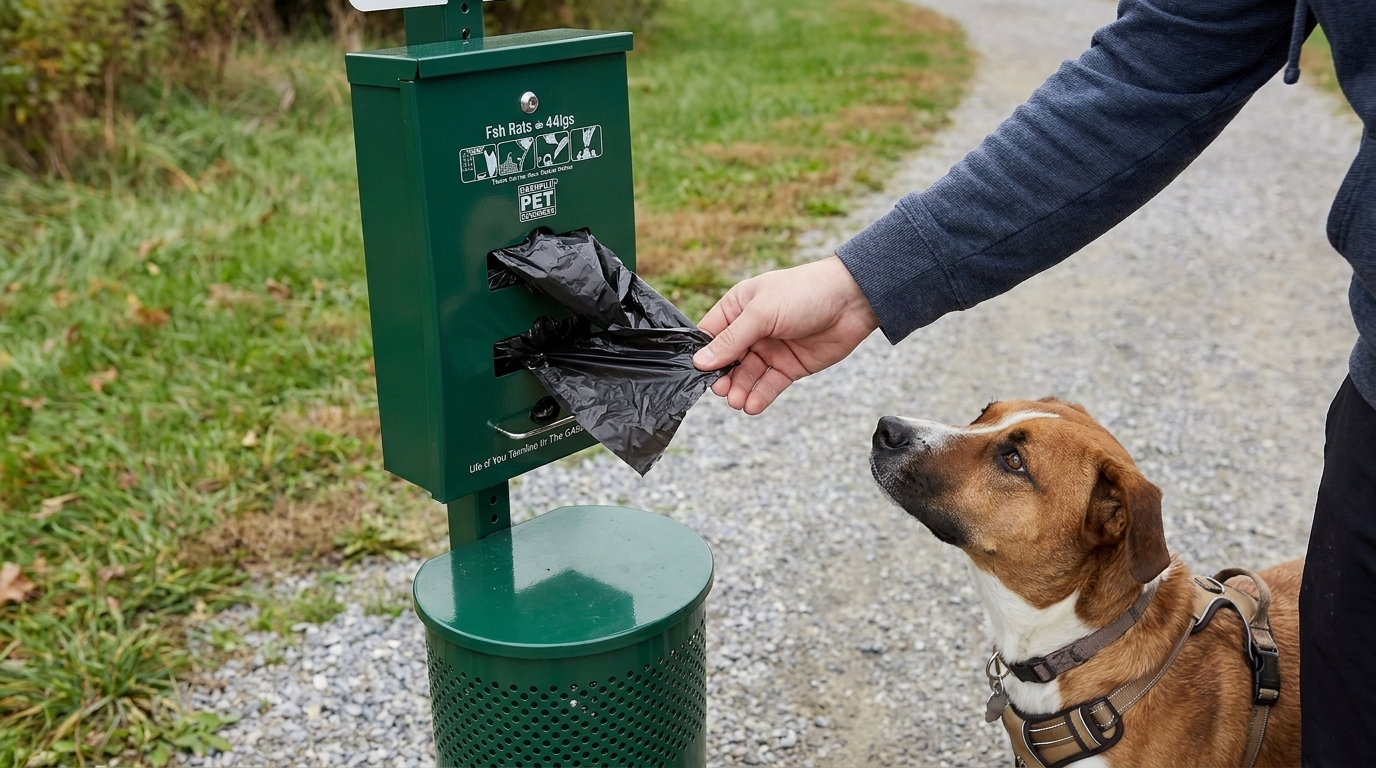
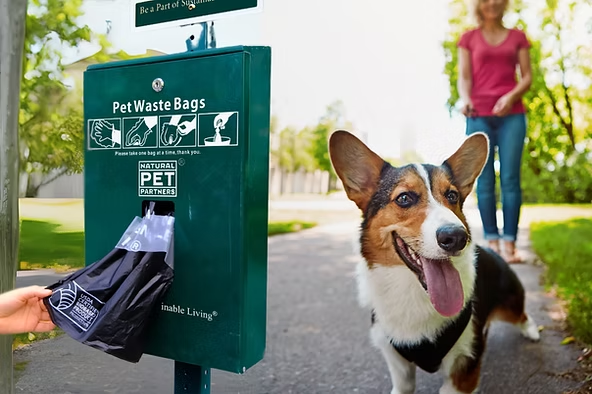
The infrastructure section should specify: minimum station count relative to the property's pet-owning unit count and acreage; placement standards (proximity to high-traffic pet walking routes, distance from building entries, visibility); bag and liner type, including any material specifications such as USDA Certified Biobased products; service frequency minimums tied to the property's pet population; and the expectation that stations will be kept stocked, functional, and serviced regularly to help prevent overflow between service visits.
Specifying station standards in the policy creates two benefits. First, it gives residents a documented expectation of what the property will provide which reduces the complaint that stations were never stocked. Second, it creates a performance baseline against which vendor service can be measured. If the policy says stations will be serviced a minimum of twice weekly and the vendor is servicing once weekly, the vendor is in breach of the service standard the community has committed to its residents.
- Minimum 1 pet waste station per 50 to 75 pet-owning units as a starting benchmark for apartment communities.
- Station placement along natural dog walking routes, not in out-of-the-way locations chosen for aesthetic or logistical convenience.
- Bag dispensers restocked before depletion not only on scheduled service days.
- Service frequency defined in visits per week, not left to vendor discretion.
- USDA Certified Biobased bags where the community has responsible purchasing commitments or environmental policy goals.
Step 3: Write Resident-Facing Rules That Are Specific Enough to Enforce
Most community pet waste policies fail the enforceability test at the language level. Rules that use words like 'promptly,' 'appropriately,' or 'in a timely manner' are not enforceable because they do not define the standard against which behavior is measured. Enforceable rules use specific, observable language that removes ambiguity about what compliance looks like.
Step
3
Replace Vague Language With Specific, Measurable Rules
Each resident-facing rule should pass the 'observable from a distance' test: could a property manager or community monitor observe, without confrontation, whether the rule is being followed or violated? 'Pet waste must be removed immediately' passes this test. 'Residents should be responsible with their pets' does not. The following table shows how common vague policy language maps to specific enforceable alternatives.
Residents are expected to clean up after their pets promptly.
Residents must remove all pet waste immediately upon defecation in any common area and deposit it in a designated pet waste receptacle.
Pet owners should use designated relief areas when available.
All dogs must use designated pet relief areas when present on the property. Walking dogs on lawn areas outside designated zones is prohibited between [hours] and [hours].
Residents who fail to clean up after their pets may be subject to fines.
First violation: written warning. Second violation: $[amount] fine. Third violation: $[amount] fine and mandatory meeting with property management.
All pets must be registered with the office.
All pets must be registered within 14 days of move-in or within 14 days of acquiring a pet. Registration requires: pet name, breed, weight, vaccination records, and emergency contact.
Bags are provided at stations for resident convenience.
Pet waste bags are provided at all designated stations. Residents are encouraged to carry personal backup bags in case a station is temporarily unavailable or out of bags.
Step 4: Define the Enforcement Procedure With Enough Specificity to Use It
An enforcement procedure that is too vague to apply consistently is the same as no enforcement procedure. Property managers and HOA board members need a documented, step-by-step process they can follow without having to make a judgment call each time a complaint arrives or a violation is observed.
Step
4
Build a Three-Stage Enforcement Ladder With Documentation Requirements
Stage 1: Informal warning. A written notice is issued to the unit on record for the registered pet involved. The notice documents the date, location, and nature of the violation. No fine is assessed. Stage 2: Formal violation and fine. A second notice is issued with the fine amount per the schedule defined in the policy. The notice references the first warning and includes the fine amount and payment deadline. Stage 3: Escalation. Repeated violations are documented and escalated to the community manager, HOA board, or, in the case of a lease community, to a lease enforcement procedure. All notices are sent in writing — email or certified mail — with delivery confirmation retained in the resident file.
The documentation requirement is not bureaucratic overhead. It is the protection against a resident who disputes a fine, a board member who questions whether the process was followed, or a fair housing complaint that requires evidence of consistent enforcement. Every violation notice should be timestamped, tied to the specific rule violated, and retained regardless of whether the fine is paid.
Enforcement Limit
Pet waste enforcement in multi-family communities has a practical ceiling determined by staff capacity. If your property cannot realistically issue and document violation notices on a consistent basis, over-building the enforcement section creates an expectation that cannot be met. Build the enforcement ladder to match your actual operational capacity, and invest the remainder of the effort in the infrastructure and vendor accountability sections.
Step 5: Write a Vendor Accountability Section That Has Teeth
The vendor accountability section is the most consistently missing piece of community pet waste policies and its absence is what turns the rest of the document into a resident-only accountability framework. If the policy commits to service standards but does not specify how those standards are monitored and what happens when they are not met, the commitment is unverifiable.
Step
5
Define Service Standards, Reporting Requirements, and Remedy Provisions
The vendor accountability section or a referenced service agreement incorporated into the policy should specify: minimum service frequency per week or per visit cycle; service completion reporting format and delivery method (email notification, service log, photo documentation); maximum response time for issues reported between scheduled visits; missed-service credit or remedy terms; and an escalation path for repeated service failures. The policy should also name the designated community point of contact for vendor communication and define the review frequency for vendor performance.
The key phrase is 'service completion reporting.' A vendor who confirms service was performed, in writing, after every visit, gives the property manager the information needed to manage the relationship without walking the property themselves. A vendor who does not provide this reporting leaves the property manager dependent on resident complaints as the only performance signal which is a reactive model that this policy is designed to eliminate.
What a Complete Pet Waste Policy Includes Section by Section
A complete community pet waste policy has six sections. Each section serves a distinct function in the accountability framework. The following table outlines what each section should contain and the most common omission that undermines it.
1. Scope and Applicability
Geographic coverage, pet types, residents vs. guests, assistance animal exemptions, effective date
No mention of guest pets or assistance animal fair housing carve-out
2. Infrastructure Standards
Station count minimums, placement requirements, bag type specifications, service frequency commitments, overflow prevention
No infrastructure obligation on the property — only resident behavioral obligations
3. Pet Registration
Registration deadline, required documentation, update requirements, fee schedule if applicable, database management
No enforcement mechanism when registration lapses or residents acquire unregistered pets
4. Resident Rules
Cleanup obligation, designated area use, leash rules, bag-carrying requirement, guest pet standards
Vague language that cannot be observed, measured, or documented for enforcement
5. Enforcement Procedure
Three-stage violation ladder, fine schedule, documentation requirements, appeal process, escalation path
No documentation requirement — violations are verbal or informal and cannot be referenced in disputes
6. Vendor Accountability
Service frequency minimums, completion reporting format, issue response window, missed-service remedy, review cadence
Entirely absent — policy covers only resident obligations with no vendor performance standard
Scope & Applicability
Geographic coverage defined (all common areas, parking, walkways, courtyards)
Pet types covered explicitly (dogs, all pets)
Guest and visitor pet coverage addressed
Assistance animal / service animal fair housing carve-out included
Effective date and amendment process documented
Infrastructure Standards
Minimum station count specified relative to unit count
Station placement standards defined (route proximity, visibility, distance from entries)
Bag and liner type specified (USDA Certified Biobased or equivalent)
Service frequency minimum defined (visits per week, not 'as needed')
Property obligation to maintain stocked, functional stations documented
Pet Registration
Registration deadline defined (e.g., within 14 days of move-in or pet acquisition)
Required documentation listed (vaccination records, breed, weight)
Update requirement for changes in pet status included
Process for registering new pets mid-lease defined
Resident Rules
Cleanup obligation uses specific, observable language (not 'promptly' or 'appropriately')
Designated relief area use requirement defined
Leash rule and common area access rules included
Personal bag-carrying requirement included as backup to station availability
Reporting process for non-compliance incidents defined for residents
Enforcement Procedure
Three-stage violation ladder defined (warning, fine, escalation)
Fine schedule documented with specific dollar amounts
Documentation requirement for each violation stage included
Written notice delivery requirement specified (email or certified mail)
Resident appeal process defined
Vendor Accountability
Service frequency minimum defined and referenced in or incorporated from vendor agreement
Service completion reporting format and delivery method specified
Issue response window defined (e.g., 3 business hours for between-visit problems)
Missed-service credit or remedy terms documented
Designated community point of contact for vendor communication named
Vendor performance review frequency defined (quarterly, semi-annual)
Can we enforce a pet waste policy against residents who claim they did not know the rules?
Yes, with two conditions. First, the policy must be incorporated into the lease or community rules document that residents sign at move-in not issued as a separate notice after the fact. Second, any new policy or policy amendment must be communicated in writing to all residents with documented delivery, and a reasonable notice period (typically 30 days) must be provided before enforcement begins. Courts consistently uphold community rules that meet these two conditions and have a defined, documented violation process.
How often should a pet waste management policy be reviewed and updated?
At minimum, annually. The review should coincide with the annual operating budget process, so that any infrastructure changes new stations, service frequency adjustments, vendor changes can be reflected in both the policy and the budget at the same time. The review should also be triggered by any of the following: a significant change in the property's pet owner population, a vendor transition, a pattern of escalating complaints that suggests the policy is not working, or a legal or regulatory change affecting pet policies in residential communities.
What is the right fine amount for a pet waste violation?
Fine amounts vary by market, property type, governing documents, and local requirements. Communities should confirm allowable fine structures with legal counsel or their property management team before publishing the policy.
Should the pet waste policy be a standalone document or part of the lease?
For apartment communities, the policy should be incorporated as a lease addendum that residents sign at lease execution not a separate community guideline document issued later. This is the only way to make the enforcement provisions legally binding as lease terms. For HOAs, the policy should be adopted as part of the community rules and regulations through a formal board vote, with notice to all homeowners per the governing documents' amendment requirements. A standalone policy document that is not incorporated into the binding governing instrument is advisory, not enforceable.
What should we do if our current pet waste service provider cannot meet the standards in the policy?
This is the right question to ask before publishing the policy, not after. If the vendor performance standards in the policy exceed what your current provider can deliver, you have two options: negotiate amended terms with the current vendor to meet the new standards, with a defined performance review period; or transition to a provider who can meet the standards before the policy takes effect. Publishing a policy with service commitments your vendor cannot keep puts the property in breach of its own documented obligations to residents.
A pet waste management policy is only as effective as the infrastructure and vendor accountability it is built on. The six-section framework in this guide scope, infrastructure standards, resident rules, enforcement procedure, pet registration, and vendor accountability gives property managers and HOA boards a complete operational foundation, not just a document to file in the lease.
The most important step most communities skip is the vendor accountability section. Before the policy is finalized, confirm that your service provider can meet the standards the policy will commit to your residents. If they cannot, that is information you need before the policy is published not after the first complaint test.
CoPS on Doody provides commercial pet waste station service designed to meet the infrastructure and accountability standards described in this guide. Service completion reporting after every visit, flat-rate monthly pricing, USDA Certified Biobased materials, defined issue response windows, and a missed-service credit policy all without a long-term contract.
Need the service infrastructure to back your policy?
CoPS on Doody provides dedicated commercial pet waste station service for apartment communities, HOAs, and condominiums across DC metro and Atlanta — flat-rate pricing, service completion reporting, USDA Certified Biobased materials, and no contracts required.
copsondoody.com
·
Get a Free Quote
·
No Contracts, No Hidden Fees
Cleaner communities. Fewer complaints.
copsondoody.com



.png)




.png)
.png)

