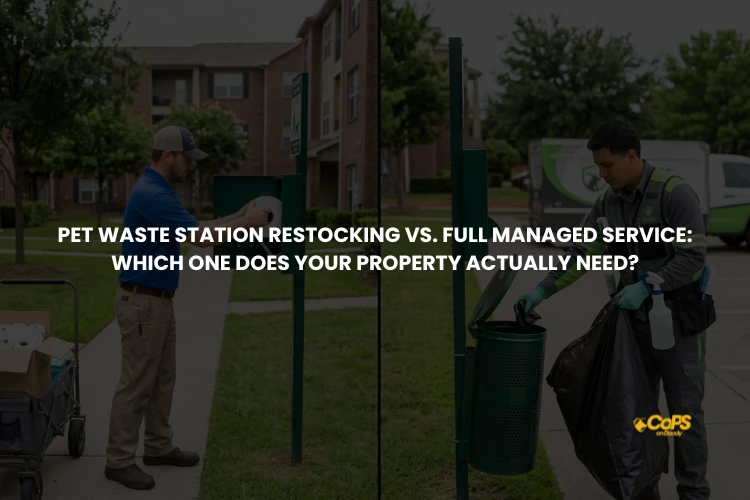
When a property manager starts shopping for pet waste station service, they typically encounter two distinct offerings, though vendors rarely label them that clearly. The first is a restocking-focused service: someone shows up on a schedule to add bags to the dispenser and, depending on the provider, empty the bin. The second is a fully managed service: a structured visit protocol that covers station inspection, liner and bag replacement, ground-area scooping, condition documentation, issue escalation, and service completion reporting. The monthly rate for the first is lower. The operational outcome from the second is categorically different.
The comparison matters because restocking-only service is not a scaled-down version of full managed service. It is a different service model with different accountability structures, different output quality, and different total cost of ownership when you account for the complaint management time, the overflow events, and the vendor disputes that fill the gap between what restocking delivers and what the property actually needs.
This article gives property managers and HOA boards in DC metro and Atlanta a direct, practical framework for deciding which service level is right for their specific property based on property characteristics, complaint history, and operational tolerance for vendor management overhead rather than on which option costs less on a monthly invoice.
TL;DRKey Takeaways
- Restocking-only service adds bags and empties bins. Full managed service includes inspection, ground coverage, documentation, and issue response.
- The monthly rate difference between the two is real. The total cost difference — including complaint management time and overflow events — often is not.
- Most apartment communities in DC metro and Atlanta need full managed service. The situations where restocking-only is genuinely sufficient are narrow and specific.
- The right question is not 'which costs less per month' but 'which produces the outcome my property needs without ongoing management overhead.'
- Six signals indicate a property has outgrown restocking-only service and needs to upgrade regardless of what the current vendor charges.
- Full managed service with flat-rate billing, site-inspection-based frequency, and service completion reporting is the model that eliminates vendor management as a recurring property management task.
What Restocking-Only Service and Full Managed Service Actually Are
The terminology is not standardized across the pet waste service industry, which is part of why the comparison is difficult to make from a vendor's marketing materials. A provider who describes their service as 'regular station maintenance' may mean full managed service with inspection and documentation or they may mean a weekly bag refill with no reporting and no ground area coverage. The only way to know is to ask specifically what happens at each visit and compare that description against the 12-dimension framework below.
What Restocking-Only Service Includes
At its core, a restocking-only service visits each station on a defined schedule and performs one or two primary tasks: refilling the bag dispenser and, in some configurations, emptying the waste bin and replacing the liner. The visit is brief. There is no station condition inspection. There is no ground-area scooping within the station radius. There is no service completion documentation delivered to the property manager. If a dispenser insert is jammed and bags are not actually dispensing despite appearing full, a restocking-only service crew will add bags without discovering the jam. If a station is damaged, the damage is noted only if it is visually obvious and reported only if the vendor has a protocol for doing so, which most restocking-only providers do not.
Restocking-only service is the dominant model in the residential pet waste market and in landscaping add-on configurations. It is efficient for low-volume, simple properties where the service need is genuinely just keeping the bag dispenser full. It is insufficient for apartment communities and HOAs where station condition, ground cleanliness, and service accountability are operational requirements rather than preferences.
What Full Managed Service Includes
Full managed service treats each station as a managed piece of property infrastructure rather than a container to be periodically refilled. At every visit, the service crew performs a structured inspection and servicing sequence: visual condition check on approach, liner removal and replacement, bag dispenser restocking with insert inspection and function testing, bin cleaning and capacity assessment, ground area scooping within approximately six feet of the station, station exterior check, and documentation of any damage or functional issues with photo evidence. That documentation is delivered to the property contact in a service completion report within hours of the visit.
The accountability structure of full managed service is also different. A missed visit generates a credit. An issue identified between visits has a defined response window, typically three business hours. Service frequency is calibrated to the property's actual pet traffic rather than set at a fixed cadence applied across all accounts. And the billing is flat-rate, with no variable restocking charges that create invoice surprises.
The Full Comparison12 Dimensions That Define the Service Difference
The following table maps both service models across the 12 operational dimensions that determine whether a pet waste station management program produces the outcome a property needs. Read it as a procurement tool, not a marketing comparison, each row represents a decision point that will either create management overhead or eliminate it.
| Dimension |
Restocking-Only Service |
Full Managed Service |
| What happens at each visit |
Bags restocked in the dispenser. May or may not empty the bin. Ground area not checked. |
Liner replaced, bags restocked, bin emptied, ground scooped, station inspected, issues documented and reported. |
| Bin overflow management |
Bin fills between visits. No monitoring. Overflow discovered by residents. |
Bin capacity monitored at each visit. Frequency adjusted if overflow pattern develops. |
| Service completion documentation |
Rarely provided. No visit-level record of what was done. |
Service completion report sent to property contact after every visit. |
| Equipment inspection |
Not included. Damage discovered when residents report it. |
Station condition checked at every visit. Photo documentation of any damage or functional issues. |
| Issue response (between visits) |
No defined response window. Informal communication only. |
3-business-hour response commitment. Named contact for between-visit issues. |
| Frequency calibration |
Fixed schedule regardless of property demand. No seasonal adjustments. |
Frequency set by site assessment of property's actual pet traffic. Adjusted as demand changes. |
| Ground area coverage |
Not included. Ground waste outside the bin is the property's problem. |
Approximately 6 feet around each station scooped at every visit. Ground waste removed. |
| Material specification |
Standard bags. Quality and material origin not specified or certified. |
USDA Certified Biobased bags and liners at verified 41% bio-based content. |
| Billing structure |
Often variable — restocking charged separately from service, or per-visit billing. |
Flat monthly rate. All bags and liners included. No restocking surcharges. |
| Contract terms |
Varies. May include term commitments depending on the vendor. |
Month-to-month. No long-term contract required. Exit with written notice. |
| Missed-service remedy |
No defined credit mechanism. Informal resolution only. |
Service credit issued if a visit is missed and cannot be made up before the next scheduled service. |
| Who it works for |
Low-density properties, simple layouts, very low complaint volume. |
Apartment communities, HOAs, condominiums — any property where station condition directly affects resident satisfaction. |
The Real Cost Comparison What the Monthly Rate Does Not Capture
The instinct to choose restocking-only service on price grounds is understandable. The monthly rate is lower. But the monthly rate is not the total cost of a restocking-only service relationship at a property that generates ongoing pet waste complaints. The total cost includes the hours a property manager spends handling complaints that a managed service would have prevented, the overtime maintenance visits required when stations overflow between scheduled service days, and the resident satisfaction cost of persistent ground waste in common areas that directly affects lease renewal decisions.
The following table maps the hidden cost categories that appear in restocking-only service relationships at properties where the service level is insufficient for the property's actual demand which describes most apartment communities and HOAs operating at any meaningful pet ownership rate.
| Cost Category |
Restocking-Only |
Full Managed Service |
| Monthly service rate |
Lower — restocking is less labor-intensive per visit |
Higher — accounts for full inspection, documentation, ground coverage, and materials |
| Bag restocking surcharges |
Often variable — billed separately when usage exceeds a stated allowance |
Included in flat rate — no restocking surcharges regardless of volume used |
| Complaint management time |
High — property manager triages overflowing station and ground waste complaints between service visits |
Low — service completion reports and between-visit response window reduce complaint volume that reaches the property manager |
| Overflow event remediation |
Unscheduled maintenance or cleanup required when bins exceed capacity between visits. This cost is absorbed internally. |
Frequency adjustment mechanism prevents overflow before it occurs. No unscheduled remediation required. |
| Dispenser jam resolution |
Property manager or maintenance staff discovers and resolves jammed dispensers after resident reports them. |
Dispenser insert checked at every visit. Jams identified and resolved during service, not after a resident report. |
| Vendor dispute overhead |
Variable billing disputes, missed-service credit negotiations, and performance conversations with no documented service record to reference. |
Flat-rate billing eliminates invoice disputes. Service completion reports provide documented performance record. Credit mechanism eliminates negotiation. |
| Lease renewal impact |
Unquantifiable but real — pet amenity complaints in online reviews and resident conversations influence prospective and renewing resident decisions. |
Consistent station condition reduces pet amenity complaint volume, which reduces the reputational exposure that affects lease renewal rates. |
| True annual cost |
Lower stated rate, higher actual cost when complaint management time, remediation, and billing disputes are accounted for. |
Higher stated rate, lower actual cost when the reduction in complaint management, remediation, and dispute overhead is factored in. |
Which Service Level Does Your Property Actually Need?The Decision Diagnostic
The right service level for a specific property is a function of four variables: pet population density, complaint history, vendor management capacity of the property manager, and the property's operational standards for resident-facing cleanliness. The following diagnostic table maps property situations to the appropriate service model. Honest answers produce an accurate result.
| Property Situation |
Restocking |
Managed |
| 50 units or fewer, 3 or fewer pet waste stations, very low complaint volume |
✔ |
✔ |
| More than 75 units with 30% or higher pet ownership rate |
✘ |
✔ |
| Any history of station overflow events in the last 90 days |
✘ |
✔ |
| Resident complaint volume that requires property manager response more than once per week |
✘ |
✔ |
| Community listed as pet-friendly in active apartment listings |
✘ |
✔ |
| Property manager cannot spare time to verify service completion independently |
✘ |
✔ |
| HOA board requires documented vendor performance for annual reporting |
✘ |
✔ |
| Property with dog park or dedicated pet relief area in addition to stations |
✘ |
✔ |
| Seasonal heavy use (spring and summer spikes in outdoor pet traffic) |
✘ |
✔ |
| Low-density single-phase HOA, 1 or 2 stations, no documented complaints |
✔ |
✔ |
| Property with sustainable purchasing or procurement documentation requirements |
✘ |
✔ |
| New construction community preparing to open and list as pet-friendly |
✘ |
✔ |
Reading the Diagnostic
If your property matches three or more situations in the 'Managed' column, restocking-only service is not sufficient for your property's operational needs regardless of the current vendor's pricing. The situations marked 'Restocking' compatible are the exception case, not the rule. Most apartment communities and active HOAs in DC metro and Atlanta fit the managed service profile.
Six Signals That Your Property Has Outgrown Restocking-Only Service
Properties that are currently using restocking-only service or a landscaper or cleaning company providing a similar scope often recognize the service level mismatch only after one of the following events surfaces. These are the signals that the current service model is insufficient for the property's actual demand.
Overflow Events Are Happening More Than Once Per Month
A station overflow event once in a season is an operational variance. A station overflow event recurring monthly is a frequency calibration failure. Restocking-only service operates on a fixed schedule that does not adjust for demand. Full managed service monitors bin capacity at each visit and triggers a frequency adjustment before overflow becomes a pattern. If overflow is recurring, the service model, not the residents, is the variable that needs to change.
You Are Receiving Complaints About Ground Waste Near Stations
Ground waste within the radius of a pet waste station means one of two things: residents are leaving waste next to a full or non-functional station, or the service is not scooping the ground area around the station at each visit. Restocking-only service typically does not include ground scooping. If ground waste near stations is generating complaints, the service model is the source and upgrading to full managed service, which includes ground area coverage at every visit, resolves the gap directly.
You Cannot Confirm When the Station Was Last Serviced
If a resident complains about an overflowing or empty station and you have no service completion record to reference, no email, no notification, no service log — your current vendor does not provide reporting. That is not a communication preference gap. It is a documentation structure gap that leaves the property manager unable to manage the vendor relationship with any data. Full managed service providers deliver a service completion report after every visit.
Your Monthly Invoice Does Not Match What You Expected to Pay
Variable billing structures in restocking-only agreements — per-bag charges above a threshold, restocking surcharges, emergency visit fees — produce invoices that differ from the rate quoted during vendor selection. If your monthly invoice is unpredictable, the billing structure is variable and the agreement did not define all the triggers for additional charges. Full managed service with flat-rate billing eliminates this category of invoice surprise entirely.
Bag Dispensers Are Empty or Non-Functional Between Service Visits
A dispenser that was restocked on Tuesday and is empty by Thursday either has a usage volume that exceeds the current service frequency, or the dispenser insert is jammed and bags are not actually dispensing despite appearing stocked. Restocking-only service typically does not check insert functionality — it adds bags to the dispenser without testing whether the dispenser is actually working. If residents report empty dispensers days after a confirmed service visit, the insert is the likely culprit.
Your Current Vendor Cannot Tell You Exactly When the Last Service Occurred
Call your current pet waste service vendor and ask for the service completion report from the most recent visit. If they cannot produce a date-stamped record of what was done at each station, they do not have a service documentation protocol. That means you have no basis to dispute a missed service, no basis to request a credit, and no data to present to a resident who asks when the station was last serviced. Documentation is not a premium feature. It is the minimum accountability structure for a managed service relationship.
When to UpgradeAnd How Fast the Transition Actually Takes
The decision to move from restocking-only service to full managed service does not require waiting for a contract to expire. Most restocking-only arrangementsparticularly those managed through landscaping or cleaning companiesare add-on services without a separate termination clause. In most cases, a property manager can transition to a full managed service provider with 30 days or fewer of notice to the outgoing vendor, and CoPS on Doody can begin service within seven days of a signed agreement.
The transition does not require a new station installation for properties with existing infrastructure. It requires a site assessment, a physical inspection of existing station placement, condition, and count followed by a proposal that reflects the frequency and scope calibrated to the property's actual demand. For most DC metro and Atlanta apartment communities and HOAs, the assessment-to-first-service timeline is 14 days or fewer.
Transition Note
If you are currently under a term contract with a restocking-only provider, review the termination clause before initiating a transition. If the contract includes an early termination fee, calculate whether the fee is lower than the continued cost of complaint management overhead under the current service model. In most cases, the comparison favors switching.
First Service After Signing
7 Days
Proposal After Assessment
72 Hours
Visit Reporting Delivery
Every Visit
Between-Visit Response
3 Bus. Hours
Frequently Asked Questions
Is restocking-only service ever genuinely sufficient for a property? Or is full managed service always the right choice?
Restocking-only service is genuinely sufficient for a narrow set of property situations: very low-density properties with three or fewer stations, minimal documented complaint history, a property manager with bandwidth to verify service independently, and no pet-friendly listing marketing active. Most of these situations describe small HOAs in low-density residential areas, not apartment communities of any scale, and not HOAs with active common areas and high pet ownership. For the majority of properties in DC metro and Atlanta that are managing pet waste as an active operational function, full managed service is the right level.
How do I make the case to an HOA board for upgrading from restocking to full managed service when the full managed rate is higher?
The case to the board is a total cost argument, not a monthly rate argument. Present the current monthly rate alongside the documented cost of the service level's deficiencies: the number of complaint-related property manager hours per month at the current service level, any unscheduled maintenance visits triggered by overflow events, and any leasing or retention impact from pet amenity complaints in online reviews. Then present the full managed service rate as the rate that eliminates all three cost categories. In most cases, the cost reduction in property manager time alone exceeds the monthly rate differential and the board can document the switch as a cost management decision, not a spending increase.
We use a landscaper for station servicing. Can we switch to full managed service without disrupting the landscaping relationship?
Yes. Pet waste station service is a dedicated function that is entirely separate from grounds maintenance. Removing the station servicing add-on from the landscaping contract does not affect the landscaping relationship it removes an add-on task that the landscaper is likely performing inconsistently and without documentation. Most landscaping contracts allow the removal of specific line items with standard written notice. The transition to a dedicated managed service provider is operationally clean and does not require replacing the landscaping vendor.
What is the minimum pet density at which full managed service becomes necessary?
The threshold is not unit count alone it is a function of pet density relative to station coverage and service frequency. A 100-unit property with 20% pet ownership and two well-placed stations serviced twice weekly may maintain cleanliness at a service level that would be insufficient for a 60-unit property with 70% pet ownership and four stations on a weekly schedule. The site assessment that precedes a CoPS proposal identifies the density-to-coverage ratio for the specific property and recommends a frequency that matches actual demand which is more reliable than any fixed unit-count threshold.
Can we start with restocking service and upgrade later, or is it better to start with full managed service from the beginning?
Starting with restocking service and planning to upgrade creates a specific operational risk: the transition moment is usually triggered by a complaint event, which means the property has already experienced the service level failure before making the change. For a new construction or pre-opening apartment community, starting with full managed service from day onecalibrated to the expected pet populationestablishes the right baseline before residents form any expectations from an inadequate service model. Correcting a poor baseline is harder than starting with the right one. For existing properties with current service relationships, the assessment will determine the appropriate starting point.
CONCLUSION
The choice between restocking-only service and full managed service is not a price decision. It is a property decision one that should be made based on what the property actually needs to maintain the resident-facing cleanliness standard it has committed to, manage vendor performance without ongoing overhead, and keep pet-owning residents satisfied enough to renew.
For most apartment communities and active HOAs in DC metro and Atlanta, restocking-only service is insufficient not because the vendors who provide it are inadequate, but because the service model itself does not cover the operational tasks that determine whether pet waste station management works. Bin emptying and bag refilling are necessary but not sufficient. Inspection, documentation, ground coverage, and accountability are what convert a pet waste station from installed infrastructure into a managed community amenity.
CoPS on Doody starts every service relationship with a site assessment that determines the right service level, frequency, and station configuration for the specific property, not a formula applied from a rate card. The assessment is free. The proposal arrives within 72 hours. Service begins within seven days of a signed agreement. No contract required.
Not sure which service level your property needs?
CoPS on Doody starts with a free site assessment, a physical property inspection that identifies the right service level, frequency, and station configuration for your specific community. DC metro and Atlanta. No contract required.
copsondoody.com
·
Get a Free Quote
·
No Contracts, No Hidden Fees
Cleaner communities. Fewer complaints.
copsondoody.com



.png)




.png)
.png)

