
By Dave Jensen, CEO, CoPS on Doody · Commercial Pet Waste Station Service
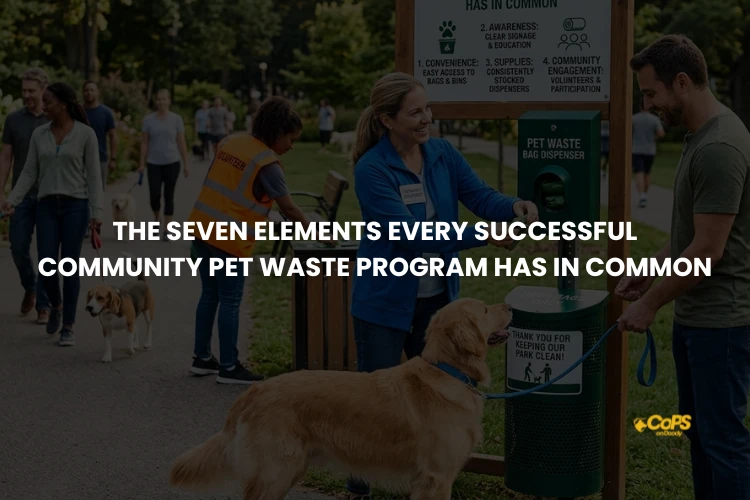
A successful community pet waste program is a system with seven working parts: station placement, equipment, service, resident convenience, resident communication, sustainability, and program management. Communities that struggle usually don't have a bad vendor; they have a missing element. And because the missing element is rarely the one anyone is looking at, the problem survives budget cycle after budget cycle.
That's why the strongest first step before budget season isn't a quote. It's a score. When you rate your community against all seven elements, the gaps stop being opinions and start being line items.
A pet waste program is more than a row of stations. Each element below does a different job, and the program only works when they work together.
Two clarifications keep this honest. On service: reliability means commitments you can point to in writing a defined service day and a stated response window not good intentions. On sustainability: waste pickup and disposal address the pollution question (the EPA identifies pet waste as a nonpoint source of water pollution EPA), while bag and liner sourcing is a separate materials decision, proven by USDA Certified Biobased documentation.
Because communities inherit their programs. Stations go in once, a service schedule gets set, and both go unquestioned for years while the community changes around them. A placement chosen a decade ago may no longer match where residents walk today. One well-placed station often outperforms two poorly placed ones but nobody notices until the complaints cluster.
The elements also fail quietly in different ways. Equipment ages visibly, but communication fails invisibly: new residents simply never learn where stations are. Program management is the element most communities score lowest on, for an understandable reason nobody was ever assigned to own it.
If you scored your community right now, which element would come in last? That's the question the scorecard makes concrete. Download the Seven Elements™ Program Scorecard and find out before the budget locks.
A scored program turns the budget season from a renewal into a decision. Instead of "should we keep paying for this?"The board sees "we score well on equipment and service, and weakest on placement and communication. Here's fixing those two costs." Some fixes need a budget; many don't. Relocating an underused station or refreshing resident station maps costs little to nothing, and a scorecard is how those no-cost wins get noticed.
It also makes next year measurable. Score the program annually and you have a running record: what improved, what slipped, and what to prioritize the same discipline boards already expect from every other service line.
Do we need a professional to score our program?
No. The scorecard is designed for a community manager or board member: rate each of the seven elements 1–5 during a normal property walk, total the score, and note your three biggest opportunities. It takes about 10 minutes plus the walk.
What's a "good" score?
The pattern matters more than the total. A program that scores 5 on equipment but 2 on communication has a clearer to-do list than any average can show. Score annually and aim for the weakest element to improve each year.
Which element should we fix first?
Usually the lowest-scoring element that touches residents' daily placement and convenience tends to move complaints fastest. Where fixes cost money, they belong in the budget conversation you're about to have anyway.
Great pet waste programs aren't lucky they're complete. Seven elements, each doing its job, reviewed on a schedule instead of after complaints. Score your community now, while the draft budget can still act on what you find.
Related reading:Why every community should assess its pet waste program before budget season

.png)



.png)
.png)

