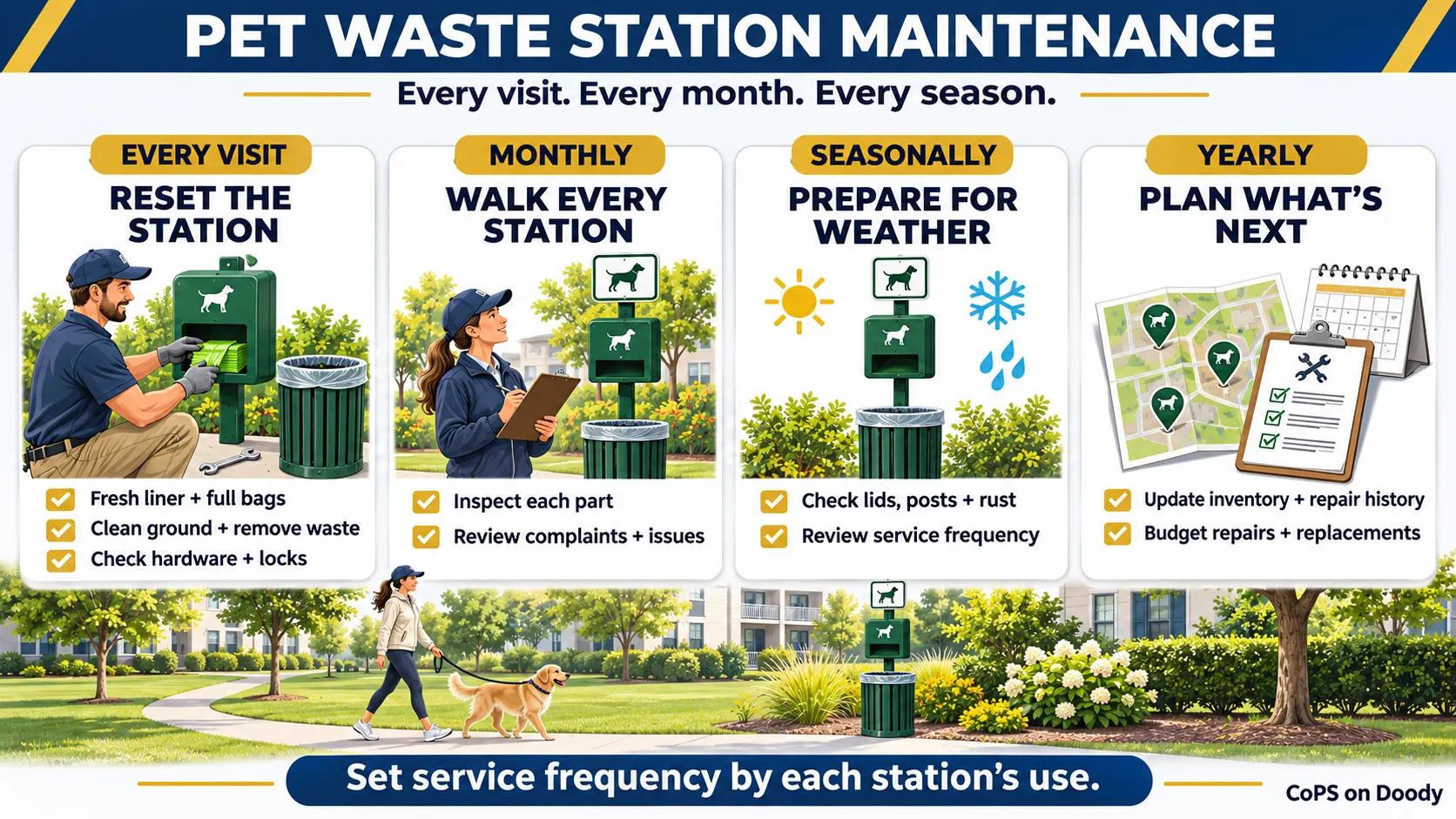
Pet waste station maintenance has two parts. On every service visit, each station gets a fresh can liner and a full supply of bags, the ground around it is picked up, its hardware is tightened and its locks lubricated, and all waste leaves the property. Between visits, someone walks past every station once a month, prepares the stations for winter and summer, and reviews the whole set once a year so worn parts are repaired or replaced on a plan.
Let us walk you through the standard we hold stations to, starting with a schedule you can print and hand to whoever services your stations.
The University of Maryland Extension calls long-term maintenance critical to a station's success, and the EPA's pet waste fact sheet lists a lack of bags or trash receptacles as a possible barrier to proper disposal. The CDC says dog poop can carry germs that make people and animals sick, and its list of diseases that can spread from dogs to people includes Campylobacter and Salmonella infections, roundworm, and hookworm. It says dog poop should be picked up "especially in areas where children may play." The EPA also calls pet waste a leading source of nutrient and bacteria pollution in urban streams and waterways.
Print this and share it with whoever services your stations.
At least one manufacturer's warranty excludes lock and hinge failures caused by skipping routine lubrication, so lubrication belongs on every visit.
Household trash in station cans is more common than you'd think. A couple of kitchen bags can fill a can long before its next service. If one station keeps overflowing, look inside the can before you change the schedule. A short reminder in the community newsletter may help.
Often enough that a resident never finds a full can or an empty dispenser. There's no universal number. The right frequency depends on how heavily each station is used, which depends on the community's layout, how much common area sits in convenient spots, where residents walk, and how much foot traffic each station gets. Every community is different, and that's why we visit every community.
The CAI Foundation's 2023 best practices report on community association maintenance describes two ways to time preventive maintenance: on a set schedule, or by usage. A regular service schedule keeps the work predictable, and usage tells you whether the schedule is right. These are the signs a station's frequency needs a look:
If a frequency change makes sense, it should come to you in writing, with a proposal showing the new rate.
Once a month, walk or drive past every station and compare each part with this table. Then check what you saw against your complaint log. A station that shows up in both needs attention.
The CAI Foundation report recommends touching up paint on exterior metal to protect it from water and sun, and it describes a community whose metal fencing was ruined by salt air and irrigation, with landscaping trapping the moisture, in a case a yearly inspection would have caught. Sprinklers and shrubs do the same thing to a station post.
For the dispenser, residents should never find it empty. We cover what an empty one says to residents in what an empty pet waste dispenser tells residents. For signs, the EPA suggests placing them next to the station to explain its purpose and give a contact for questions.
NOAA's 1991 to 2020 climate normals show far more freezing nights and snow around Washington, and more hot days and rain in Atlanta.
Atlanta's snowfall normal is marked provisional by NOAA because it rests on fewer years of data.
In the DC metro, plan for snow and salt. Snow plowed or shoveled off walks can bury a station or knock it over, and a buried station can't be used or serviced. Give your snow contractor a station map and ask crews to keep a path open to each one, since residents walk their dogs in the snow too. Montgomery County's Department of Environmental Protection says salt can accelerate concrete deterioration and corrode aluminum and steel, so check posts and bases beside salted walks and parking lots each spring. Locks and hinges may stiffen in the cold, one more reason they're lubricated on every visit. The median first freeze at Dulles, out toward Loudoun County, comes more than three weeks before Reagan National's, so outer suburbs should start winter checks by mid-October. After a thaw, expect extra ground pickup, since waste left under the snow may appear all at once.
In metro Atlanta, plan for heat and rain. Hartsfield-Jackson averages 47 days a year at 90°F or hotter and about 50 inches of precipitation, compared with about 42 at Reagan National. Before summer, confirm every lid closes tightly and check whether the frequency still fits how fast cans fill in the heat. In Gwinnett County, storm drains carry water directly to local waterbodies, and the county's water department counts pet waste among the largest sources of contamination in Georgia streams, so ground pickup matters most around stations near drains and slopes.
Reagan National still averages 40 days a year at 90°F or hotter, and Atlanta averages 36 nights at or below freezing, so the summer checks apply in the DC metro and the lock and lid checks belong on Atlanta's fall list.
Clean a station when it's soiled and again after winter. Wash the can, lid, and dispenser with mild soap and water, rinse, and let them dry before restocking so the bags stay dry. The University of California's Integrated Pest Management program recommends washing garbage cans regularly with soap and water.
Skip abrasive pads, steel wool, and harsh chemical cleaners, which can scratch or strip the coating; at least one manufacturer's warranty excludes damage from abrasive cleaners. If you disinfect with bleach, the American Galvanizers Association warns that bleach corrodes galvanized steel, so keep the contact short, then rinse and dry. The same group notes that wet road salt speeds corrosion of galvanized steel, which is why the spring check includes rinsing salt off posts and bases in the DC metro.
They can when waste sits. DC Health's rodent control FAQ explains that rats are drawn to dog waste because it's rich in nutrients, and Montgomery County's health department lists dog droppings among the things that attract rats. Fairfax County's health department notes that rats often gnaw the bottoms of receptacles, so check cans for holes, and DC Health reports that rodents are seen more often from April to June and from October to November, which lines up with the spring and fall checks.
For flies, UC's pest program notes that blow flies can breed in accumulated pet waste and that house flies can develop from egg to adult in as little as seven days under optimal summer conditions. It recommends containers with tight-fitting lids where feasible. The fixes are the ones that keep a station working anyway: lids that close, cans that aren't overfilled, and waste removed on a regular service schedule.
If your own maintenance staff service the stations, give them gloves and a way to wash up. The CDC lists touching animal waste and touching garbage among the key times to wash hands, scrubbing for at least 20 seconds, with a hand sanitizer of at least 60% alcohol when soap and water aren't available, and it says to wash after contact with dog poop "even if you use a bag."
OSHA requires employers to assess the workplace for hazards that call for protective equipment, certify that assessment in writing, and train employees on the equipment (29 CFR 1910.132). It also requires appropriate hand protection when hands are exposed to hazards (29 CFR 1910.138). Neither rule names pet waste, so ask your safety adviser what applies. Virginia and Maryland run their own state OSHA plans.
Keep five short records, somewhere they'll outlast any one manager or board.
The CAI Foundation report notes that board and management turnover often means association records are destroyed, lost, or never kept, and it recommends a record retention program that carries forward to future managers and boards.
Put the service standard in your written service terms: the regular service schedule, what each visit includes, how quickly problems reported between visits get a response, and how frequency changes are made. Public contracts often leave these out. Of seven public pet waste station scopes we reviewed, only one set a response time for station problems, and three required service logs or reports. CoPS on Doody, for reference, commits to a three-business-hour issue response.
Repair the part when the station is sound. Replace the station when its post, footing, or can has failed, or when you keep repairing the same one.
No authoritative useful-life figure exists for pet waste stations. Reserve study standards leave component lives to the reserve specialist, so track install dates and repair history, and ask your specialist whether stations belong in the reserve study or the operating budget. Our guide to building a pet waste program budget covers that choice.
Replacing a station means new digging. UMD Extension's installation guide calls for anchoring stations with concrete or another method. Have underground utilities marked first. Miss Utility notes that in Maryland and DC a contractor must dig on a ticket in its own company name, and none of the one-call centers mark private lines such as irrigation or landscape lighting. Whoever handles your pet waste station installation should handle the locate request. If you're replacing a dispenser, keeping the bag opening within the 2010 ADA Standards' reach range of 15 to 48 inches is good practice; ask counsel whether it's required at your property.
A replacement is also a good time to confirm the location still fits how residents walk. Our guide to the best locations for pet waste stations covers that, including the notice each state requires before digging. When you choose new stations, look at how they're built: rounded interior bolts, a slanted dispenser roof with a drip edge, drain holes, a base plate, and an enclosed can are aimed at several of the failure points above. CoPS identifies problems in the field, and Natural Pet Partners (NPP) designs solutions.
Often enough that no resident finds a full can or an empty dispenser. There's no single number; it depends on how heavily each station is used. If a can is full when service arrives, or ground waste builds up between visits, the frequency needs a look.
Yes, if waste sits. DC Health explains that rats are drawn to dog waste because it's rich in nutrients. Keep lids closed, don't let cans overfill, check can bottoms for gnaw holes, and keep a regular service schedule.
Use mild soap and water, rinse, and let it dry before restocking. Avoid abrasive pads and harsh chemicals, keep any bleach contact short on galvanized steel, and rinse off road salt after winter.
No authoritative figure exists. One manufacturer estimates 3 to 10 years, depending on materials, use, maintenance, and environment. Track your own install dates and repairs, and plan replacements from that history.
The standard is the same whoever does the work. If your own maintenance staff service the stations, count the full cost: payroll, time off, benefits, payroll taxes, ordering and stocking bags, and your own time on complaints and supply orders. A landscaper or cleaning company is a separate question. They're outside vendors whose main work is something else, and while anyone can service a station, doing it neatly and correctly on every visit is specialist work.
It depends on the county. In Montgomery County, the Department of Environmental Protection installs stations in common areas managed by community associations and maintains them for up to a year at no cost, after which the association can decide to adopt them. In Prince George's County, partners in the Scoop That Poop program install, maintain, and monitor their own stations. The Loudoun Soil and Water Conservation District offers up to $7,000 per community for installation and requires a maintenance agreement of at least three years. Check your county's current terms.
Good station maintenance is a short list done on every visit, a monthly walk, checks before winter and summer, and a yearly review, with records that outlast any one manager or board and the whole program written into your service terms. Here's the standard. Evaluate every provider against it, including us.
Sources, all retrieved 2026-10-05 to 2026-10-06.
University of Maryland Extension, Pet Waste Stations (updated May 20, 2025), https://extension.umd.edu/resource/pet-waste-stations, and Install a Pet Waste Station, EBR-31 (Apr. 2015), https://extension.umd.edu/sites/extension.umd.edu/files/publications/PetWaste_ExtensionBrief.pdf
U.S. EPA, Stormwater Best Management Practice: Pet Waste Management, EPA-832-F-21-032E (Feb. 2023),
https://www.epa.gov/system/files/documents/2023-01/bmp-pet-waste-management.pdf
CDC, Dogs (June 15, 2026), https://www.cdc.gov/healthy-pets/about/dogs.html, and About Handwashing (Feb. 16, 2024),
https://www.cdc.gov/clean-hands/about/index.html
CAI Foundation, Best Practices: Community Association Maintenance (2023),
https://foundation.caionline.org/wp-content/uploads/2023/06/BestPracticesCAMaintenance.final2_.pdf
NOAA NCEI, U.S. Climate Normals 1991-2020, Washington Dulles (USW00093738), Washington Reagan (USW00013743), and Atlanta Hartsfield (USW00013874),
https://www.ncei.noaa.gov/data/normals-annualseasonal/1991-2020/access/
Montgomery County DEP, Winter Salt Management, https://www.montgomerycountymd.gov/propertycare/winter-salt-management, and Pet Waste,
https://www.montgomerycountymd.gov/propertycare/pet-waste
Gwinnett County Department of Water Resources, Protecting Our Waterways and Stormwater,
https://www.gwinnettcounty.com/government/departments/water
American Galvanizers Association, Trucking/Transport of HDG Steel in Winter (2021), https://galvanizeit.org/knowledgebase/article/trucking-transport-of-hdg-steel-in-winter, and Corrosive Chemicals and Galvanizing (2024),
https://galvanizeit.org/knowledgebase/article/corrosive-chemicals-and-galvanizing
University of California Statewide IPM Program, Pest Notes: Flies (May 2015),
https://ipm.ucanr.edu/PMG/PESTNOTES/pn7457.html
DC Health, Rodent and Vector Control Division, https://dchealth.dc.gov/service/rodent-and-vector-control-division, and Changing Seasons,
https://dchealth.dc.gov/service/changing-seasons
Montgomery County DHHS, Vector Control: Rats,
https://www.montgomerycountymd.gov/HHS/LandR/VectorControl-Rats.html
Fairfax County Health Department, Rats and Mice (Apr. 18, 2025),
https://www.fairfaxcounty.gov/health/environment/rats-mice
OSHA, 29 CFR 1910.132 and 1910.138, https://www.osha.gov/laws-regs/regulations/standardnumber/1910
OSHA, State Plans, https://www.osha.gov/stateplans
Zero Waste USA, Warranty (manufacturer), https://zerowasteusa.com/warranty/, and its station lifespan article (manufacturer)
Prince George's County Department of the Environment, Scoop That Poop,
Loudoun Soil and Water Conservation District, Pet Waste Station Program,
https://loudounsoilandwater.com/index.php/pet-waste-station-program/
Miss Utility, Homeowner Safe Digging Resources, https://www.missutility.net/homeowner/
U.S. Department of Justice, 2010 ADA Standards for Accessible Design, §§ 308.2.1, 308.3.1,
https://www.ada.gov/law-and-regs/design-standards/2010-stds/
Public pet waste station scopes reviewed (seven, 2019 to 2026), listed in the CoPS source ledger (rfp-scope-norms-2026-10).