What an Empty Pet Waste Bag Dispenser Says to Residents

Keep pet waste bag dispensers stocked by matching supplies to each model, setting service frequency from usage, and assigning one owner.
June 9, 2026
Community

An empty pet waste bag dispenser tells residents that nobody is keeping up with the station, and it leaves a dog owner without the one thing they need at the moment they need it. In a properly managed program, it should never happen. When it does, the cause is almost always the restocking arrangement, not the residents.

That's not a knock on anyone. Restocking often sits with maintenance staff who have a full list of work orders, with a landscaper who services stations on mowing days, or with a vendor that drops off bags and nothing else. Let us walk you through what residents take from an empty dispenser, what the research supports, why dispensers run out, and a restocking standard you can hold any provider to.
‍

empty dispenser

‍

What an empty dispenser tells residents

Residents don't know your service schedule. They know they reached for a bag and there wasn't one. The simplest conclusion is that nobody is keeping up with the station, and some carry that conclusion over to the rest of the program.

Cleanliness is what residents notice. When Fairfax County surveyed dog park visitors in 2019, cleanliness was the factor most tied to their satisfaction, and the county's study found its dog park bag stations were often empty, because of heavy use and visitors taking bags for use outside the park. Its fix was a standard: restock bags once a week, and post signs asking visitors to take only what they need. A community can set its standard higher than a public park's.

What the research says, and how far it goes

No study has measured empty pet waste dispensers directly, so the evidence comes from surveys of dog owners and from research on littering. Each says something different, and they don't all hold up equally.

ResearchWhat it foundAbout dog waste or litter?How well it holds up
The Raleigh Scoop, NC State graduate study (2015), 757 responses The most common reason for not picking up was no bag or receptacle, or believing there was none; more than 60% of those who didn't pick up gave it Dog waste A self-selected online survey; it doesn't say whether a station was nearby
Penn State and Leave No Trace for Boulder, Colorado (2018), 541 observations and 386 surveys How easy owners felt proper disposal was mattered most to whether they intended to do it; most suggestions asked for more trash bins, and about three in ten mentioned bag dispensers Dog waste, on trails One open-space system
Cialdini, Reno, and Kallgren (1990) People littered more into a littered setting than a clean one Litter Replicated in preregistered field experiments by Bergquist and colleagues (2021), which also found a single piece of litter may prompt as much littering as a fully littered setting
Schultz and colleagues (2013), 130 U.S. sites Existing litter raised littering; more receptacles lowered it Litter Peer-reviewed national observation study
Keizer, Lindenberg, and Steg (2008) Seeing one rule broken made people more likely to break another General rule-breaking and litter A 2023 meta-analysis found the effect real but weak, so treat it as a "may"

Taken together, this supports three practical habits: keep every dispenser stocked, keep the ground around each station clean, and be careful what your signs say. Cialdini's later work found that messages calling a problem common can make it worse; at Petrified Forest National Park, a sign saying many visitors took wood was followed by more theft than a sign simply asking people not to take it. So skip notices like "many residents don't pick up" or "bags keep disappearing," and ask for what you want instead.

Why dispensers run empty

Most causes trace back to how restocking is organized, not to the dispenser itself.

CauseWhat you'll noticeWhat fixes it
Visits spaced for another job Stations serviced on mowing day, and less often when mowing slows A station schedule set by how quickly each station uses bags, in every season
The community's bag order hasn't arrived Someone is ready to restock, but there are no bags Decide in writing who supplies bags; when the provider brings them, restocking doesn't wait on a purchase order
Frequency too low for a busy station One station runs out while others still have bags More frequent service at that station, by written proposal, or a higher-capacity dispenser
The wrong bag format Jams, clumps, or a dispenser that looks full but won't feed One bag format matched to each dispenser model
Bags stored hot or damp Bags stuck together in the pack Store bag stock cool and dry, and use it by the date on the box
Water getting in A soaked roll or pack A dispenser with a rain guard or drip edge, with wet bags removed at each visit
Bags taken in bulk A dispenser that empties soon after it's filled A friendly sign asking for one bag at a time, closer checks, and a locking dispenser
No clear owner No one can say when the dispenser was last filled One named owner and a record for every station

Two of these show up in public contracts. One Illinois park district's 2024 landscaping bid has stations serviced on the same day as mowing, and several public scopes, including a 2019 Annapolis community association's, have the owner supply the bags. Bag taking is documented too: in 2019, a volunteer-run dog park in Edmonds, Washington, reported thieves dismantling dispensers and taking whole rolls, and responded by anchoring the rods.

Roll bags or header bags: know what your dispensers take

Station dispensers take one of two bag formats, and some take both. Roll bags tear off a continuous roll along a perforation. Header bags hang from a strip on two prongs or rods inside the dispenser and pull out one at a time. Many dispensers are built for one format only, and some need a converter for the other, so match the bags to the model.

Capacity varies by model. These figures come from the manufacturers' own pages:

Manufacturer and modelFormatBags held
DOGIPOT Junior and Header Pak Junior Roll or header (separate models) 400
BagSpot 2-n-1 Roll or header 600 roll plus a 200-bag spare, or 400 header plus 100 spare
Zero Waste USA Roll and SINGLpul Roll or header 800 including a backup roll, or 800 header
NAMCO 2123 Roll or hanger Up to 700
Natural Pet Partners Centurion Roll or header 600, with a slanted roof and drip edge to keep bags dry
Pet Waste Eliminator E3 Header (rolls with a converter) 560 on one company page, 1,200 on its spec sheet; confirm with the maker

Manufacturers disagree on whether header bags reduce bulk taking. BagSpot and Zero Waste say one-at-a-time bags cut waste and tampering, while DOGIPOT says observation studies show no extra waste with rolls. None of them has published an independent study, so choose a format for fit and service, and use a lock and a friendly sign where bags go missing.

Bag material is a separate question. If your community specifies USDA Certified Biobased bags, the label states the certified percentage, which USDA measures as the share of the bag's organic carbon that comes from renewable sources rather than petroleum. It describes what the bag is made of. Keeping pet waste out of streams depends on getting it picked up.

Who keeps your dispensers full now?

Each arrangement tends to run empty for its own reasons, so start with who restocks today.

Many apartment and condo communities, and some larger community associations, have in-house maintenance staff who restock between other jobs. The work looks small, but its full cost includes the payroll, time off, benefits, and payroll taxes behind those hours, the time spent ordering and stocking bags, and the manager's time on supply orders and complaints. Restocking also competes with every other work order.

Landscapers and cleaning companies are outside vendors, and many do good work in their own trade. Pet waste isn't their specialty, and station service may follow the mowing schedule rather than how fast your stations use bags. Practices vary, so ask rather than assume. Anyone can do the job. Not everyone does it right.

Some vendors offer restocking only, without inspection, can liners, or ground pickup. Every community, even one with a single station, is better served by a managed program that looks after the whole station on a regular service schedule. Our guide to pet waste station maintenance covers the rest of the station.

‍

What public contracts require

Public contracts show how agencies write restocking into scope, and a community can borrow the wording.

ContractRestocking wording
City of Moorpark, California (2025) Inspect dispensers weekly and refill them as needed and whenever they're less than 75% full
City of Lubbock, Texas (2024) Replace bags as needed so each station holds the maximum number of bags each week
Hillsmere Shores Improvement Association, Annapolis (2019) Service weekly March through October and every two weeks November through February, with extra service calls answered within 24 hours
Fairfax County Park Authority dog parks (2020 study) Restock bags once a week, with signs discouraging taking more than needed

Set a restocking standard

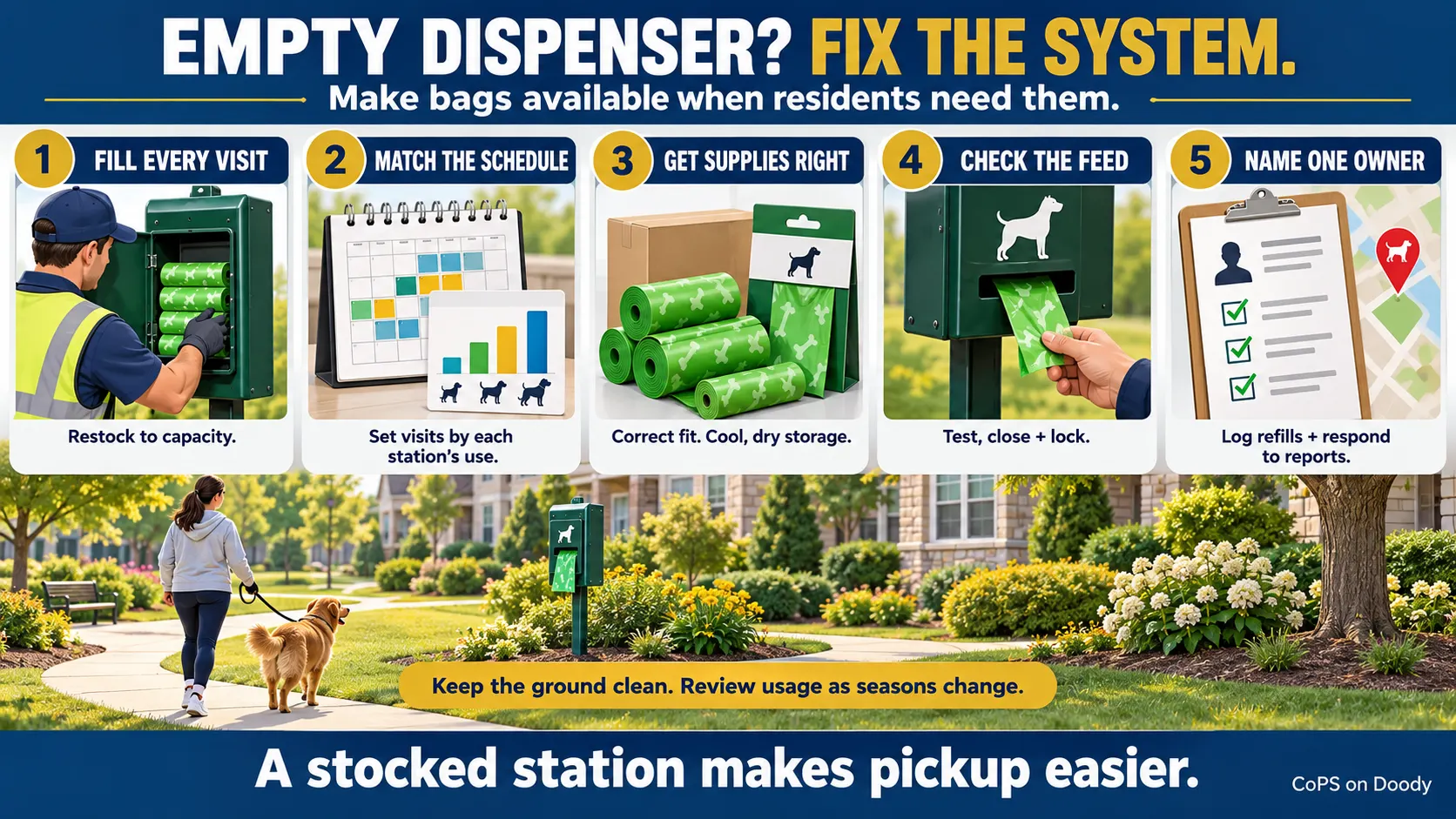
The standard starts with one outcome: no resident ever finds an empty dispenser. Put these parts in your service terms, or in your staff's written procedures if you restock in-house.

Part of the standardWhat to put in writingWhy it matters
Restock to capacity on every visit Every dispenser filled to capacity at every visit, not only when it looks low Gives the next stretch of use its full supply
Frequency based on use Visit frequency follows how quickly each station uses bags, reviewed as seasons change; any change comes with a written proposal showing the new rate Busy stations use bags faster than quiet ones
A usage log The number of bags loaded at each station on each visit No authoritative bags-per-station figure exists, so your own log sets the schedule
Bag supply Who supplies bags, in one format matched to each dispenser, stored cool and dry A late order or the wrong bags empties dispensers too
One owner A named provider or staff member answers for every station Shared jobs are easy to overlook
A response window A stated time to respond when a resident reports a problem between visits Problems get handled when they're reported

Here's the standard. Evaluate every provider against it, including us. CoPS on Doody, for reference, commits to a three-business-hour issue response, and a regular service schedule and a stated response window both belong in your written service terms.

How to set frequency from your own usage log

No authoritative figure tells you how many bags a station uses, so measure your own:

  • For four weeks, record the number of bags loaded at each station on each visit to bring it back to capacity.
  • Compare that number with the dispenser's capacity. A station that needs most of its capacity replaced at each visit is close to its limit and needs more frequent service or a larger dispenser; one that needs only a handful is well served.
  • Look for sudden jumps at one station, which may mean bags are being taken in bulk.
  • Check again when the seasons change or a new building, trail, or dog park opens.
  • Bring the log to your provider. Any change in frequency should come with a written proposal showing the new rate.

‍

A restock checklist for every visit

Use this if your own staff restock stations, or to check a provider's work on a property walk.

☐  Remove wet, torn, or tangled bags from the dispenser.

☐  Confirm the bags match the dispenser's format.

☐  Load the dispenser to capacity from dated, dry stock.

☐  Pull one bag to confirm the next one feeds cleanly, then close and lock the dispenser.

☐  Pick up any waste or dropped bags on the ground around the station.

☐  Record the station number, the date, the bags loaded, and any repair needed.

The maintenance checks on the rest of the station, from hinges and locks to the can liner and sign, are in our maintenance guide.

If you find an empty dispenser this week

Restock it the same day and check every other station, since stations on the same schedule may run low together. Then:

  • Have the ground around the station cleaned, so the next resident sees a clean spot.
  • Use the causes table to find the reason, and name one owner for restocking in writing.
  • Skip notices that say bags keep disappearing; post a short, friendly request to take one bag at a time instead.
  • Hold off on new fines until every dispenser has bags. It's hard to ask residents to pick up when the station they use has none.
  • Give the board a short note on what happened and what changed.

Frequently Asked Questions

How often should a pet waste bag dispenser be restocked?

On every service visit, filled to capacity, with the visit frequency set by how quickly each station uses bags. There is no fixed rule, because every community is different. If usage changes, the frequency should change too, with a written proposal showing the new rate.

‍

How do you refill a pet waste station dispenser?

Unlock the dispenser, remove any wet or torn bags, load a full roll or header pack in the format the dispenser takes, pull one bag to check it feeds, and lock it again. Then record how many bags you loaded.

‍

Should a community use roll bags or header bags?

Either works if it matches the dispenser. Manufacturers disagree on whether header bags reduce bulk taking, and no independent study settles it, so choose for fit, capacity, and a locking, weather-resistant dispenser.

‍

What should every HOA pet waste station have?

A dispenser stocked with bags that fit it, a lined can with a lid, a clear sign, and a regular service schedule with one owner responsible for it. Locations are selected around the community's layout and how residents walk their dogs.

‍

Will fines or more signs fix a pickup problem?

Not while dispensers are empty. Stock every station first, and keep sign wording positive. After that, signs and any enforcement your governing documents allow carry more weight; confirm enforcement steps with association counsel.

‍

Who is responsible for keeping dispensers stocked?

Whoever your management agreement or service contract names. If no one is named, assign one owner in writing, and say in the same document who supplies the bags.

Bottom Line

An empty pet waste bag dispenser is a small failure that every resident who reaches into it sees, and it shouldn't happen under a managed program. Restock every dispenser to capacity on every visit, set frequency by each station's use, settle who supplies the bags, keep the ground clean, and name one owner.


‍

About the Author

Dave Jensen is a commercial pet waste management leader with over 17 years of experience and CEO of CoPS on Doody. He built multi-million dollar sales programs, created the first CAI- and CAMICB-approved continuing education course on pet waste management, and has trained thousands of community association professionals nationwide.

Related Articles

Taking Pet Waste Off the Landscaper's Contract The Scope Handoff

Taking Pet Waste Off the Landscaper's Contract: The Scope Handoff

Learn More
A Two-Week Time Log: Measuring What Pet Waste Takes From Your Staff

A Two-Week Time Log: Measuring What Pet Waste Takes From Your Staff

Learn More
fully-burdened-labor-rate-grounds-staff

How to Calculate the Fully Burdened Labor Rate for Grounds Staff

Learn More
Pick Up After Your Dog Signs What to Say and Where to Put Them

Pick Up After Your Dog Signs: What to Say and Where to Put Them

Learn More
Program Management The Element Nobody Owns

Program Management: The Element Nobody Owns

Learn More
We Asked 10 Questions About Our Service. Here's What We Found.

The Four Types of Pet Waste Dabblers (And How to Spot Them)

Learn More